Got Milkweed? Updated Plant Guide for Central and South Texas

Our first Milkweed Guide posted back in the fall of 2010 and has continued to be one of our most-read blogposts.   With spring here and butterfly gardeners chomping at the bit to create host and nectar habitat for Monarchs and other butterflies, it’s a good time to talk milkweed choices and availability.

Slide1

Much has changed since that 2010 post.  A three-year, drought-induced emphasis on native, drought-hearty plants has created a greater demand for native milkweeds. That said, supply continues to be lacking.

Monarch Watch recently launched its Milkweed Market on its homepage, a virtual marketplace of native milkweed seed.    When you click on the vendors, though, most species are not available.

Monarch Watch, The Xerces Society, a pollinator advocacy organization, and the Native Plant Society have all engaged in milkweed restoration initiatives.    This is good news, but it will take time to develop the market commercially.

Those of us who have attempted cultivation of native milkweeds from seed in our home gardens have often met frustration and failure.   The very traits that make native plants so hardy also often make them extremely particular about their soil, drainage, moisture and available light.  As George Cates, chief seed wrangler at Native American Seed Co. in Junction, Texas told me:  ”These milkweeds have a mind of their own.”

Monarch caterpillars will ONLY eat Asclepias species, or milkweed.  Photo by Monika Maeckle

Monarch caterpillars will ONLY eat Asclepias species, or milkweed. Photo by Monika Maeckle

Plugs for native milkweeds are practically impossible to find in nurseries and because of their extremely long tap roots, transplanting them successfully often fails.   Texas longterm drought has sparked a broader interest in native plants, so the availability of milkweeds and other “from here” pollinator plants will continue to grow.

For now, though, planting from seed is the most viable option.  If you can collect your own seed in the wild, go for it.  Native milkweed seed is expensive–as it should be.  When you realize what it takes to produce the seed, you won’t begrudge its price tag.  Read that saga here.

Since the time to take cuttings and collect seed will soon be upon us, we offer guidance below, based on personal experience.  Other appropriate milkweeds are suggested in this article by the Native Plant Society.  Keep an eye out for your local botanical garden or native seed society’s pop-up plant sales to score some proven homegrown natives.

Texas Butterfly Ranch Suggested Milkweed Species for our Area

Antelope HornAsclepias asperula  

The most common native milkweed in these parts has fuzzy leaves and an odd greenish-white bloom and can stand two-feet tall.  During dry spring seasons, the hearty perennial is sometimes the ONLY plant blooming.  Last year in Central Texas when we had an exceptionally wet winter, the Antelope Horns were not as pervasive as you would think.   Too much moisture and too much competition from less hardy plants kept these guys laying low. 

Antelope horns

Asclepias asperula, Antelope Horns Milkweed on Texas Hill Country roadside in April 2011,    photo by Monika Maeckle

Antelope horns is especially appropriate for wildscapes, ranches, and large plantings.  It can best be propagated by seed, which is available commercially from native seed suppliers.  

Be mindful that stratification is recommended for successful germination.   According to the Ladybird Johnson Wildflower Center, Antelope horns can also be propagated from root cuttings taken in the spring.  If you have it growing in nearby fields, ranches or wildscapes, you might give this a try.  If you choose to plant seeds you’ve gathered yourself, collect those in June.  

Typically 30 – 45 days of stratification will be required before installing in moist soil.  See our post on how to get Antelope Horns milkweed to germinate, courtesy of Native American Seed Company in Junction, Texas.

 Green MilkweedAsclepias viridis 

This common native milkweed in our area is sometimes called Green Antelope Horn Milkweed or Green Mlikweed and is the most common milkweed in the state of Texas.   The Edwards Plateau is the western reach of its range, which starts in East Texas.

Asclepia Viridis, Green Milkweed or Green Antelopehorn Milkweed Photo courtesy Ladybird Johnson Wildflower Center

Asclepia Viridis, Green Milkweed or Green Antelopehorn Milkweed Photo courtesy Ladybird Johnson Wildflower Center

I have a single one of these plants growing under a porch at the ranch.   The solitary bloomer never receives supplementary water and barely enjoys rain, given its location tucked under a breezeway.

Yet every year it pushes out a batch of blooms and seedpods, peeking from under the  deck, reaching for the sun.   Those of us who raise Monarch caterpillars like the fact that Green milkweed has larger leaves than other available milkweed, which makes feeding voracious caterpillars a bit easier.

Green milkweed can range from one-three feet in height and is best propagated by seed which is commercially available.  Like Antelope Horns, it sports showy whiteish-green globes of flowers that attract Monarchs as a host, and huge bees and other butterflies for its nectar.

Swamp MilkweedAsclepias incarnata

Another excellent native milkweed for our area is Swamp Milkweed, a lovely pink bloomer that sports lush pink flowers in August and blooms through September.

Swamp milkweed grows along rivers and streams and is an excellent choice for riverbanks in the Hill Country or perhaps in an area where you have air conditioning condensate draining.  Spiders LOVE this plant.  I have witnessed “death in the afternoon” more often than I care to remember: Monarch butterflies snagged by orb weaver spiders as they perch on Swamp Milkweed leaves, in search of an easy feast.

Monarch on Swamp Milkweed on the Llano River

Monarch on Swamp Milkweed on the Llano River, photo by Monika Maeckle

For years we’ve had this milkweed growing along the banks and on the Chigger Islands of our Llano River ranch, but recent, prolonged drought has taken a severe toll, lowering our water table so much that much Swamp milkweed has died.

 Butterfly Weed, Asclepias tuberosa

This bushy orange bloomer is often confused for Tropical Milkweed (see below) and is frequently mislabeled at nurseries.  One of the best ways to tell if a milkweed in question is tuberosa is to break off a leaf and see if  milky latex pours out.  If it doesn’t, then it’s Butterfly Weed.

Ascelpias tuberosa

Asclepias tuberosa, or Butterfly Weed, is a great nectar plant for Monarchs and other butterflies. Photo courtesy Ladybird Johnson Wildflower Center

Detractors of Butterfly Weed point out that it doesn’t contain the toxic cardenolides that protect Monarchs from predators, thus should be avoided.   The toxins, contained in the latex of  most milkweed species, give the Monarch its bright warning colors and bad taste that deters predators.

The 18-inch-tall perennial serves as a fantastic nectar plant.  Its abundant orange blooms attract all kinds of butterflies.   If you’re trying to stick with natives, choose this one to grace your butterfly garden.

Butterfly weed can sometimes be found locally at nurseries. The plant is propagated easily from seeds and cuttings and blooms through the Fall, when nectar sources are wanting.

Tropical Milkweed, Asclepias curassavica

Tropical milkweed is not native, but it is widely available at garden centers in one-gallon pots and it also germinates easily from seed and cuttings. As much as I support native plants, this is my favorite Monarch host plant.  It’s easy to grow, not a water hog, propagates easily from seeds and cuttings, blooms prolifically and draws Monarchs like a magnet.  Commercial butterfly breeders and even organizations like Monarch Watch rely on Tropical milkweed to raise butterflies in captivity.

Asclepias curassavica, Tropical milkweed, NOT native, but a great Monarch host and nectar plant for all butterflies.  Photo by Moniak Maeckle

Asclepias curassavica, Tropical milkweed, NOT native, but a great Monarch host and nectar plant for all butterflies. Photo by Monika Maeckle

The plant can be controversial for native plant purists and some scientists.   Theories abound on the appropriateness–or not–of Tropical milkweed in Central and South Texas.

The plant originated in Central America and has gradually moved north.   Dr. Chip Taylor, founder of Monarch Watch, points out that Tropical milkweed is the plant on which Monarch butterflies evolved.

In my completely unscientific kitchen experiments, I’ve noticed that Monarch caterpillars PREFER Tropical milkweed. When offered a choice of Tropical milkweed, Swamp Milkweed or Antelope horns, Monarch caterpillars inevitably choose Tropical milkweed.

Studies show that the toxins in Tropical Milkweed inoculate Monarch moms and their young. While it can be challenging to find Tropical milkweed in the Fall when Monarchs are moving through Texas, it’s easy to cut back your spring plants to encourage new growth for migrating visitors.   My butterfly breeder friend Connie Hodson, of Flutterby Gardens in Manatee, Florida, says you can cut any six-inch stalk of Tropical milkweed in a potting soil and vermiculite mix, and have new plants in no time.    You can also order seeds or harvest them yourself from fellow gardeners.

NOTE:  If you choose to plant Tropical milkweed, best practice suggests slashing it to the ground in late fall or early winter.   It will push out new shoots as the weather warms. This  will discourage overwintering of organisms possibly harmful to Monarchs.

Matelea reticulata  Pearl Milkweed vine

Milkweed vine

Milkweed vine, lovely addition to the garden!  Photo by Monika Maeckle

While Milkweed vine is in the Asclepias family, there doesn’t seem to be any evidence that Monarchs and Queens use this vine as a host plant. It grows in the wild in the Texas Hill Country.

Anyone have experience with Milkweed vine as a host?

I include it today because it is an absolutely delightful plant with its heart-shaped leaves, perfect green symmetrical flowers, and a lovely, intriguing pearl-like dot in the middle. Someone needs to make earrings out of these flowers.

In the Fall, Milkweed vine produces huge seed pods, about three times the size of Tropical milkweed.  The plant climbs and curls for six – 12 feet and is sometimes called Green milkweed vine, Net vein milkvine, and Netted milkvine.

More on this topic:

Like what you’re reading? Follow butterfly and native plant news at the Texas Butterfly Ranch. Sign up for email delivery in the righthand navigation bar of this page, like us on Facebook, or follow us on Twitter, @monikam. You can also read our stuff on the Rivard Report.

Persnickety Texas Milkweeds “May not Lend Themselves to Mass Seed Production”

Native American Seed Company is on a mission to restore the earth, one native seed at a time.

The 300-acre spread about 115 miles west of San Antonio on the banks of the Llano River just northeast of Junction, Texas, boasts 75 acres of native plants in production

Antelope horns milkweed seed pods

Antelope horns milkweed pods last June at Native American Seed in Junction, Texas.                Photo courtesy Native American Seed

for the distinct purpose of harvesting native seed.

The company’s nondescript cedar post gate opens onto a caliche drive that winds through classic Hill Country mesquite, agarita and sotol, then spills into planted rows of huisache daisy, standing cypress, gayfeather, American blanketflower and other native wildflowers and grasses.   Water pumped from the nearby Llano River maintains the verdant fields, and allows the company to grow, harvest, process, package and ship more than 170 species of native seed and 30 seed mixes nationwide.

Antelope Horns milkweed

Antelope Horns milkweed last June, after well-timed and regular rains in early 2012. Photo courtesy Native American Seed

Among the seed stock, two native Texas milkweeds, Asclepias asperula, commonly known as Antelope horns, and Asclepias viridis, often called Green milkweed, have challenged the 25-year-old seed company’s experts.  The Monarch butterfly host plants are essential to the Monarch butterfly migration, which funnels south through the Texas Hill Country each fall.  Native milkweeds are famously difficult to propagate, even for professionals. “Species in Texas may not lend themselves to mass seed production,” said George Cates, chief “seed wrangler” at Native American Seed.

Native Texas milkweeds require stratification–cold and moisture to soften up their outer shells.   They need 45 days of moist conditions, specific soil conditions, and alternate wet and dry periods.   Worst thing you can do: overwater them.  (Check out Native American Seed’s Milkweed Stratification process at this post.)

Gardeners and butterfly fans committed in theory to propagating and planting native milkweeds (and I consider myself among them) have been vexed in practice by their persnickety ways.   That’s what often drives us to plant Tropical Milkweed, the nonnative Asclepias curassavica that is easy-to-grow, widely available and the favorite of Monarch butterflies for hosting and other butterflies for nectar. While the practice bothers some scientists and native plant purists, our rationale is that Monarch caterpillars need to eat.   In short, it’s better to provide SOME host plant for migrating Monarchs than NONE as they pass through Texas.

George Cates

George Cates stands in a field of future Antelope Horns in April. Nothing sprouting yet. PHoto by Monika Maeckle

Native American Seed and the Portland-based Xerces Society, a nonprofit organization devoted to protecting invertebrates and their habitats, hope to change all that.

In 2010, the Xerces Society approached the 18-person staff of the Native American Seed Company about establishing a partnership to restore native milkweeds to the American landscape.  Xerces had recieved a $117,000 conservation innovation grant from the USDA’s National Resources Conservation Service.   “We call it the ‘milkweed CIG,’” said Brianna Borders, project manager for the undertaking, since renamed Project Milkweed.  A requirement of the grant was that the recipients match the sum by raising an equal amount.

Project Milkweed identified several U.S. regions for milkweed seed production–California, the Great Basin, Arizona, New Mexico, Florida, and Texas. “Texas was a clear choice, arguably the most important state to the Monarch migration,” said Borders.  The $334,000 was pretty much divied up equally between the areas, she said.

xerceslogo

Native American Seed was an ideal candidate for the project, said Borders, because of the company’s long involvement in native seed production and its opportune location on the Monarch flyway.  Founder Bill Nieman, a high school dropout who turned a trash hauling business into a successful landscaping and design firm and then into Native American Seed, has a long history as a conservationist. The company’s mission aligned perfectly with the task.

The company’s 100-page catalogue practically serves as a free native plant guide. The vivid and abundant photography, renderings of how seeds look when they sprout, and descriptive verbiage describing each plant’s soil type, sunlight needs, and other traits

Irrigating at Native American Seed

Native American Seed will use its full irrigation alltoment from the Llano River to produce native seeds. Photo by Monika Maeckle

offer a broad overview of the life cycle of many plants native to the U.S.   Especially entertaining is Nieman’s annual introductory letter in which he tackles topical environmental issues–from invasive plants and water waste to wind power lines.

Results for the Mlikweed Project have been mixed so far.  The program launched just as Texas entered the ongoing historic drought.  In April 2011, the milkweeds didn’t flower or produce seed (which is expected, given they are perennials).  Borders said the first seed harvest last year (2012) was “pretty modest.”The 2,400 linear feet of native milkweeds  produced 1.5 pounds of seed, which, at an average of 65,000 seeds per pound, amounts to almost 100,000 seeds.  Of those 100,000 seeds, 95% have been restratified and replanted.

“We didn’t set a target for how much seed has been produced because there are so many unknowns,” said Borders.

Meanwhile, others have tackled the daunting task of producing milkweed plugs.  Monarch Watch, based at the University of Kansas at Lawrence, launched a “Bring Back the Monarchs” milkweed restoration campaign back in 2010.  Last fall, the program got a second life here in Texas when it partnered with the Native Plant Society to recruit volunteers to gather native seed, then mail them to Kansas for cultivation there.

bring-back-the-monarchs

The milkweed restoration campaign previously used a Texas grower. Pat McNeal, of McNeal Growers in Manchaca, Texas, assumed those duties in 2012,  but said recently that Monarch Watch “had better success in Kansas where they have four real seasons.”

McNeal suggested that the best way to propagate Texas native milkweeds would be to cultivate the tubers for two years, then plant those in the fall.   “These milkweeds don’t adapt their schedules for us,” he said, adding that Texas native milkweeds don’t do well in containers.  The plants can have a two-meter long tap root making them difficult to transplant.  ”It’s like trying to grow a potato in a pot,” said McNeal.

Dr. Chip Taylor, who oversees the program, continued cultivation this year with a Kansas grower.  He said he anticipates that 25,000 native milkweed plugs will have been produced this spring.  All have been sold on preorder. Monarch Watch will soon set up  a “Milkweed Market” for retailers on its website so people can connect with growers in their area.

Antelope Horns milkweed root stok at American Native Seed

Cates points out root stock from 2012′s Antelope Horns milkweed crop, which has yet to sprout this year because of a lack of rain.    Photo by Monika Maeckle

At Native American Seed, the battle for Texas native milkweed seed plods on.  Cates assumes primary responsibility for their production.   He joined the company in 2003 as a student intern in ecological sciences at Austin College in Sherman, Texas.  After graduating he came on fulltime in 2007.

On a windy Friday afternoon in April, Cates pointed to the dry landscape.  ”The grass hasn’t been green since 2010,” he said. With the Llano River flowing at an historic low, Cates mentioned the seed company will once again use its entire irrigation allotment, strategically watering wildflowers and native grasses, supplementing with a recently installed rainwater collection system.

Monarch on Tropical Milkweed

Cates says voting for Tropical milkweed is a vote against native milkweeds. Photo by Monika Maeckle

A dry winter coupled with early, hot tempertures, watering restrictions on the Llano, and an unpredictable climate suggest months of hard work and frustration ahead for Cates.  But the difficulties haven’t dampened his zeal for restoring native plants with seeds.  ”A plant in the ground will produce 100x more seed than tubers,”  he said.  ”That’s where we’re at–we’re trying to grow a substantial amount of this seed material.”

Cates has little patience for Tropical milkweed, the easy answer for gardeners in the long haul of native plant restoration. “We’re all about having it right now,” said Cates.  “These kinds of conservation efforts can’t be done ‘right now.’  It takes time.”

“Every time you vote for Tropical milkweed with your dollar, you vote against this,” he said, pointing to tidy, dry rows of future Antelope horns, which had yet to sprout this year.

Cates kneeled down and dug his fingers into the soil to find root stock from the 2012 milkweed crop. “Half of what we do fails, but that doesn’t make us stop.”

Like what you’re reading? Follow butterfly and native plant news at the Texas Butterfly Ranch. Sign up for email delivery in the righthand navigation bar of this page, like us on Facebook, or follow us on Twitter, @monikam. You can also read our stuff on the Rivard Report.

How to Get Texas Native Milkweed Seeds to Germinate

Our friends at Native American Seed have been working for years on the best way to get persnickety Texas native milkweed seeds to germinate.   “Native milkweeds simply don’t do well in containers,” said George Cates, seed wrangler at the seed farm and land restoration company in the Hill Country town of Junction.  ”They require a very specific set of conditions and have an extremely long tap-root, making containerization untenable.”

Want native Texas milkweed?  Start with seeds.  Photo courtesy Native American Seed Co.

Want native Texas milkweed? Start with seeds.

So what’s the solution to getting native milkweeds into our landscape?  Start with seeds.

The process has been perfected by Cates, who has germinated thousands of seeds in the last year for Native American Seed‘s customers and the Xerces Society.    Read a report about the project and the status of native Texas milkweed seed production here.   Here’s Cate’s process:

Milkweed Stratification Procedures, Courtesy Native American Seed

NOTE:  Cates insists that sterile rubber (latex) gloves be worn at all times and that containers and implements be sterile.   Otherwise, mold can grow in the vermiculite and damage the seeds.

1. Mix seeds with pre-chilled distilled water and let soak for 24 hours in the fridge.

2.  After 24 hours, pour seeds into strainer and rinse with distilled water.

3. Moisten vermiculite with distilled water, the exact quantity required varies with different media, moist but not dripping is best.

4.  Mix rinsed seeds into vermiculite using your hands, and wear sterile gloves.

5.  Seal container and store in fridge for 30-45 days at 35-45 degrees.  Remove and plant immediately if you see mold.

6.  Plant entire mixture or sift seeds out and plant in prepared seed bed when soil temps are warm (70 degrees+).

7.  Water often until germination occurs.


Antelope horns milkweed, a Monarch butterfly host plant, in bloom.  Photos by Native American Seed

Antelope horns milkweed, a Monarch butterfly host plant. Photos by Native American Seed

Soaking and washing the seeds removes natural chemicals that inhibit germination.  When the seeds are moved from the cold darkness of the refrigerator to the bright light and warmth of the sun, they are “shocked” into sprouting.  ”The stratification process is meant to mimic nature,” he said, adding that the plants likely developed this dormancy strategy as an answer to drought conditions.

Good luck with your milkweed seeds and let us know how it goes!

Like what you’re reading? Follow butterfly and native plant news at the Texas Butterfly Ranch. Sign up for email delivery in the righthand navigation bar of this page, like us on Facebook, or follow us on Twitter, @monikam. You can also read our stuff on the Rivard Report.

Queen, Monarch Caterpillars and Butterflies: How to Tell the Difference

Found a Monarch caterpillar on my milkweed!

                               –my friend Hugh Daschbach, via text message

How to tell the difference between a Queen or Monarch caterpillar

Every year around this time as the Queen butterflies start to show up, we get lots of questions about how to tell the difference between Queens, Danaus gilippus, and Monarchs, Danaus plexippus.  And with the warm weather that has gripped South Texas throughout November and now December, many of us are still finding eggs and caterpillars in the leaves of our milkweed.   Queens are here en masse.

Three Queen butterflies

Queens have been flying and reproducing this Fall.

As it turned out, the caterpillar in question that my friend Hugh texted me about (excuse the typos) was in fact a Queen.  The giveaway:  it had three sets of protuberances–frequently called antennae, but actually only one set are antennae and the other two are filaments.  The antennae have special sensing properties while the filaments are mostly for show, and to throw off predators.

Queens on Purple Mistflower

Queens on Purple Mistflower

Hugh’s confusion is common:  because of their similar color, size and affinity for milkweed as a host plant, Queens and Monarchs are often mistaken for each other in their various life stages.

But once you look closely, it’s not that hard to tell the difference between Monarchs and Queens.

First, Queens appear solid orange compared to the varying shades of a Monarch.  In the photo above, notice how with their wings folded, the Queens’ solid dark orange is interrupted with occasional white dots–nothing like the striking stained glass veins and color pattern of the Monarch below.

Resident Monarch butterfly on the San Antonio River Museum Reach

Monarch butterfly on the San Antonio River Museum Reach

With their wings open, the difference is even more obvious.  The Queen is solid, the Monarch has varied coloration.  Both of the examples below are male butterflies, as you can see by the prominent display of their family jewels–the defunct pheremone sacs that presumably once drove the lady butterflies wild.

Queen butterfly, wings open

Queen butterfly.  It’s a male.

Female Queens and Monarchs don’t have these prominent markings with wings open.   In Monarchs, the black veins are generally wider and more pronounced in the females.

Monarch butterflies are on the move in Texas

Male Monarch butterfly.  Notice the two dark spots, his “family jewels.”

In the caterpillar stage, the most obvious difference is that Queens have one set of antennae and two sets of filaments, while Monarchs have one set of antennae and one set of filaments. Antennae are on the head of the butterfly, while filaments are at the rear–and in the case of the Queen, in the middle.

Queen caterpillar with three filaments

Queen caterpillar sports three sets of protuberances–two sets of filaments, one set of antennae.

Notice in the photo above, the Queen has what appear to be THREE sets of protuberances.  The Monarch caterpillar only has TWO.  Both wear distinctive yellow, black and white striped suits.   The Queen often will have a slight red blend as the filaments connect to the caterpillar’s torso.  The patterns of the stripes can vary depending on time of year, humidity and diet.

Monarch butterfly caterpillar has two filaments

Monarch butterfly caterpillar has one set of antennae, one of filaments–two total sets.

Scientists don’t fully understand the biological purpose of the filaments, which seem to reach out and “feel” the universe around them.   They swerve and turn in various directions, almost punctuating caterpillar moves like a roving eye or arched eyebrows on the human face.

For the sake of identification, let’s just say their purpose is to signal the difference between Queens and Monarchs.   For more on filaments and what we do and don’t know about them, check this link on the Monarch Watch page.

Queen and Monarch chrysalises

Queen and Monarch chrysalises. Monarch in the middle.

In the chrysalis stage, Queen chrysalises are almost identical to Monarchs, except they are generally smaller.  They also sometimes offer a subtle pink hue, as evidenced in the picture above, Monarch in the middle, Queen on the sides.

Like what you’re reading?  Follow butterfly and native plant news at the Texas Butterfly Ranch. Sign up for email delivery in the righthand navigation bar of this page, like us on Facebook, or follow us on Twitter, @monikam.  You can also read our stuff on the Rivard Report.

Tales of a Butterfly Evangelist Shared at Pecha Kucha Night San Antonio

When Vicki Yuan invited me to present on butterflies to the San Antonio chapter of the American Architecture Foundation’s periodic Pecha Kucha Night event, I had no idea what a challenge it would be to frame the amazing story of the Monarch butterfly migration into 20 20-second slides.

That’s right.  Twenty slides, each timed exactly to 20 seconds.  That’s the strict format for Pecha Kucha, a program launched in Tokyo in 2003 for sharing people’s passions by two British architects.    Pecha Kucha means “chit chat” in Japanese.

There’s so much to tell when you’re talking butterflies.  Those who know me can attest to my tendencies to natter on about their charms.  Convey a multi-generation, 3,000-mile migration made by creatures that weigh less than a gram and find their way “home” to a place they’ve never been–all in six minutes, 40 seconds?

If Monarch butterflies can complete such a journey, I should be able to share their story–and my own evolution as a butterfly evangelist–in under seven minutes.  It was a great exercise in expository discipline.  I hope you enjoy it.

For more on Pecha Kucha Night San Antonio, see the Rivard Report’s coverage of the event.

Like what you’re reading?  Follow butterfly and native plant news at the Texas Butterfly Ranch. Sign up for email delivery, like us on Facebook, or follow us on Twitter, @monikam.

Want to Meet the Beetles? Better Hurry, Removal of Milkweed Beetles from San Antonio River’s Milkweed Patch Imminent

An invasion of red-and-black milkweed beetles have made a temporary eyesore of the San Antonio River’s celebrated Milkweed Patch on the Museum Reach.  The striking insects, whose colorful torsos suggest the patterns of a tiki mask, have moved into the 1200-square foot Tropical milkweed garden on the banks of the San Antonio River just south of the Pearl Brewery  in a classic play of nature’s cycles.

Milkweed Beetles have taken over the Milkweed Patch

Milkweed Beetles have taken over the Milkweed Patch

The beetles, which look like ladybugs on steroids, don’t bite, sting or carry diseases. They do, however, defoliate milkweed plants, and have left the highly trafficked stretch of the River with some unattractive bald spots.

Migrating Monarch butterflies moved through town earlier this spring, laying the first generation of eggs in their annual migration at the Milkweed Patch.  The resulting acrobatic caterpillars occupied the Patch, feasting on milkweed leaves, the Monarch butterfly host plant.  Late straggling Monarchs continue to mingle with our local colony but the pervasive milkweed beetle, Labidomera clivicollis, dominates.

Milkweed Patch going bald thanks to milkweed beetles

Milkweed Patch going bald thanks to milkweed beetles

Volunteers for the Monarch Larvae Monitoring Project (MLMP), a citizen scientist program based at the University of Minnesota and which aims to better understand the Monarch life cycle and migration, have noticed fewer Monarch caterpillars and chrysalises during their weekly observations as beetles consume the milkweed leaves.

Discussions ensued about possibly pruning the milkweeds, which typically die back in winters when a hard freeze occurs.   That didn’t happen this year.  But San Antonio River Authority staff determined a better approach would be to hand-remove the beetles, THEN prune the plants.

Milkweed beetles have defoliated the Milkweed Patch. But aren't they cute?

Milkweed beetles have defoliated the Milkweed Patch. But aren't they cute?

“We believe this to be a holistic management approach with minimal negative impact to the environment that is consistent with our commitment to the local community for the project, ” said Steven Schauer, Manager of External Communications at the San Antonio River Authority (SARA), which oversees maintenance of the area.   The Museum Reach stretch of the San Antonio River was designed as a manicured, urban park setting, unlike the Mission Reach section, which is managed as a native riparian restoration.

SARA deserves praise for working with MLMP  volunteers and resisting the use of pesticides to address the problem.   A round of pesticides would quickly rid the area of

Gulf Fritillary

Gulf Fritillary, photo courtesy NABA.org

beetles (and other plant pests) and would also jeopardize the Monarchs’ and other butterflies’ continued colonization of the River.  Just north of the Milkweed Patch is a huge Passionflower planting, where Gulf Fritillary butterflies have made their home and are breeding.

If you’d like to “meet the beetles,”  better do so in the next few days.  The critters will be less visible once the hand removal is accomplished.

Like what you’re reading?  Follow butterfly and native plant news at the Texas Butterfly Ranch. Sign up for email delivery in the righthand navigation bar of this page, like us on Facebook, or follow us on Twitter, @monikam. 

Desperately Seeking Milkweed: Monarch Butterfly Caterpillars’ Voracious Appetites Create Milkweed Emergency

Anyone have any emergency milkweed? The 30 or so caterpillars have totally stripped mine and the nurseries don’t seem to have any. I really don’t want to lose them. –T. Kinsey, San Antonio

I, too, have run out of food (asclepias tuberosa) for my Monarch caterpillars. I have approximately 14 caterpillars ranging from the 1st through the 5th instar. The little ones can’t eat the hard stem, which is all that is left. I am scrambling around asking everyone I know if they have any butterfly milkweed and so far, no luck.  –C. Nugen, Stephenville

I have a great number of monarch caterpillars on the milkweed plants in my garden,  more than I have ever seen!! Only thing is,  I think there are more than there is food. Will they find nearby plants to eat or start eating the stems of the plant? Please help as I am bit worried that they will not all get to the next life stage.  –L. Jarvis, San Antonio

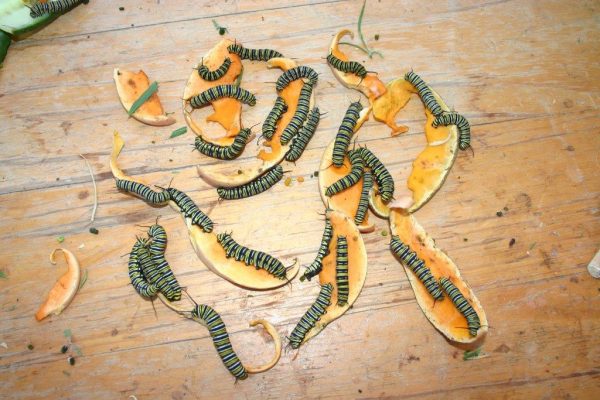
Monarch butterflies have been arriving in the “Texas funnel” for weeks, laying their first generation of eggs on milkweeds in yards, gardens, and throughout the state.  But judging from emails, text and Facebook messages I’ve been getting, we just don’t seem to have enough milkweed to keep up with their voracious appetites.  The creatures eat 200x their birthweight in milkweed leaves by the time they bust their stripes to form their gold-flecked jade chrysalises.

The milkweed shortage appears to be the result of the Monarchs’ early arrival and crazy weather this year.  When the Monarchs arrived in March, a lot of wild milkweed wasn’t even out of the ground yet.    The wet, mild winter provoked a bountiful wildflower showing, creating serious competition from more aggressive species.   Then we had a slew of 80- and 90-degree days that sped up growth of both the caterpillars and plants.   Result?  Lots of caterpillars and not enough food.

What to do if you find yourself with dozens of hungry caterpillars and no milkweed for them to feast on?  If  you don’t have access to milkweed in the wild nor from fellow gardeners, your best bet is to call local nurseries and ask if they have any Asclepias in stock.   Be sure to ask for Asclepias, the scientific name, since it’s not unusual for nurseries to sell “butterfly bush” or “butterfly weed” which are great nectar plants (often in the Buddleia family) for all types of butterflies, but useless for hosting Monarchs or other milkweed feeders.

Next, tell the nursery staff that you are raising caterpillars.   That means the plants you purchase for caterpillar food must be free of systematic pesticides.  Nursery staff will often swear they have not sprayed anything on the plants, but that doesn’t mean the grower didn’t.

Fat and happy Monarch cats devoured Sharon Sander's milkweed

Fat and happy Monarch cats devoured Sharon Sander's milkweed patch

Two friends experienced this difficult lesson in the past week.  Sharon Sander emailed with joyous photos of hundreds of Monarch caterpillars decimating the milkweed patch  at the River Road Community Garden.  Sander asked if I had any extra milkweed.  Since I did not, I encouraged her to seek out pesticide-free milkweed at one of our local nurseries.

Beautiful Asclepias Curassavica from Shades of Green turned out to be full of pesticides

Beautiful Asclepias Curassavica from Shades of Green turned out to be full of pesticides

Sander located milkweed at Shades of Green Nursery in San Antonio.  She explained to nursery staff that she was raising caterpillars and was told no systematic pesticides had been used.   She brought the plants home and moved 200 caterpillars to the robust plants.

The next day, “They all died,” Sander wrote via text message.  Sander contacted Shades of Green, an excellent nursery, and was given pesticide-free replacement plants.  Still, a sad lesson.

Wendy Meyer, co-manager of Shades of Green was very apologetic about the incident and said that unbeknownst to Shades of Green, the grower had used the pesticide Dursban (chlorpyrifos) on the milkweed plants.  Supposedly Dursban dissipates in 10-14 days, but in the meantime is readily absorbed into the plant tissue and anything that eats the plant.

Boo-hoo! Dead Monarch caterpillars fall victim to pesticide laced milkweed

Boo-hoo! Dead Monarch caterpillars fall victim to pesticide laced milkweed

Jenny Singleton of Grapevine relayed a similar story.  Upon leaving town for vacation, she stocked up on milkweed for the hungry Monarch caterpillars she was leaving behind.  ”I went to my favorite nursery to buy more milkweed and left the new, full plants next to the eaten up ones,” Singleton wrote in an email. “Checked on them this AM and to my horror, I’ll bet 75% were dead! I was sick!”

Unfortunately, nurseries don’t always know their growers as well as they  should.  And most plant shoppers won’t buy plants with bugs on them.   Milkweed plants are an ecosystem unto themselves and attract aphids, milkweed beetles, milkweed bugs, various flies and wasps.  Pesticides will kill all these pests–as well as Monarch eggs and caterpillars. It’s a challenge for growers who are often inclined to spray plants immediately before shipping to make them attractive and insect free to shoppers.

Tropical milkweed is easy to grow

Tropical milkweed is easy to grow

If you don’t know the provenance of your host plants, the best solution is to GYO (grow your own) milkweed.  Milkweed flowers develop a plump seed pod.  Tropical milkweed, while not native, is easy to grow and a Monarch butterfly magnet.  Remove the seeds from the milkweed fluff and sow in pots or the garden.  We’ll detail that process in a future post.

Like what you’re reading?  Follow butterfly and native plant news at the Texas Butterfly Ranch. Sign up for email delivery in the righthand navigation bar of this page, like us on Facebook, or follow us on Twitter, @monikam. 

UPDATE: Winter Monarch Butterflies are Reproducing at the Museum Reach Milkweed Patch on the San Antonio River Walk

Graduate student Kelly Nail was pleasantly surprised at the bounty of butterfly life unfolding at the Museum Reach milkweed patch on the San Antonio River Walk just this week.  The patch of milkweed, a Monarch butterfly host plant, was planted two years ago as part of the City’s redevelopment of the former drainage ditch and lies just a five-minute walk south of the Pearl development on lower Broadway.

Kelly Nail, Graduate Student, Univeristy of Minnesota

Kelly Nail, Graduate Student, Univeristy of Minnesota

Nail majored in mathematics and biology at St. Olaf College.  After teaching high school biology in rural Mississippi, she returned to school to study Monarch butterflies.  Her dissertation, overseen by renown Monarch butterfly scientist Dr. Karen Oberhauser at the University of Minnesota, will explore the effect of climate change on Monarch butterflies.  Nail flew to Houston this week to talk to Monarch citizen scientists about “winter Monarchs,” then made the three-hour drive to San Antonio to see how Alamo City butterflies are faring.

The Museum Reach milkweed patch did not disappoint.

We observed several Monarchs flying, more than a dozen Monarch caterpillars and one Queen caterpillar in various stages of development, dozens of chrysalises–spent, interupted, and in process–and one egg.  We also saw instances of the brilliant-but-creepy tachinid fly.  This parasitoid lays eggs on Monarch caterpillars, which kills them when the flies feed on their living bodies and eventually hatching just before the Monarchs pupate, leaving a caterpillar corpse in their wake.  Scientists suspect that Monarchs born later in the season and further south are more likely to encounter such a fate.

Nail was delighted to find such a jackpot of Monarch data. “I was impressed to see all stages of the life cycle in one single place,” said Nail.  ”And right along the River Walk in the middle of San Antonio.  It’s pretty amazing.”

One of the questions she hopes to answer:  Are “winter Monarchs” reproductive?  Judging from this field trip–no doubt about it.

Butterfly fans and those of us who tag Monarch butterflies in the fall have always been told that late season Monarchs do not reproduce and are behaviorally and biologically different from spring and summer Monarchs.  Supposedly, late season Monarchs remain sexually inactive, saving their energy for the great migration to Mexico.  There, they wait out the winter and emerge from their diapause in the spring to partake in an orgy of butterfly mating in the mountains of Michoacan, often laying their first eggs on Texas milkweeds in March or April.

Butterfly fans know that local populations of Monarch butterflies can establish themselves when host and nectar plants are available and the weather cooperates.  We see it in Houston, Florida, and now–San Antonio.

Based on personal observation and discussions with professional butterfly breeders, it appears that Monarchs are just like us:  opportunists.  With ripe conditions and mates available, they’ll pounce on the chance to reproduce.

Our local Monarchs are likely to continue their procreative antics as long as  temperatures remain above freezing and milkweed and nectar plants provide host and sustenance.  San Antonio’s Museum Reach milkweed patch,  semi-protected from the elements with supplementary grey water and temperatures more moderate than street level, is destined to become a favored nectar and host plant hangout where Monarch butterflies gather to find partners.   That’s good news for those of us who hope to enjoy butterflies year-round.

We look forward to Nail’s research and to more visits to the milkweed patch.

Like what you’re reading?  Don’t miss a single post from the Texas Butterfly Ranch. Sign up for email delivery in the right navigation bar on this page, like us on Facebook, or follow us on Twitter, @butterflybeat.

High Winds, Cold Temps Made Migrating Monarch Butterflies Leapfrog Texas this Spring, says Monarch Watch

“Texas is key,” says Monarch Watch founder Dr. Chip Taylor. “PLANT MILKWEED!”

Monarch Watch released its annual Monarch Population Status report authored by its founder Dr. Chip Taylor of the University of Kansas at Lawrence last week.  As we suspected and witnessed firsthand, the news was not good.

Dr. Taylor wrote that even though the population doubled from last year—450 million were estimated at the ancestral roosting spot in Michoacan, Mexico—a perfect storm of bad weather made for inhospitable conditions for the first generation of  Monarch visitors that usually grace our state each spring and fall.

Antelope Horns Milkweed

Antelope Horns Milkweed on Texas Hill Country roadside in April 2011

Taylor told us last year how important Texas is to the Monarch butterfly migration, and reiterated the point:  “As you’ve heard from me before, Texas is key. For the monarchs to have a good year, the conditions in Texas for the first generation have to be favorable.”

But UNfavorable conditions prevailed.  Even though native milkweeds appeared along roadsides and streams, and in gardens this spring, inspections for caterpillars yielded an unusually small cache.   Why?

Cold weather, raging wildfires, ongoing drought, and extreme winds appear to have kept Monarch butterflies away.   Taylor suggests much of the migrating Monarch butterfly population skipped Texas and these inhospitable conditions. Instead, they continued flying in search of more friendly weather and host plants where eggs could be safely laid and guaranteed a food supply after hatching into caterpillars.

But upon arriving further north, the story was not much better.  The brutal winter 0f 2011 made for a late spring–and late developing milkweed.  In April, citizen scientists posted pictures of immature milkweed stalks peeking from the earth in Oklahoma and the Midwest on the Monarch Watch Facebook page. The baby plants were covered with Monarch butterfly eggs.  Sandra Schwinn of Broken Arrow, Oklahoma, posted the photo below of a teeny milkweed stalk with 21 eggs on it.   What would all those caterpillars eat once they hatched?  The milkweed just wasn’t ready yet.  Timing seems to be working against the Monarch butterflies this year.

Eggs on milkweed stalk

This stalk of milkweed in Broken Arrow, Oklahoma, hosted 21 eggs--Sandra Schwinn photo

“At this writing – 26 April – it appears that most of this early reproduction won’t be successful,” wrote Taylor. “We can’t do anything about the physical conditions that drive the monarch population but we can provide the milkweed and nectar resources they need – PLANT MILKWEED!”

That’s a call to action for Texas gardeners.

For details on milkweed species appropriate for Central and South Texas, check out our Milkweed Guide.   Dr. Taylor’s Monarch Population Status report is available here.