Butterfly FAQ: How to Tag A Monarch Butterfly in Six Easy Steps

One of the most common questions we get at the Texas Butterfly Ranch is how the heck do you tag a Monarch butterfly?

Ready to tag some butterflies?

Ready to tag some butterflies?

It’s pretty straightforward, really.  You’ll need a butterfly net, a clipboard or mini notebook and a writing utensil to record your findings.   You’ll also need tags issued by Monarch Watch ($15 for 25 tags).    I recommend a hat and camera, too.

Before you go, apply sunscreen or insect spray if you use them, then wash your hands thoroughly.   Monarchs and other butterflies are more resilient than we think, however, Deet, Paba  and other chemical contact with their scales, wings and bodies should be avoided.  There’s no need to sterilize your hands or wear gloves.  Just wash your hands.

Monarch Watch tags and data sheets

You’ll need Monarch Watch tags and data sheets to tag Monarch butterflies. And a butterfly net.

When should you go tagging?  I like late mornings after my second cup of coffee.   By then, the butterflies have had a chance to warm up their bodies and are out flying and nectaring.  Remember, butterflies won’t fly if the temperature is less than 60 degrees, so late mornings and afternoons on sunny days are ideal.   Right before sunset is good, too, especially when they’re migrating.  In the Hill Country in October, masses of Monarch butterflies will often drop from the sky around dusk and look for roosting spots—usually in protected tree limbs and often near water sources.

Ready for some tagging?  Here’s how to do it.

  1. Locate butterfly

Millions of migrating Monarch butterflies will pass through the “Texas funnel” on their way to their ancestral roosts in Michoacan, Mexico, over the coming weeks and months.    According to Monarch Watch, peak migration for San Antonio and Austin will be October 2 – 22.

Frostweed is a fall favorite nectar source for Monarch butterflies.

Frostweed is a fall favorite nectar source for Monarch butterflies.

Typically, we see a first pulse of vanguard Monarchs around Labor Day in the Hill Country and in our San Antonio and Austin gardens.  In September we’ll consistently see individual Monarchs trickling through town.  By October, groups will show up and form evening roosts in trees and large bushes like Poverty Weed along our rivers and other protected locations.

The best places to see them are along our streams and rivers where late season blooms offer a nectar rich rest stop.  Monarchs fuel up on their journey south, so anywhere with late season butterfly-friendly flowers—native and Tropical milkweeds, Gregg’s Purple mistflower, Cowpen daisies, Frostweed, Goldenrod, lantana, for example—should draw them, as well as other butterflies.

Your own garden, if it has butterfly-friendly flowers blooming, should draw Monarch butterflies.  Look, observe, wait.   And be patient.  For some prime Monarch butterfly spotting, stop by the Milkweed Patch along the Museum Reach of the San Antonio River this fall.

2.  Net butterfly

Netting a Monarch butterfly—or any butterfly for that matter—is more challenging than it looks. The flitting creatures exhibit extreme skittishness and their compound eyes afford them a 360-degree field of vision. The slightest movement can send them sailing.

When I first started tagging Monarchs, I diligently chased them in flight. After slipping in the river more than once and skinning my knee after tripping down the steps at my house while in hot pursuit, I resolved to only try and net Monarchs when they’re roosting or nectaring. I’ve witnessed several ace netters with excellent hand-eye coordination, quick reflexes, and a sniper’s aim nab butterflies in flight, but I’m not among them.

Monarch nectaring on swamp milkweed

It’s easier to net Monarch butterflies when they’re nectaring. Sneak up on them from behind.

Suggestions:  wear low-key clothing that blends into the environment, move slowly, keep quiet and sneak up on them from behind.  Once you swing your net, the butterflies will scatter.  It resembles fishing in that sense;  when you cast your line, the fish get spooked and flee, but they’ll be back. After a few minutes, the butterflies will resume their activities—nectaring, resting or roosting.  Or they may fly out of your reach.

Once you get a butterfly in your net, be sure to flip the net sock over the circle of the rim—otherwise the clever insects can slip out.   With the net sock folded over the net structure, they will remain in your net.

Annie Schenzel demonstrates proper net technique

Annie Schenzel demonstrates proper net technique. See how the net sock is draped over the rim? No butterflies can escape.

Some folks take the net down to the ground after they swoop the butterfly into the net to ensure the butterfly doesn’t escape.   This is especially helpful when you capture many at once.

3. Collect butterfly/butterflies from net

Once the butterfly or butterflies are in the net, gently reach in and clasp an individual in your cupped hand, wings folded together if possible.  (No insecticides or sunscreen on your hands, please.)  The butterflies will flail around in the net, so try to calm them by folding their wings closed and gently pressing the net fabric on them. Also, try holding the butterfly upside down;  it seems to calm them.

Keep the net closed so that other butterflies don’t fly out as you remove the one in your grasp, then pull out your catch and take a look.

Tracy Hamilton shows how to retrieve a Monarch from the net.

Tracy Hamilton shows how to retrieve a Monarch from the net.

4.  Examine butterfly, establish its sex.

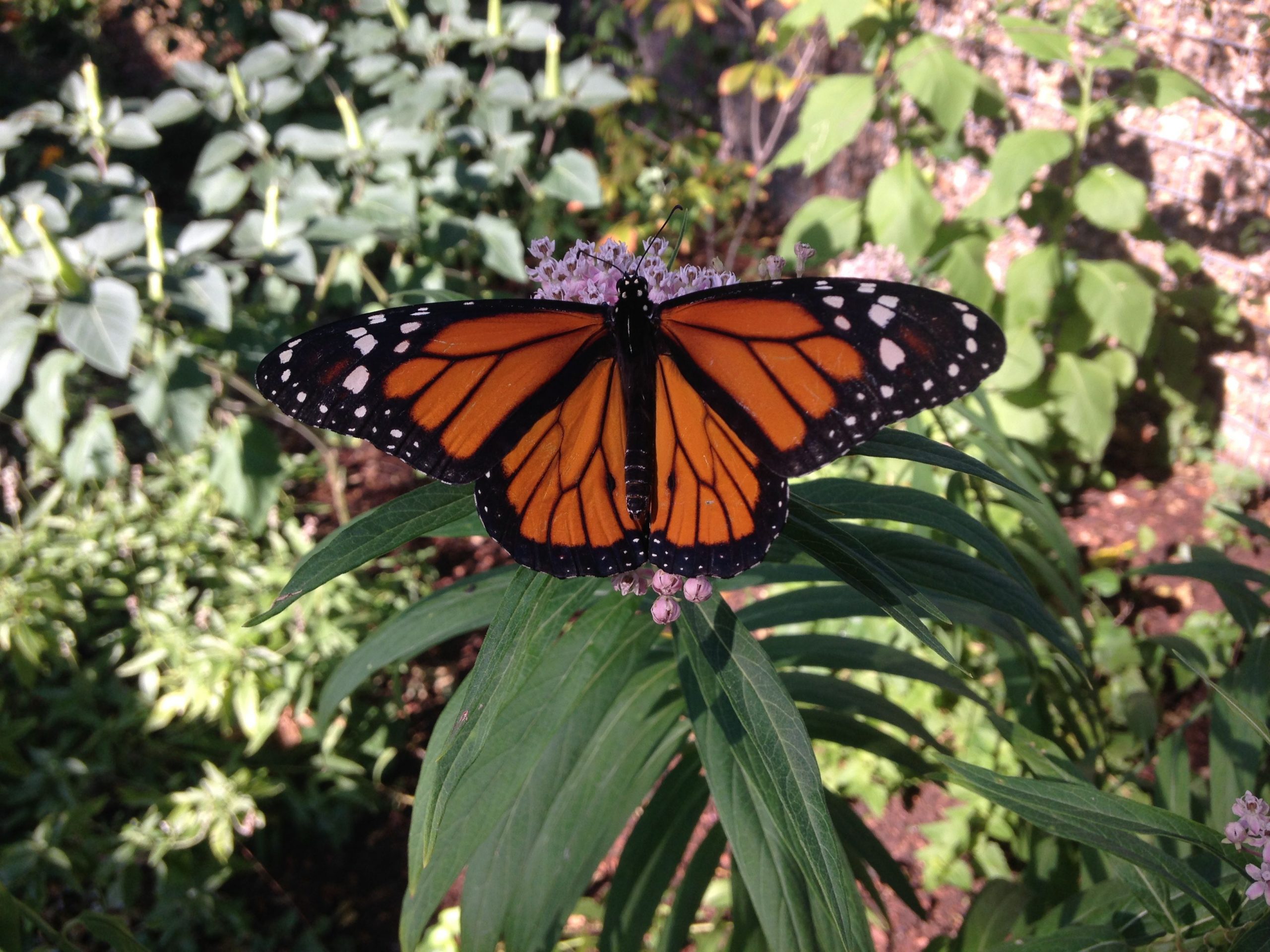
This is when you examine the butterfly to determine its sex.   Open the wings gently and look for the two pheromone sacs on the lower half of the butterfly’s wings.  If you see two black dots, it’s a male.  If not, it’s a female.   Also note the state of the butterfly—is it

Male Monarch Butterfly

Male Monarch Butterfly: it’s a boy! See the two black dots on the veins of his lower wings? Those are pheromone sacks–supposedly they drive the lady butterflies CRAZY.

weathered and raggedy, or fresh and healthy?  If the butterfly is extremely worn out and highly unlikely to make it to Mexico, refrain from tagging it.  Let the poor creature fly off.  Note the info on your data sheet or notebook, as well as the tag number.

Raggedy Monarch butterfly

Raggedy Monarch butterfly. I don’t tag beat-up butterflies like this. Doubtful she’ll make it to Mexico. Plus, don’t want to waste tags.

5.  Remove tag from sheet and adhere to butterfly

Holding the butterfly between two fingers with wings closed with one hand, remove a Monarch Watch sticker from the tag sheet.  I like to use my thumbnail and get them on the tip of my nail so they’re easy to slip onto the discal cell of the butterfly’s wing. Some

Use your thumbnail to lift tag from sheet and transfer to butterfly.

Use your thumbnail to lift tag from sheet and transfer to butterfly.

people prefer a toothpick to lift the tag off the sheet. Try not to handle the adhesive too much, as it won’t stick to the butterfly’s wing as well if it has oil from your fingers on it.

Place the tag on the discal cell, as illustrated in the tagging sheet sent to you by Monarch Watch.  Press gently, but firmly.  Congratulations!  You’ve tagged a Monarch butterfly.

Press the tag onto the discal cell in the middle of the lower wing, as shown.

Press the tag onto the discal cell in the middle of the lower wing, as shown.

Make sure you’ve noted the tag number, butterfly’s sex, any other useful data, on your data sheet or notebook.

6.  Release

Open your grasp and let the butterfly go.  If you’re so inclined, send her off with a kiss and best wishes for safe travels to Mexico.

Off she goes!

Off she goes!

After the Monarch migration season, send all your data to Monarch Watch by December 1 so it can be entered into the online tag recovery database.   In the spring, you can check  to see if any of your Monarchs were recovered in Mexico.

Monarch butterfly recoveries

Of about 1800 Monarchs tagged, we’ve had 24 recoveries in Mexico.

Good luck with your tagging.  Please let us know how it goes.

Like what you’re reading?  Follow butterfly and native plant news at the Texas Butterfly Ranch. Sign up for email delivery in the righthand navigation bar of this page, like us on Facebook, or follow us on Twitter, @monikam.  You can also read our stuff on the Rivard Report.

Here’s How to Track the Monarch Butterfly Migration from Your Desk

The Monarch butterfly migration is underway.   Early reports from Canada suggest they’re embarking on directional southward flight, the first sign that migratory behaviour is afoot.  Next, they’ll start roosting.  Meanwhile, Monarch watchers in the northern reaches are reporting FOS (first of season) sightings.

 Monarch butterflies are on their way

Coming soon to nectar sources near you: Monarch butterflies

We generally see Monarch butterflies at our Llano River ranch during Labor Day weekend, but I saw my FOS in Austin last week.  Another graced my San Antonio front yard garden on Tuesday.    Given our hepped up weather pattern, an early migration seems likely.

In his periodic state-of the-union message assessing this year’s Monarch butterfly population August 20, Dr. Chip Taylor of Monarch Watch suggested the migratory population will be small this year, occupying only three hectares once they arrive in Mexico.  Taylor cited   a “year like no other” in the 117 years that climate records have been kept, with crazy weather and drought resulting in a late season lack of nectar and host plant sources.  As we wrote last week, wildfires in Oklahoma and aerial spraying of insecticides in a battle against West Nile virus in North Texas and now elsewhere could further complicate Monarch’s migratory journey.

That makes tracking Monarchs this year even more interesting than usual.  The good news is more resources for following their progress exist than ever. I’ve listed my favorites below.

Twitter Search

Using Twitter as a search engine is my favorite Monarch butterfly tracking tool.  It provides real-time updates of Monarch butterfly sightings.   Granted, not everyone uses Twitter, but for those who do and are interested in clocking the migration in real-time, it can be indispensible.

Twitter is a free, real-time search engine, as well as a broadcast outlet for individuals and organizations.  That means you can visit  http://search.twitter.com and punch in “monarch butterflies” or “monarch migration” or “monarch butterfly” and dozens of hours-old “tweets”–brief 140-character updates—will be returned, telling you where Monarchs are flying RIGHT NOW.

Twitter was conceived as a mass text messaging tool, thus the brevity of the updates.  It refreshes constantly.  And to use Twitter as a search engine, you don’t even need to open an account.

Twitter search ONLY indexes recent updates.  Google and other search engines are more akin to archives for the entire web.   You can try searching Google News, but this won’t return the on-the-ground reports Twitter delivers.  Like these, from today:

The results from these searches paint a real-time picture of what’s happening with the Monarch migration NOW.  Yes, there’s junk in there, but also insights, relevant news stories, photos and facts.  By clicking on the Twitterer’s profile, you learn their location.

Don’t scoff.  Give it a try and check out this Twitter search for the Monarch butterfly migration.

Monarch Watch Facebook Page

If you’re reading this blog and you’re on Facebook, then you likely have already “LIKED” the Monarch Watch Facebook page.  If not, go ahead, do it now, and join the party.  (And while you’re at it, why not LIKE the Texas Butterfly Ranch Facebook page?)

With more than 8,700 fans, Monarch Watch’s page serves as a delightful online plaza where the Monarch Watch team from the University of Kansas engages with the rest of us to share information, photos, and wax passionate about Monarch butterflies and their migration.   Citizen scientists, recreational observers, and professional and amateur biologists and entomologists join the conversation.  Like this:

Monarch Watch on Facebook

I almost always learn something from the Monarch Watch Facebook page.  Here, veteran caterpillar wranglers offer wisdom born from hundreds of hatched chrysalises, newbie enthusiasts pose curious questions and the sharp folks at Monarch Watch and the crowd set inaccuracies straight.  The photos are often amazing, like the one above of Monarchs “doing it.”

Journey North

Billed as the nation’s premiere citizen scientist project for children, Journey North tracks wildlife migrations and seasonal change.   This time of year, they post a weekly migration update on Thursdays based on observations from Monarch butterfly enthusiasts of all ages, from Canada to Mexico.   Here’s an excerpt from a recent report:

First Signs in North Observers in Canada reported directional flight for the first time this week, a clear sign of migration:

“Monarchs flying in a southwest direction at the       Kenesserie Tallgrass Prairie. Monarchs have been very common at this prairie site all summer, but now they are flying in the same direction rather stopping to browse for milkweed or nectar.”
8/19/12 Highgate, Ontario

Watching the Map
 We’re expecting the first report of roosting monarchs any moment. The shift to roosting behavior is another sign of fall migration, and is typically first reported from northern latitudes by now.

The Journey North website is specifically written for children and educators, and its teacher tone can be grating to those further down the road in their Monarch educations.   That said, the site offers loads of useful tools and resources for teachers and others on the Monarch butterfly migration.

Journey North's Migration App

Journey North recently launched an app for tracking the Monarch migration.

Journey North recently launched a laudible app that allows citizen scientists to post sightings of migratory species from their phones.   Check out the app and sign up if it suits you.

Monarch Watch Website

Journey North devotes itself to wildlife migrations besides Monarch butterflies (they also monitor hummingbirds, whales and birds), but the Monarch Watch website brags Monarch butterflies, all the time.

Monarch Watch website offers Monarch info 24/7/365

Based at the University of Kansas at Lawrence, Monarch Watch founded the citizen scientist tagging program embraced by thousands of us who tag Monarchs each fall.  Its comprehensive website offers information on how to tag a Monarch, raising milkweed, rearing Monarch caterpillars, and a database of all the Monarch tags recovered in Mexico, so those of us who tag can find out if any of our butterflies made it home.

The site also posts predictions for when the peak migration will occur at your latitude based on Monarch Watch scientists’ well-researched opinions.  The Monarch Watch blog is also worth a look.

D-Plex List

If the above won’t sate your migration curiosity, then consider signing up for the D-PLEX list,  an email exchange that includes about 650 scientists, conservationists, enthusiasts, and others, including some very interesting characters.

Named after the Monarch butterfly’s Latin designation, Danaus plexipus, the D-PLEX is an old fashioned email listserv started by Dr. Taylor and invites the public.  Sign up to receive D-PLEX emails on the Monarch Watch webpage.

Careful, though.  The D-PLEX can overtake your email inbox.   Conversations can escalate to generate dozens of emails a day, many of which you may not find useful.   I’ve set up all D-PLEX emails to forward to a special email box that I check once a day, so as not to be overwhelmed.

Don’t forget to check in with us here at the Texas Butterfly, too.  We’ll do our best to keep you posted.

Like what you’re reading?  Follow butterfly and native plant news at the Texas Butterfly Ranch. Sign up for email delivery in the righthand navigation bar of this page, like us on Facebook, or follow us on Twitter, @monikam.  You can also read our stuff on the Rivard Report. 

Illegal Logging “Stopped,” but Climate Change, Aerial Insecticides Spell Challenges for Monarch Butterflies

Good news from the Monarch butterfly roosting sites in the mountains of Michoacan this week: for the first time since the creation of the Monarch Butterfly Biosphere Preserve in 2000, officials declared that illegal logging there has practically been eliminated.

Logging

Illegal logging in Mexico has practically been eliminated, says the World Wildlife Fund, Mexico

Mexican government officials and the World Wildlife Fund, Mexico, made the announcement after a review of aerial photographs of the Oyamel forests in Michoacan province this week revealed no detectable loss of forest to logging.  Approximately 50 acres fell victim to drought, erosion and disease.

“The battle is not yet won,” Omar Vidal of the environmental group WWF Mexico, told the Associated Press in a widely circulated report.

Unfortunately the good news in Mexico was tempered with the harsh reality that 2012 will be tough for the Monarch butterfly migration this fall.  A year “like no other,” according to Dr. Chip Taylor, founder of Monarch Watch–and a year that includes climate change, drought, wildfires, and now massive aerial insecticides in the strategic North Texas migration flyway.

Monarch migration map

Monarchs must pass through Texas coming and going to Mexico.

The year started with a wet spring that arrived strong and early, creating a timing snafu here in the “Texas funnel.” The Lone Star State is always the first stop on the multi-generation Monarch migration spring tour.  A sound launch here in April, based on mild temperatures and fresh, ample milkweed host plant, sets up a successful first generation of Monarch butterflies to lay eggs, hatch caterpillars and chrysalises, and carry the torch northward.

But that didn’t happen this year.  The Texas spring came on hot, early, and accompanied by strong winds.  When Monarchs arrived in March, a lot of wild milkweed wasn’t even out of the ground yet.    The wet, mild winter provoked a bountiful wildflower showing, creating serious competition from more aggressive species.

Then we had a slew of 80- and 90-degree days that sped up growth of both the caterpillars and plants.  Readers of this blog contacted us with tales of a serious milkweed shortage.  “Plants grew rapidly this spring with many species blooming 10-30 days earlier than normal,” wrote Taylor in his annual Monarch Population Status blogpost, published July 30.  ”Plants that typically flower in the fall began blooming in June and reports continue of water stressed plants blooming early.”

Resident Monarch butterfly at the San Antonio River Milkweed Patch

Milkweed shortages dogged Monarch butterflies this year.

That’s a problem because Monarch caterpillars prefer young, healthy plants rather than those that are over-the-hill and “senescing,“ as scientists call it.  Studies of caterpillars reared on older, mature milkweed suggest less healthy butterflies, and problems like the OE virus and tachinid flies are more common.

Summer brought extreme heat and no rain, with the historic drought suffered in Texas last year now expanding to the Midwest–not good for butterflies and devastating for host and nectar plants.  Successive generations of Monarchs seem to having a tough time syncing their schedules with the new climate calendar and plants seem confused, too.

It will be an interesting migration.   We generally start to see the vanguard of migrating Monarchs in late August here in Texas.  By Labor Day, a dribble of early arrivals grace our goldenrod at the ranch.  On the way, they will have seen a torched landscape from wildfires in the Midwest and Oklahoma, and now, massive aerial insecticide sprays in Dallas, a response to an outbreak of West Nile virus there.

The aerial spraying of insecticides like Duet, the chemical dispersed last night over 106,00 acres of Dallas county, has not taken place since 1966.  The Environmental Protection Agency and Centers for Disease Control and Prevention have said that Duet, comprised of synthetic pyrethenoids, are safe and pose no health risk to humans or pets.  Descriptions of the chemical provided by Clarke Corporation say the chemical is even safe for bees.

Scientists and citizens expressed reservations about aerial spraying.  The Dallas-area town of Lancaster even voted to not participate in the program.

Dr. John Abbott, Curator of the Entomology Collection at the University of Texas at Austin, questioned the effectiveness of such a measure.  ”All this will do is knock out the adults that are flying, but it doesn’t do anything about the eggs and larvae,” he said.

“Aerial spraying will kill some, but not all adult mosquitoes, but it won’t solve the problem since the spraying will not impact the breeding sites,” said Dr. Taylor via email.   “Why aren’t they attacking the breeding sites?”

Dr. Mike Merchant, Professor and Extension Urban Entomologist at the Texas AgriLife Extension Service in Dallas, dismissed concerns of Duet effecting the Monarch migration.  ”I wouldn’t anticipate that Duet would have much impact on Monarch migrations or survival, ” he said via email.  ”The insecticide lasts for just a few hours before degradation or evaporation.”   Merchant added that since spraying is done at night, butterflies would be less likely to encounter it and that studies suggest these insecticides are less toxic to larger insects.

“That said, we are taking a wait and see approach,” he wrote.

And that’s what we will do, as we await the first arrivals of this year’s Monarch migration.

Like what you’re reading?  Follow butterfly and native plant news at the Texas Butterfly Ranch. Sign up for email delivery in the righthand navigation bar of this page, like us on Facebook, or follow us on Twitter, @monikam.  You can also read our stuff on the Rivard Report.

Founder of the Monarch Butterfly Roosting Sites in Mexico Lives a Quiet Life in Austin, Texas

I am the only living member of the team who discovered the Monarch Butterfly overwintering sanctuaries in Mexico in 1975.  The discovery was published by National Geographic Magazine in August, 1976.  My picture is on the cover.  I was referred to as Cathy back then…I have been here in Austin living a quiet life and I am interested in participating in your Austin Butterfly Forum.

 –Best regards, Catalina

Catalina Trail, January 2, 1975, the day she and Ken Brugger "discovered" the Monarch butterfly Overwintering Sites

Catalina Trail, January 2, 1975, the day she and Ken Brugger “discovered” the Monarch butterfly overwintering sites Photo copyright Catalina Trail

The best and brightest Monarch butterfly entomologists and citizen scientists gathered in Minneapolis in late June for the annual Monarch Butterfly Conservation Meeting hosted by the University of Minnesota. More than 100 Monarch aficionados, conservationists and citizen scientists joined academic heavyweights like Chip Taylor, Lincoln Brower, and Karen Oberhauser at the three-day “Monarch Geek Festival.” Participants enjoyed sessions on  topics ranging from rearing Monarchs to conservation habitat management.

Yet one key player in contemporary Monarch history, a soft-spoken woman whose pivotal role helped unravel the mystery of the Monarch butterfly overwintering sites, was not in attendance:  Catalina Trail of Austin, Texas.

Catalina Trail, then known as Cathy Aguado, was the woman on the cover of National Geographic in 1976

“Cathy Aguado,” as she was known in 1975 when she and her partner Ken Brugger worked as “research associates” for Dr. Fred Urquhart, remained at her South Austin home.  Trail now performs social work as a case manager for an Austin nonprofit organization, helping people face some of life’s toughest challenges.  In her limited spare time, she tends her vegetable garden.

“I live a quiet life,” she said during a recent interview at a South Austin restaurant.

When Trail left a comment on the Texas Butterfly Ranch blog on May 24, I gasped audibly.  Really?  The woman busting through the magical wall of Monarch butterflies on the cover of the August 1976 National Geographic Magazine lives and works in Austin?  Why have we never heard from her?  And how many times had I looked at that photo and wondered:  Who is she?  What was she thinking? How did it happen?  She’s so lucky.

Born on a ranch in the mountains at El Salto, in the Mexican state of Michoacan in 1949, Trail grew up outside Morelia, the state capitol.  She and her partner Ken Brugger would be the first Westerners to walk among and make sense of the millions of Monarch butterflies roosting in the Oyamel trees of the Michoacan forest in Cerro Pelón, about 120 miles east of her birthplace.

Their “discovery”–and I use the quotation marks deliberately, since native people knew of the overwintering sites for centuries before Westerners pieced the migration puzzle together–occurred on January 2, 1975.  Trail was 25 years old.

Catalina Trail, always a bit of a free spirit, traveled the hemisphere in the 70s.

Free spirit and itinerant traveler Catalina Trail traveled the hemisphere in the 70s. Photo copyright Catalina Trail

Trail had always displayed a sense of curiosity and adventure.  As a child, she would sneak off to the library at the Universidad de San Nicólas de Hidalgo to peruse books on science.   “I was the girl that played with insects,” she said, adding that after mountain rains, she would observe Mexican blues, Gulf Fritillaries and miscellaneous Swallowtails puddling in a seasonal stream near her house.  ”I’m not a scientist.  I’m a gardener that likes insects.”

El Salto to Cerro Pelon

A = Birthplace of Catalina Trail; B = Discovering of Monarch roosting spots. Map by Google

When she was almost 12 years old, Trail moved with one of her five sisters from the ranch to Morelia.  By age 17, she was living in Mexico City, working at a pharmacy and later in sales for Philips Comercial.

During the 70s, she roamed the hemisphere, a fearless,  free-spirited young woman who explored Mexico, Guatemala, El Salvador and many points south.  She traversed the United States and Canada–alone and with friends.  They rode buses and slept in cheap hotels, sometimes camping along the way, satisfying their wanderlust and search for adventure.

Trail was only 21 when she met Brugger, a smart, charming norteamericano, who worked as a self-taught engineer at textile giant Rinbros in Mexico City.   Brugger loved trading the brutal winters of Wisconsin  for the warmth of Mexico.  He took every opportunity to explore the country from his Winnebago.  A Canadian friend introduced the two in Acapulco when Catalina was taking a break from her Mexico City job and was visiting the Pacific Coast resort to attend immersion English classes.

Naturally, the 53-year-old Brugger found Trail captivating.  ”He followed me around,” said Trail. When she departed for a trip to El Salvador, “he wrote me letters on the back of a tortilla.”

Catalina Trail in her South Austin vegetable garden

Catalina Trail in her South Austin vegetable garden.

Trail said she and Brugger first started looking for Monarch butterflies in 1973, a year before their marriage in Austin. Ken had seen an ad placed by Dr. Fred Urquhart in the Mexico City News, an English language newspaper, seeking “research associates” to help track Monarch butterflies.  The job was voluntary at first, and Brugger thought it would be fun. ”C’mon, want to do it?” he asked her.  At first she hesitated.  ”Good luck with the campesinos and the Mexican government,” she said.

Ultimately, Brugger convinced “Cathy” as he called her, a name she never liked, to join the Monarch quest.  Luckily she did, and surely her native smarts and Spanish fluency, plus her familiarity with the people and the countryside, proved key to locating the overwintering sites.   Anyone who’s traveled in rural Mexico can attest to the suspicion native residents have toward outsiders.   One could argue that were it not for Trail, the Monarch butterfly roosting sites would not have been revealed to the world in 1976.  It would have happened, but later.

Monarch butterflies in Cerro Pelon, Michoacan, Mexico

Cerro Pelón in 2011. This was the first roosting spot found by Trail and Brugger in 1975.

Brugger and Trail took weekend trips to Morelia throughout 1973 to look for Monarch butterflies. It wasn’t until 1974, as they came closer to finding the roosting spots and after reporting regularly to Urquhart of their progress, that the couple received compensation for their time — room, board, expenses, and car rental.

“That’s when we started taking it more seriously,” said Trail.

In October 1974,  Brugger and Trail saw pulses of Monarchs moving west from Mexico City.  Urquhart had also received reports around that time that at least some of his experimental Monarch butterfly tags had been recovered northwest of the capitol.  Evidence mounted that Monarchs were heading to Michoacán.

“We decided to go get supplies and topo maps,” said Trail.  Because of work obligations, they had to squeeze their research into weekends and days off.  ”We knew where we had to look.”

Trail described several wild adventures, including Winnebago breakdowns and arduous climbs up difficult mountain trails.  On their research excursions, she always carried photos of  Monarch butterflies in their various stages, asking every campesino and viejo:  have you seen these?

“Fred gave us some pictures from his collection, a mounted butterfly, and photos of butterfly, chrysalis and caterpillar,” said Trail.  ”I always told them:  we’re doing it for science.”

Nobody they asked ever admitted to seeing the butterflies, she said.  And this is where her story departs from accepted Monarch history.  In the book Four Wings and a Prayer, author Sue Halpern relates a conversation with Brugger in which he describes dangerous encounters.

Catalina Trail, A Founder of Monarch Butterfly Overwintering Sites, 1975

Catalina Trail in Cerro Pelón, 1975, the first site “discovered” by she and Ken Brugger.  Photo copyright Catalina Trail

“‘We went through a lot of dangerous territory.  People threatened to shoot us.  They told us that Zapata had hidden some gold up there and they thought we were looking for that,’” Ken Brugger told Halpern in the book.   In the National Geographic story, Urquhart describes a scene in which “Mexican woodcutters, prodding laden donkeys, had seen swarming butterflies and had helped point the way” to the roosting site.

Trail tells a different story.  ”We went all along Route 15, Macho de Agua, El Capulín, Popocatepetl, and Nevado de Toluca areas, asking everyone. Nobody admitted to seeing butterflies like that–they didn’t know what we were talking about.” Trail said her former husband was not well in his old age.  By the time Halpern interviewed him, sometime before the book’s publication in 2001, Brugger often spoke nonsensically.  ”That’s not the way it happened, and Ken never corrected that.  I told him it was wrong and he said it didn’t matter.”

Trail said she and Brugger had hired a local “so we wouldn’t be alone” and routinely hiked 18 kilometers a day over the skirt of the mountain and back to their camper or inn at day’s end.

Finally, on January 2, 1975, the couple came upon Cerro Pelón, a dramatic high elevation summit that spills into an arroyo, or dry streambed.  ”That’s when we saw them,” recalled Trail.

The location hosted what seemed to be a Monarch butterfly superhighway and fir trees laden with millions of the roosting creatures.   Occasional dead butterflies littered the forest floor.

Catalina Trail, then known as Cathy Aguado, in Cerro Pelon on January 2, 1975

Trail was first to the site at Cerro Pelón on January 2, 1975. Photo copyright Catalina Trail.

Trail was first to the site.   Brugger and their helper (you can see him behind Trail in the photo above) brought up the rear with food, water, and gear, including a camera that snapped the photographs reprinted in this story.

“I see them! I see them!” she yelled.

Two days later, they came upon Chincua and El Rosario.

“That second day, it snowed,” Trail remembered.  Brugger and Trail found five colonies on that trip and raced to Tuxpan to relay the news to Urquhart by phone.  Urquhart recalled the phone call in the story he wrote for National Geographic.  ”On the evening of January 9, 1975, Ken telephoned us from Mexico. ‘We have located the colony!’ he said, unable to control the excitement in his voice. ‘We have found them–millions of Monarchs–in evergreens beside a mountain clearing.’ ”

An entire year later, Fred and Nora Urquhart, and photographer Bianca Lavies joined Trail and Brugger in Mexico to visit the roosting sites. The fantastic photo of Trail graced the front of the magazine, her historic role in the discovery reduced to cover girl and a vague reference by Urquhart to a “bright and delightful Mexican, ‘Cathy.’”  The explosive story and dramatic photos inside rocked the world of lepidoptery.

Trail and Brugger returned to Michoacan in 1978 together for the last time.  ”I was almost sad that we had found them because everything was in such disarray in the first few years,” said Trail recently.  ”And there was a lot of controversy,” she said, referring to myriad disagreements about scientific credit-taking that followed.  The drama and disagreement explains why Trail dropped out of the Monarch story for decades. Halpern’s book, Four Wings and a Prayer, chronicles the saga.

Trail and Brugger, married for 18 years, separated in 1991.  Her desire to earn a formal education at Austin Community College seemed to unnerve her older husband and caused problems.   They eventually divorced, and in 1995 Trail married a fellow social worker, George Trail.  In 1996 Trail graduated with a degree in social work from the University of Texas at Austin.  Brugger died at age 80 and his grown son by Trail, whose privacy she chooses to protect, also lives in Austin.

Trail returned to the roosting sanctuaries in February for the first time in 34 years.  Canadian filmmakers invited her as their guest in the course of filming the documentary, Flight of the Butterflies.    ”During the trip from Mexico City Airport to El Rosario, federal and state police patrolled the roads and the sanctuary,”  she said, describing “mixed feelings of safety and dread, which surprised me as a native Mexican in Michoacan.”  Trail missed an opportunity to meet President Felipe Calderon who took part in the IMAX film, since her return to Austin was scheduled prior to his arrival at the Monarch sanctuaries.

For Trail, as for many of us, a fascination with Monarch butterflies is almost impossible to shake. She’d like to get involved in Monarch conservation again and plans to attend future meetings of the Austin Butterfly Forum.  Since she doesn’t spend much time on the computer, she doesn’t participate in the hyperactive online Monarch butterfly information exchange.  ”I’d rather look at the tassels of my corn and hope the pollen will fall down and pollinate,” she said.

Her journey to find the Mexican mountain home for Monarch butterflies, and her place in Monarch history, remain.   A few years ago, about 100 Monarchs roosted in her garden one fall evening.   It was a reunion of sorts.

“I had my own little colony, and I stayed up all night.”

Like what you’re reading?  Follow butterfly and native plant news at the Texas Butterfly Ranch. Sign up for email delivery in the righthand navigation bar of this page, like us on Facebook, or follow us on Twitter, @monikam.  You can also read our stuff on the Rivard Report.

Tales of a Butterfly Evangelist Shared at Pecha Kucha Night San Antonio

When Vicki Yuan invited me to present on butterflies to the San Antonio chapter of the American Architecture Foundation’s periodic Pecha Kucha Night event, I had no idea what a challenge it would be to frame the amazing story of the Monarch butterfly migration into 20 20-second slides.

That’s right.  Twenty slides, each timed exactly to 20 seconds.  That’s the strict format for Pecha Kucha, a program launched in Tokyo in 2003 for sharing people’s passions by two British architects.    Pecha Kucha means “chit chat” in Japanese.

There’s so much to tell when you’re talking butterflies.  Those who know me can attest to my tendencies to natter on about their charms.  Convey a multi-generation, 3,000-mile migration made by creatures that weigh less than a gram and find their way “home” to a place they’ve never been–all in six minutes, 40 seconds?

If Monarch butterflies can complete such a journey, I should be able to share their story–and my own evolution as a butterfly evangelist–in under seven minutes.  It was a great exercise in expository discipline.  I hope you enjoy it.

For more on Pecha Kucha Night San Antonio, see the Rivard Report’s coverage of the event.

Like what you’re reading?  Follow butterfly and native plant news at the Texas Butterfly Ranch. Sign up for email delivery, like us on Facebook, or follow us on Twitter, @monikam.

Number of Monarch Butterflies Down as They Leave Michoacan and Head through Texas

The Monarch butterfly population status report was made public this week. Given last year’s perfect storm of bad conditions–late freeze, historic drought, raging wildfires–butterfly followers were expecting bad news.  It was.  Overall Monarch butterfly numbers were down 28%.

Monarch butterflies are leaving Michoacan and heading to....Texas!

Monarch butterflies are leaving Michoacan and heading to Texas.

The much anticipated document issued each spring by the World Wildlife Fund assesses the overall health of the migrating population by calculating the physical space they occupy in the Oyamel fir forests of Michoacan, Mexico.  This year, the millions of butterflies occupied a little more than seven acres.   The average is almost 18 acres.

Monarch Watch, a Monarch butterfly monitoring program based at the University of Kansas at Lawrence, put a positive spin on the findings, tagging the report “relatively good news,”  given dismal expectations.  ”Nevertheless, this represents another low population – one well below the long term average near seven hectares,” the citizen scientist and academic collaborative reported.

The report was issued especially late this year, on March 15, an act that aggravated scientists and left others wondering why it took so long.  ”The international scientific community is baffled why it  took so long for WWF and others to release the colony data for the current overwintering season,” wrote renown Monarch butterfly scientist Dr. Lincoln Brower in an email to the DPLEX list, a butterfly listserv followed avidly by

Monarch butterflies are on the move in Texas

Monarch butterflies are on the move in Texas

butterfly enthusiasts and scientists.  ”The long delay actually hampered research planning for important molecular studies by the scientific community.”   Brower challenged WWF officials on the reasons for the decline, suggesting that while crazy weather and habitat loss tied to herbicide tolerant crops are factors, illegal logging and “severe degradation of the Oyamel forest ecosystem has been and still is occurring.”

Interestingly, a spokesperson for PROFEPA, the equivalent of the Environmental Protection Agency in Mexico, said earlier this year that illegal logging at the roosting grounds had been contained to 3.7 acres.

The good news is that the butterflies have left their Mexican roosts and are coming our way. Reports from Twitter, Facebook and butterfly listservs detail FOS (first of season) sightings of the migrating butterflies flitting through Texas, laying eggs on native and tropical milkweed plants, delighting gardeners and butterfly fans.

Kip Kiphart, a volunteer for the Monarch Larvae Monitoring Project at Cibolo Nature Center in Boerne reported via email that he found 27 eggs on his native milkweed plants in Bergheim, Texas this week.  Others chimed in:   “Saw two in my  yard in southwest Austin,” said Helen Boudny Fremin. “We’ve had a couple in Marathon this past week,” reported Mathew York.  ”Pretty sure I saw a Monarch butterfly yesterday,” tweeted Mike Leggett, an outdoor writer in Austin. Those migrating Monarchs presumably will visit San Antonio’s local colony over at the Museum Reach Milkweed Patch for some mixed company nectar sipping.

Monarch butterflies have left Michoacan and been spotted all over Texas

Monarch butterflies have left Michoacan and been spotted all over Texas

Texas has been called the “most important state” to the Monarch butterfly migration because of its strategic location between the roosting grounds and the milkweed beds and nectar prairies that serve as hosts and food sources for the famous insects.   Millions of Monarchs pass through Texas each spring and fall as they make their multi-generation migratory flight from the Mexico to Canada and back.  Spring in Texas is a critical time for the Monarchs, as they seek out milkweed plants–their host, and the only plant on which they will lay eggs–to continue their multi generation migration north.

With our exceptional and well-timed South Texas rains this winter, the Monarchs will have plenty of wildflowers for nectar and milkweed  for reproducing. Time to plant more milkweed in our gardens to get the migration off to a good start.

Like what you’re reading?  Don’t miss a single post from the Texas Butterfly Ranch. Sign up for email delivery in the right navigation bar on this page, like us on Facebook, or follow us on Twitter, @monikam.

Mexican President Felipe Calderon Visits Monarch Butterfly Preserves in Michoacan

President Felipe Calderon of Mexico visited the Monarch butterfly preserves in Michoacan last week to film an IMAX film and call attention to the importance of the butterflies’ unique ancestral roosting spots to the sustainable economic development of the impoverished communities surrounding them.

Mexican President Felipe Calderon visits the Monarch butterfly sanctuaries in Michoacan

Mexican President Felipe Calderon visits the Monarch butterfly sanctuaries in Michoacan--photo by La Voz

Late February and early March are ideal for visiting the sanctuaries since rising temperatures warm up the butterflies and make them more active.

Unfortunately, tourism at the roosting areas, including visits from scientists who make such pilgrimages the basis for their life’s work, has fallen dramatically in recent years because of narco violence and instability in the region.   U.S.-based tour operators have pretty much ceased offering Monarch butterfly sanctuary tours because of potential liabilities.  (An exception:  Bill Toone’s EcoLife Foundation.)

Deforestation in Mexico is still a problem

Deforestation in Mexico is still a problem

The U.S. State Department advised Americans to avoid “non-essential travel” to 14 of Mexico’s 31 states in an amped-up  travel warning on February 8.   The warning came on the heels of a 15-ton meth seizure outside Guadalajara and expanded on previous advisories that has Mexican tourism authorities annoyed.

While informal reports of this years’ visitor count to El Rosario Sanctuary list slight increases ecotourism (up to 100,000 from 80,000 last year), the butterfly preserves need all the help they can get.  Fewer visitors means locals will have to seek other ways of earning a living, including illegal logging.  My husband and I braved Mexico last year to visit the sanctuaries and it was a memorable, monumental trip;  however, not sure I would do it again until the situation changes there.

It’s unfortunate, but travel in Mexico right now is just too potentially dangerous.  Driving through the Mexican provinces, once a common adventure for many Texans, now is fraught with risk, sometimes death.  Says the advisory:   “TCOs [Transnational Criminal Organizations] have erected their own unauthorized checkpoints, and killed or abducted motorists who have failed to stop at them. You should cooperate at all checkpoints.”   Doesn’t sound like much of a vacation.

The good news is that migrating Monarch butterflies are already on their way to Texas.   The active DPLEX list, a Monarch butterfly list-serv that charts the creatures’  every move, has reports of first-of-season sightings and egg-laying on South Texas milkweeds, which are emerging early this year because of our warm winter.

As the Spring Equinox approaches and the migrating insects leave Mexico, they’ll nectar up for their journey north,  head our way, and grace us with their joyous presence.    On March 15, the state-of-the-union report of the Monarch butterfly population for 2011-2012 will be released by Mexican authorities.   We’ll keep you posted.

Like what you’re reading?  Don’t miss a single post from the Texas Butterfly Ranch. Sign up for email delivery  on the right navigation bar of this page, like us on Facebook, or follow us on Twitter, @butterflybeat.


Scientific Research in Progress at the San Antonio River Museum Reach Milkweed Patch

Mary Kennedy and Mobi Warren showed up right around 10 AM on Saturday for their shifts as volunteers of the Monarch Larvae Monitoring Project (MLMP) citizen science program.

Milkweed Patch Citizen Science Project

Milkweed Patch Citizen Science Project

With temperatures in the 50s, not much was flying at the Milkweed Patch at the San Antonio River Museum Reach just south of the Pearl Brewery.  But that didn’t deter these novice lepidopterists from perusing dozens of milkweed plants, and noting the profuse life teeming in the understory.

What, exactly, do volunteers for the Monarch Larvae Monitoring Project do?

Simply, they monitor milkweed plants for all stages of the Monarch butterfly lifecycle–eggs, caterpillars in five stages, the lovely jade-green gold-flecked chrysalises, and the butterflies.  The goal:  to better understand how and why Monarch populations change over time and space and to conserve Monarchs and their threatened migration.

One aspect of the project requires inspecting adult butterflies for the unpronounceable Ophryocystis elektroscirrhaor OE, protozoan.   Mary Kennedy, a former science teacher who has been involved with MLMP since 1999, demonstrates.

Kennedy carefully lifts a recently hatched Monarch, rubs a sterile Q-tip on its belly and tucks the sample into a zip-lock bag to be sent to a laboratory at the University of Minnesota.  She then takes a special piece of round tape, holds it against the creature’s abdomen, and lifts scales and spores onto the adhesive.

OE Spores with Monarch Butterfly Scales

Eeeew! OE spores look like little footballs next to Monarch Butterfly Scales–photo courtesy of MLMP

The tape is secured onto a sheet of paper and later will be viewed under a microscope for OE spores, which can be deadly to Monarch butterflies. The butterfly is then marked gently with a black marker as well as a cut-in-half Monarch Watch tag (used in the fall to help track their migration) so that it’s not inadvertently monitored again.  Check out the slideshow above to see how it works.

Interested in helping out at the Milkweed Patch?  Volunteers meet on Saturdays at various times, depending on the weather.  Contact Mary Kennedy at mbkenned@sbcglobal.net for more information.

Like what you’re reading?  Don’t miss a single post from the Texas Butterfly Ranch. Sign up for email delivery in the right navigation bar on this page, like us on Facebook, or follow us on Twitter, @butterflybeat.

Butterfly FAQ: Pros and Cons of Tropical Milkweed and What to do with a Winter Monarch Butterfly Caterpillar or Chrysalis

Several emails like the one below landed in my mailbox this week seeking counsel on what to do about late season Monarchs.

Hi Monika,

My friends found seven Monarch caterpillars on a well- protected piece of milkweed.  Six are gone, but one spun a chrysalis that they are protecting.  Do you have any advice?  We are wondering how long it will be in the chrysalis state in the winter.  Thanks for any advice you can give.

Dale

I would bring it inside, Dale–but that’s just me.

Usually it takes 10 – 14 days to eclose, or become a butterfly, but cooler temps can extend the process.  Caterpillars I

Monarch caterpillar makes its "J" shape and readies to form its chrysalis, 12/21/2011

Monarch caterpillar makes its "J" shape and readies to form its chrysalis, 12/21/2011 in my kitchen.

found on potted milkweed in mid December and brought inside hatched just last week and flew off on a warm 70-degree afternoon. But it could easily have gone the other way, with an ice storm hitting just as my butterflies hatched.  Then what?

Deciding whether or not to adopt in-process butterflies during the off-season always presents a quandary. Questions to ask:

  1. Do you have nectar available? Newborn butterflies generally don’t need to eat for the first 24 hours, but then they’ll need sustenance.
  2. What about host plants?  A butterfly’s first priority is to mate (for males) and lay eggs (for females) on their specific host plant.
  3. Will the weather cooperate?  Butterflies don’t fly when it’s less than 65 degrees.  Most will die with a freeze.

With our crazy Texas weather, Monarchs and other butterflies can hatch throughout the year depending on temperatures and host plant availability.  As noted last week, Monarchs are reproducing regularly on the San Antonio River — even into January.   Whether or not the eggs of those late season couplings make it to the butterfly stage is a crap shoot dictated by Mother Nature.

Monarch chrysalis about to hatch in my kitchen

Monarch butterfly about to hatch in my kitchen

Generally, if I have host plants, I take found caterpillars into my kitchen to increase their chances of becoming a butterfly.  Studies suggest that  caterpillars and eggs left entirely to nature have a 10% chance of becoming a butterfly.  When we lend a hand the odds are flipped–with a 90% chance.

What’s sad is when butterflies hatch and enter a world with no potential mates, no nectar and no host plants.   I once bought several chrysalises at Butterfly World, the Disneyland”

Tropical milkweed on San ANtonio River Walk

Tropical milkweed on the San Antonio River Walk 1/04/2012

of butterflies and a worthy destination for butterfly fans in Coconut Grove, Florida.  I returned to Texas in mid December with Luna and Polyphemus Moth cocoons, and a Giant Swallowtail chrysalis.

I pinned each to the curtain of my kitchen window as directed, providing the bright light that can speed up development.

The Luna Moth hatched beautifully and was released on a relatively warm January evening.  The Polyphemus Moth never hatched.   When the Giant Swallowtail eventually eclosed–about six weeks after purchase–an ice storm raged outside.  A week of cold and freeze followed.  The poor creature flailed around on my kitchen floor, refusing the cut flowers and diluted Gatorade I offered via Q-Tip. After three sad days, the Swallowtail perished.

For Monarchs, this may not be a problem if you have milkweed growing year round. The non-native but easily adapted Asclepias curassavica, sold in many nurseries as Tropical milkweed, provides nectar and host plant material and grows gregariously in pots that can be moved in and outside.

That said, some Monarch scientists, including our friend Dr. Lincoln Brower, worry that cultivating Monarch butterflies on Tropical milkweed year round can result in undesirable colonies of Ophryocystis elektroscirrha, or OE, a protozoan disease that infects Monarchs and other milkweed feeders. OE is present in the landscape but seems to especially flourish on Tropical milkweed in southern climates late in the year.  In colder climates and the wild, milkweeds die off in the winter, apparently purging OE to a large degree.

Scientists speculate that local OE-infested Monarchs will breed with migrating populations, possibly jeopardizing the migration.  Butterfly breeders and enthusiasts argue that OE is like staphylococcus–present in our populations and getting out of hand only under stressed circumstances.  Some believe that OE is simply a part of the evolutionary cycle, killing those butterflies less fit than others.

The answer, Dale, is that it’s a cold, cruel world for butterflies caught in flighty Texas winters–and an uneasy call for butterfly fans seeking to lend them a hand.

Like what you’re reading?  Don’t miss a single post from the Texas Butterfly Ranch. Sign up for email delivery in the right navigation bar on this page, like us on Facebook, or follow us on Twitter, @butterflybeat.

Monarch Butterflies Arrive in Michoacan, Mexico, Just in Time for Thanksgiving

As we all sit down to feast and say thanks today, reassuring news arrives from our friends in Mexico:  the Monarch butterflies have arrived in Michoacan.

As this video by El Universal, a respected Mexico City daily, reports, butterflies began pouring in to the Oyamel forests surrounding Morelia  this week.   As reported earlier, the sanctuaries opened to the public on November 18.

Monarch Butterfly Sanctuary in Michoacan, Mexico

Monarch Butterfly Sanctuary in Michoacan, Mexico--photo by El Universal

Monarch butterfly scientists predict one of the smallest Monarch butterfly roosting populations in history this year because of the harsh conditions that prevailed in 2011:  a brutal freeze followed by a late Spring, historic drought and raging wildfires.

“Keep your fingers crossed that there are no winter storms in Mexico that could make matters worse,” wrote Dr. Chip Taylor in his annual state-of-the-Monarch-butterfly report on the Monarch Watch blog in September.

We’ll keep you posted on the status of the overwintering population as reports unfold, but in the meantime we can all say “gracias” to the fact that despite the challenges, the Monarch butterfly migration continues.  For now.

Like what you’re reading?  Don’t miss a single post from the Texas Butterfly Ranch. Sign up for email delivery in the right navigation bar on this page, like us on Facebook, or follow us on Twitter, @butterfly beat.