

London, England — I wish I’d been able to visit the Chelsea Physic Garden in London before I had written my recent book, Plants with Purpose: Twenty-five Ecosystem Multitaskers.
My collection of plant profiles would have been much expanded by the fun facts I picked up on a recent visit to this four-acre, 350-year-old oasis in the Chelsea district of London.
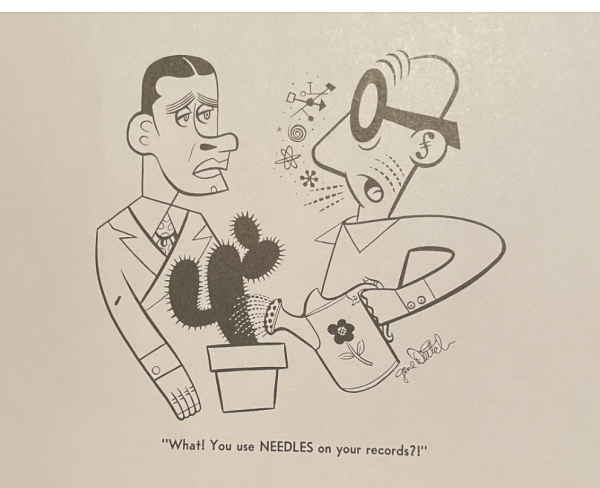
Cartoon by Gene Dietsch via Cat on a Hot Thin Groove cartoon collection
For example, I was unaware that the cactus needles of prickly pear and other members of Opuntia species so common in Texas were once used as record player needles for 78 records in the 1940s.
According to several sources, the cactus needles were in common use when 78s were produced from shellac, a softer material than the vinyl that followed. The cactus needles were less harsh than metal, and inflicted less wear on the LPs, detracting from their sound quality. As records became more popular and their production switched from shellac to vinyl, the prickly pear needles were replaced with metal ones, which were more durable on the the harder surface.
Nor did I know that Belladonna atropa, a member of the Solanaceae family just like potatoes, tomatoes and my favorite plant with purpose, Jimson weed, contains a chemical that dilates one’s pupils.
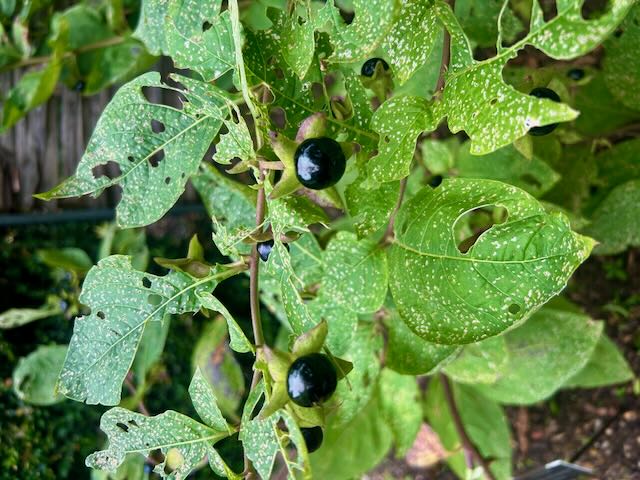
Belladonna atropine, commonly known as Belladonna nightshade or deadly nightshade, dilates your pupils. –Photo by Monika maeckle
As recently as the 1800s, women put drops of Belladonna nightshade in their eyes to make their pupils dilate and, in their view, their eyes more attractive, resulting in the “pretty lady” monicker.
Today, every time you visit the opthamologist for an eye exam, those drops put in your eyes that make the sun unbearable and allow for a thorough eye exam contain chemicals synthesized to replicate those first discovered in Belladonna.
The Chelsea Physic Garden also hosts two enormous Ginkgo biloba trees. According to our guide, Valerie, Ginkgo biloba trees are outrageously resilient and a few, which sat only one – two kilometers from the center of the 1945 atomic bomb explosion in Hiroshima during World War II, survived. While almost every other plant and animal perished from the blast, the Gingkos were charred, but lived on. The trees continue to thrive today and serve as a symbol of hope, peace and resilience.
Valerie also mentioned during our one-hour tour that King Charles became a patron of the garden years ago and now the plot enjoys what she described as “pedigreed manure” for use as fertilizer and compost, presumably imported from the royal stables.
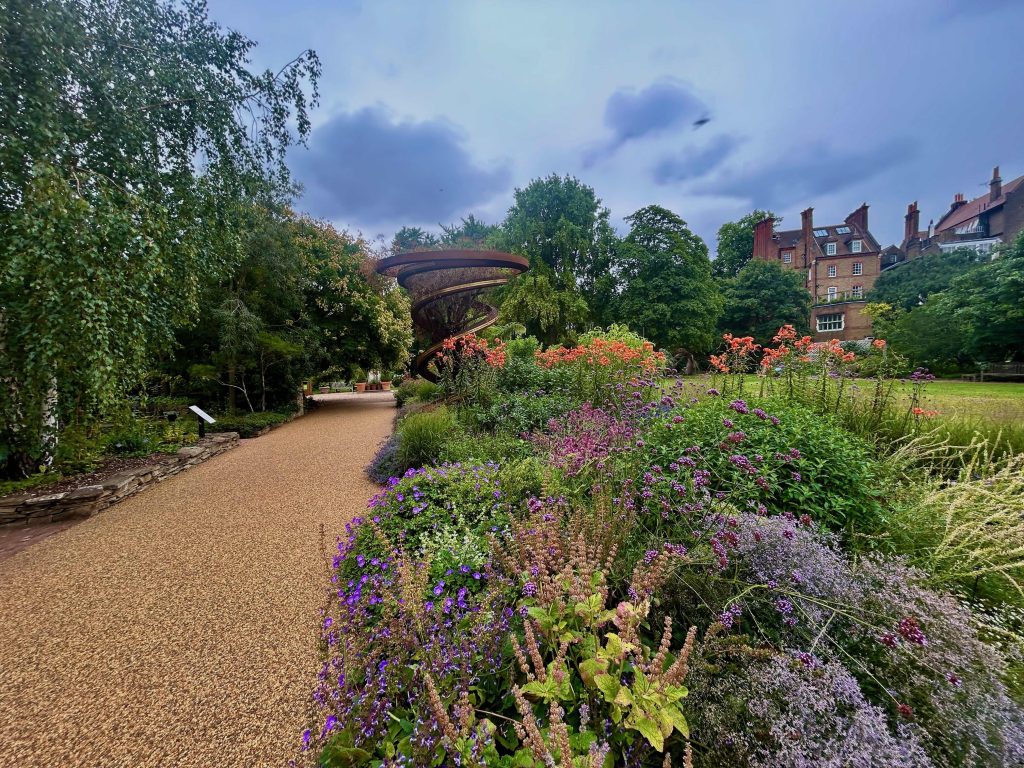
Highly recommended: a visit to the Chelsea Physic Garden in London. –Photo by Monika Maeckle
Started in 1673, the garden was started by the Worshipful Society of Apothecaries of London to teach plant science at a time when herbalists served as pharmacists and prior to the practice of modern medicine. Back then, the word “physic” meant “healing,”–as in the word physician for doctor, for example. The plants and stories at Chelsea Physic Garden focus on plants’ medicinal and healing properties.
According to the garden’s website, its mission is to demonstrate the medicinal, economic, cultural, and environmental importance of plants to the survival and wellbeing of humanity in a way that is relevant to contemporary society.
No doubt the garden holds gems aplenty about the multiple ways that plants save us–by providing food, medicine, the air we breathe, the stories we tell and the mental well being that results from enjoying a garden.
As Eve Barro writes on the garden’s website: “I love metaphors. I will let you contemplate this one: Plants are alive. They are amazingly beautiful channels of stories. They have a past, a present and a future. They are incredibly unique yet unbelievably entangled. They are constantly changing, multiplying, and hybridising. And so are we. And so is our relationship with them.”
TOP PHOTO: Yellow-haired sun fly on Pokeweed at the Chelsea Physic Garden. –Photo by Monika Maeckle
Check out the book!
Related Articles
- Plants with Purpose: Multitasking plants that do more than look beautiful
- Childhood dream to become an author comes true with monarch butterfly book
- Legacy lawn at historic home in San Antonio transformed to wildflower meadow
- San Antonio architect converts downtown parking lot into a native “prairie cloud”
- Wherehousebarn pollinator garden beckons butterflies and tenants to downtown San Antonio
- Scientist and naturalist David Hillis provides holistic and enlightening tour of the Texas Hill Country
- In Defense of Plants: explorations of the remarkable nature of plants
- Agrawal: Milkweeds don’t need Monarch butterflies, but Monarchs need milkweed
Hi Monika! Thank you for writing this. I discovered the Chelsea Physic Gardens on a visit to London many years ago, and found it fascinating. It’s like Kew Gardens in miniature in some ways, and like you I learned so many interesting things there. I especially loved the mini greenhouse in display – a glass box used by early plant explorers like Joseph Banks to bring back live specimens. The CPG is a true hidden gem!