
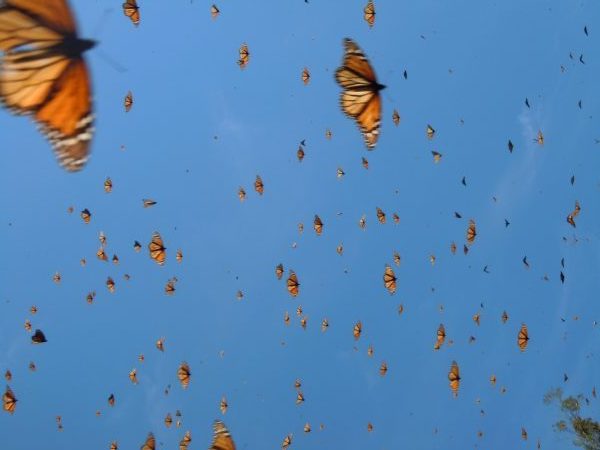
Monarch butterflies are heading our way from their ancestral roosting sites in the mountains west of Mexico City.
Migration tracking and citizen science organization Journey North reported this week that a “massive departure” was underway from the insects’ overwintering grounds.
“Warm weather, clear, blue, bright sky with gentle wind waves seem to favor the massive departure, which has been taking place for nearly three weeks now,” Journey North correspondent Estela Romero reported from Mexico on March 2.
Monarch butterflies depart their winter roosting sites in Mexico this week. –Video via Journey North
Mexican officials have yet to announce the most recent season’s overwintering population status.
Monarch butterfly expert Chip Taylor, founder of Monarch Watch, the citizen science and conservation organization that tracks the insects through tagging initiatives, said he expected an announcement in the next 10 days or so.
South and Central Texas are known as the “Texas funnel” and a critical passageway for migrating monarchs and other animals as they head north each spring from overwintering areas. Texas is known as one of the first places monarchs stop to lay eggs on their only host plant, milkweeds, any member of the Asclepias family.
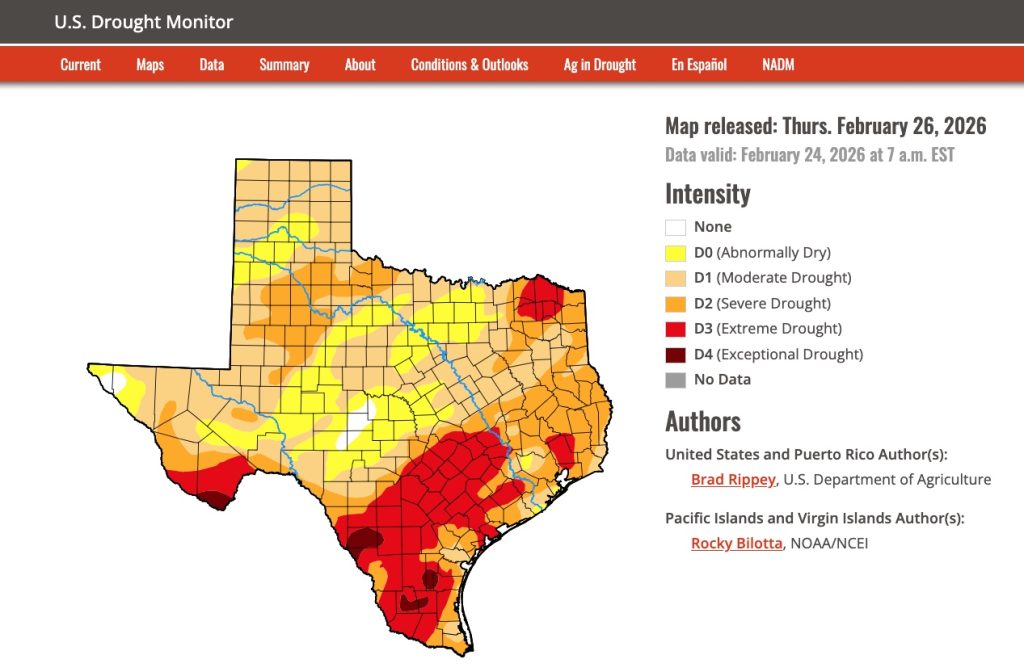
As monarchs arrive in Texas this year, they’ll find extremely unwelcoming conditions.
High temperatures, a lack of rain, and dehydrating winds have created a discouraging context for reproduction. The state just experienced its hottest February in history and many parts of Texas are enduring a sixth year of drought, ranging from “abnormally dry” to “extreme drought,” according to the U.S. Drought Monitor.
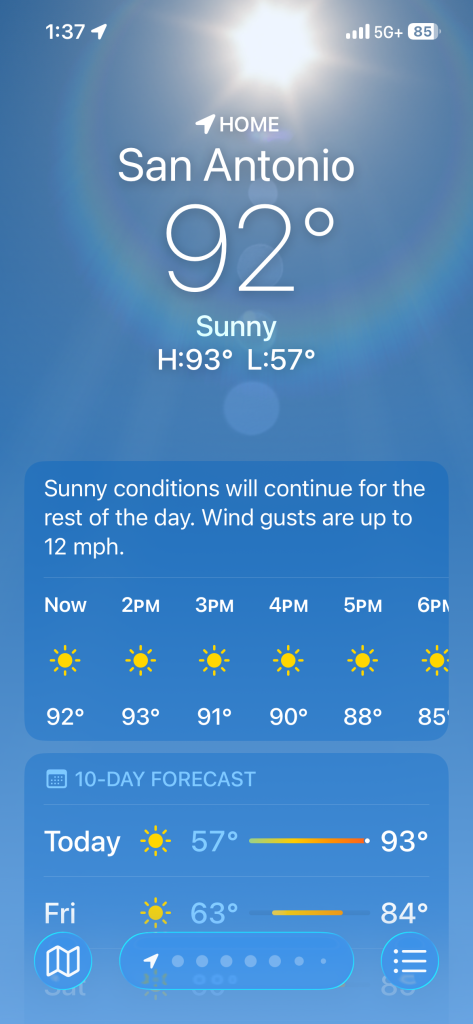
Last week in San Antonio, temperatures lingered in the 90s for several days, topping 95 on February 26 and breaking the previous daily heat record of 91 degrees set in 1954.
In the border town of Falcon Village, located in the Rio Grande Valley between Zapata and Rio Grande City, temperatures were reported at 105 degrees, which would break the record for the hottest temperature ever recorded in the United States during meteorological winter, according to the San Antonio Express News. The previous record was 104 degrees.
An outing last weekend to the Llano River in the Texas Hill Country where Swamp milkweed and Antelope horns milkweed can typically be spotted creeping from the riverbank and winter mulch respectively, revealed no stems emerging from the earth.
That said, Chuck Patterson of Driftwood, Texas, reported on March 3 that over the last week, “much more milkweed has emerged and we’re seeing it more frequently. It ranges in size from 1/2” to 5” with 3-4” being seen regularly.”
Weather forecasts call for at least two rounds of rain in much of the state later this week, so relief for the dry conditions may be in sight.
Apart from a lack of host plant at the moment, very few nectar sources are showing themselves, given the lack of rain and harsh temperatures. “The only reliable nectar sources right now are agarita and mountain laurel blooms,” Patterson shared via the Monarch Watch D-PLEX list, a listserv for those who follow the monarch butterfly migration. We witnessed the same dearth of flowers on the recent Llano River outing.
Tracking the monarchs’ journey north will be amplified by more data for the first time this year, as monarch scientists have been working with a new technology: BluMorpho transmitters.
A state-of-the-art micro transmitterdeveloped by Cellular Tracking Technologies is revolutionizing how professional and citizen scientists can track the epic fall migration of monarchs.
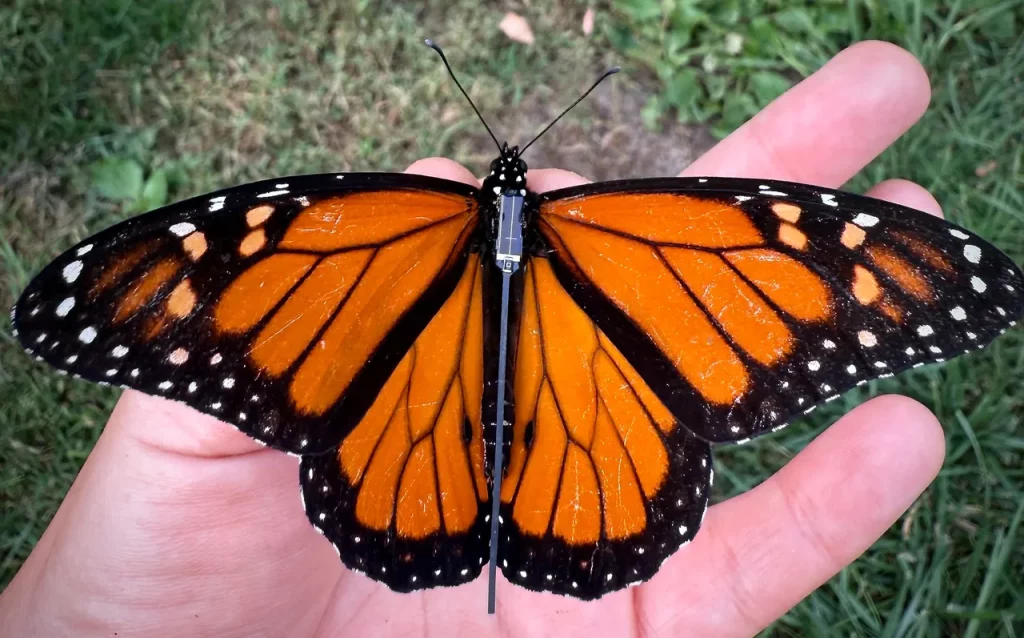
More than 600 BluMorpho tags have been installed on the backs of monarch butterflies since the project launch last fall. –Photo via Monarch Joint Venture
The solar-powered radio tags track the monarch butterfly migration in real-time using Bluetooth, providing hundreds of detections via a free app, Project Monarch Science. The app and cellular-connected receiver networks can relay exact locations of monarchs via Blutooth and wifi connections. The tags, which weigh about as much as a grain of rice, are applied to the backs of monarchs with glue. At least 600 of the tags have been deployed since the project’s launch last fall.

Download the free app wherever you get yours.
Anyone who would like to participate in the data collection project can download the app for free. According to the app introduction, “All you have to do is go outside, look for monarchs, and use this app to record and upload your detections to the Project Monarch data server.”
The self-sticking circular tags that monarch butterfly community scientists have utilized for more than three decades will continue to be available from Monarch Watch to anyone interested in hand tagging monarchs.
Chip Taylor, who founded and popularized the monarch tagging program at the University of Kansas at Lawrence more than 30 years, shared his excitement about the BluMorpho tags in a recent phone call.
“It’s fantastic to watch and to be able to see this stuff,” said Taylor this week. “Right now we’re tracking butterflies going north, covering 60 miles per day and then 20 miles per day and we can link what they do day after day after day. We’ll learn a lot about this return migration which we’ve never been able to do before.”
Current Monarch Watch director Kristen Baum also expressed her enthusiasm. “These tags give people a different view that we otherwise wouldn’t have. Hopefully, it’s an incentive to get out there and plant monarch habitat and contribute to other community science projects.”
TOP PHOTO: Monarchs depart Cerro Pelón sanctuary in Mexico. –File photo by Monika Maeckle
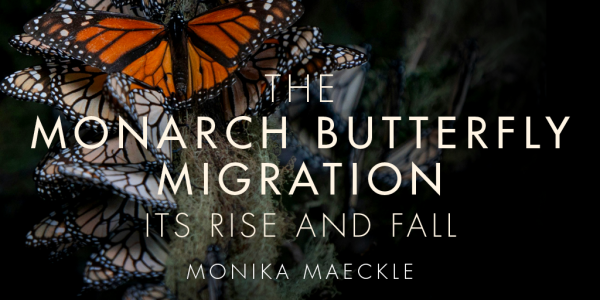
Need more context? Check out my book!
Related articles
- New study: Hot temps cause monarch butterflies to ‘drop out’ of their annual migration
- Butterfly Bonanza on the Llano River this weekend–everything buy monarchs
- Monarch butterflies heading our way as annual fall migration takes flight
- Monarch butterfly numbers vault 99% over last year’s historic low, California population teetering
- Commercial butterfly breeders brace for devastating hit as monarch ESA listing looms
- Monarch butterflies listed as “threatened” under the Endangered Species Act
- A tense online debate: raising monarch butterflies at home
- New study: monarch migration at risk, monarch butterflies are not
- USFWS rules monarch butterflies worthy of protection, but they don’t have resources to protect it
Like what you’re reading? Don’t miss a single article from the Texas Butterfly Ranch. Sign up for our email newsletter, like us on Facebook, follow us on Twitter, @monikam or on Instagram.
As a Master Gardener and speaker, I’m promoting that gardeners across the state should move water budget from lawn to nectar plants.