
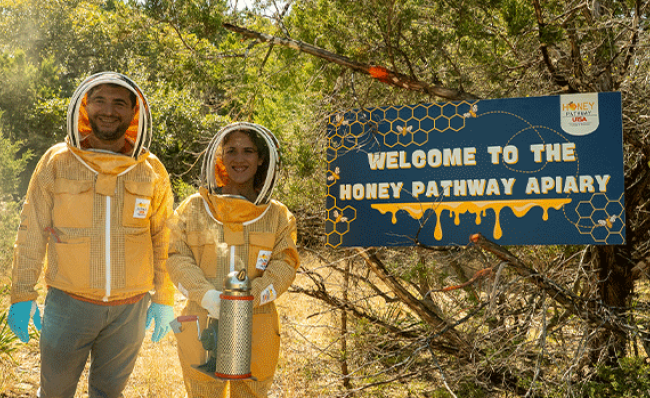
Oceanna Escribano’s grandparents were both beekeepers, so she likes to say it runs in her blood. But the 24-year-old biology graduate from Puerto Rico never had the chance to learn apiary skills until she joined the College of Sciences at the University of Texas at San Antonio and enrolled in the school’s HONEY Pathway program.
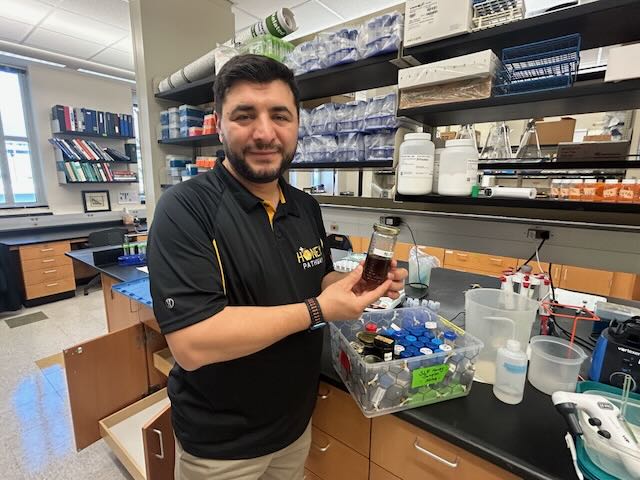
Ferhat Ozturk shows off his honey samples at the UTSA HONEY Pathway project lab. –Photo by Monika Maeckle
Founded in 2023 with the help of a $2.8 million, five-year grant from the USDA, the Honeybee Oriented NextGen Entrepreneurs and Youth (HONEY) Pathway incorporates beekeeping, mentoring, lab and business training to provide a hands-on learning experience that prepares students for careers in food, agriculture, natural resource management, and science.
Since its first class in the fall of 2024, 68 students have enlisted in the HONEY Pathway project. Twenty-seven HONEY Seminars have been delivered to more than 600 participants, 50 scholarships awarded to undergraduate and graduate students, and more than 250 Kindergarten–12 students reached through hands-on bee biology demos.
The program is the brainchild of Ferhat Ozturk. The Turkish scholar holds a PhD in cellular and molecular biology and fled a hostile academic landscape in Turkey for the U.S. in 2013. After myriad odd jobs including working at fast food restaurants, driving Ubers, and a stint teaching high school, he landed at UTSA in 2022 armed with a unique background in the understudied-but-promising field of honey’s biochemical properties and how they might apply to medicine–specifically wound care. Ozturk has led the HONEY Pathway since its inception, but is leaving UTSA for a tenured position at Sul Ross University in Eagle Pass, where he will continue his participation while also integrating students from West Texas.
Moving forward, the HONEY Pathway at UTSA will continue under the direction of UTSA Vice Provost for Faculty Success Kelly Nash, and Amelia King-Kostelac, an Assistant Professor of Practice in UTSA’s biology department. Both Nash and King-Kostelac helped develop the initial program.
“Effectively what we’re doing is to use Sul Ross as a second location and we’ll have more interaction between students here and there,” said King-Kostelac, who works closely with Ozturk on the HONEY Pathway team.

Check out my books!
Ozturk’s passion for honey-as-medicine is palpable.
“Honey will kill bacteria on your face. Warm honey helps with constipation and cold honey for diarrhea. It fights stomach ulcers,” he explained, adding that in general, darker honey often has more medicinal value than lighter honey.
Ozturk and the HONEY Pathway project made recent news when some of their research was called out in a Washington Post article. Headlined “Lanternfly honey has arrived. Just don’t ask how it’s made,” the story highlighted the novelty of honey being produced from insect poop rather than nectar or pollen.
Ozturk points out that this is not unusual. As generalists, bees harvest various sweet liquids–from cola and Big Red to the honeydew–excrement–of insects.
Turns out despite its destructive habit of decimating grape fields, walnut trees and other plants, the invasive Spotted Lantern Fly makes an interesting contribution to the foraging choices of bees. It slurps sap from trees and then excretes an estimated 90% of that sap as honeydew. European honeybees (also not native to the U.S.) have taken a liking to the free, available syrup and incorporated it into their foraging. The result: a very dark honey that tastes a lot like black-strap molasses and contains a plethora of antibiotic, antioxidant and bioactive medicinal properties.
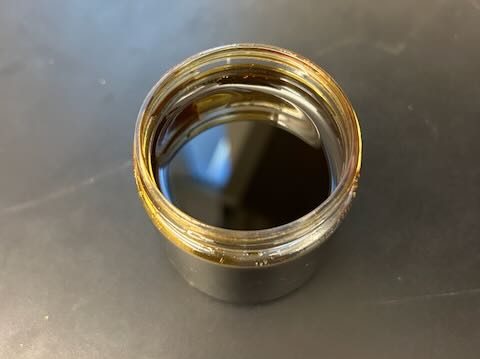
Spotted Lanternfly honey from Ferhat Ozturk’s HONEY Pathway project at UTSA. –Photo by Monika Maeckle
Early research suggests Spotted Lantern Fly (SLF) honey could rival Manuka honey, a pricey New Zealand variety sometimes called “liquid gold,” and sells for up to $1,000 per pound, said Ozturk. Currently, Manuka honey is the only type of honey approved for use by American hospitals for wound treatment.
In 2014, an infestation of the SLF was discovered in Pennsylvania. Since, the creature has made its way as far south as Georgia. To date, no Spotted lanternfly colonies have been observed in the state of Texas.
As a recent graduate and the 2025 Texas Honey Queen, Escribano can attest to the unique flavor and characteristics of SLF honey, which she sampled in the UTSA Honey Pathway lab.
“Out of hundreds of honeys, SLF honey was amazing!” said Escribano. “SLF kicked every other honey. It had amazing results.”
As Carla Marina Marchese, founder of the Connecticut-based American Honey Tasting Society told the Washington Post, “It’s getting to be the buzz around the world.”
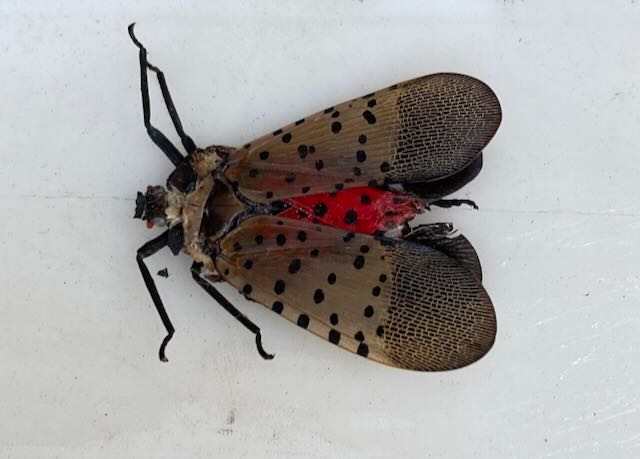
The invasive Spotted Lantern Fly makes an irresistible honeydew that bees harvest. –Photo by Monika Maeckle
Escribano continues to fulfill her obligations as Texas Honey Queen, an ambassador-like post that entails promoting beekeeping for the Texas Beekeepers Association. This week she’s in Mobile, Alabama, to compete for the title of American Honey Queen, a competition staged by the American Beekeeping Association. Meanwhile, she’s preparing for the DAT–the Dental Admission Test, which will get her into dental school, a lifelong goal of hers.
She’s delighted by an interesting overlap of dentistry and honey that she encountered in the HONEY Pathway. “While I was doing research on honey and oral hygiene, I learned that honey can help with a lot of diseases including fixing a cavity. If the tooth is not too far gone, it can remineralize the cavity.”
TOP PHOTO: Professor Ferhat Ozturk and 2025 Honey Queen and UTSA biology graduate Oceanna Escribano stand at the entrance of the HONEY Pathway apiary at the University of Texas San Antonio. –Courtesy photo
Related posts:
- The recovering beekeeper: my misguided quest to “save the bees”
- Photo of South Texas Cactus bees earns Karine Aigner Wildlife PHotographer of the Year award
- Should we give up avocados to help save the monarch butterfly roosting sites?
- Flower “bed” works overtime as bachelor pad for solitary male bees
- How to plan a successful butterfly garden
- Mostly native butterfly garden outperforms lawn every time
Like what you’re reading? Don’t miss a single post from the Texas Butterfly Ranch. Sign up for email delivery, like us on Facebook, or follow us on Twitter, @monikam.
Leave A Comment