
Jeffrey Glassberg has been down this road before. Back in 2017, he and his team fought the construction of a border wall along the Texas – Mexico border.
As founder of the National Butterfly Center (NBC) in Mission, Texas, the biologist and author of myriad books on butterfly identification fought the Trump administration during the president’s first term when construction of a physical border wall along the Rio Grande, one mile from the 100-acre NBC facility, was initiated.
Why does Texas need a physical border wall? To keep out undocumented immigrants, according to the administration, which labels workers crossing without legal entry and asylum seekers as “criminal aliens.”
Glassberg and his team were able to prevent a border wall at the NBC at that time, but today the fight resumes.
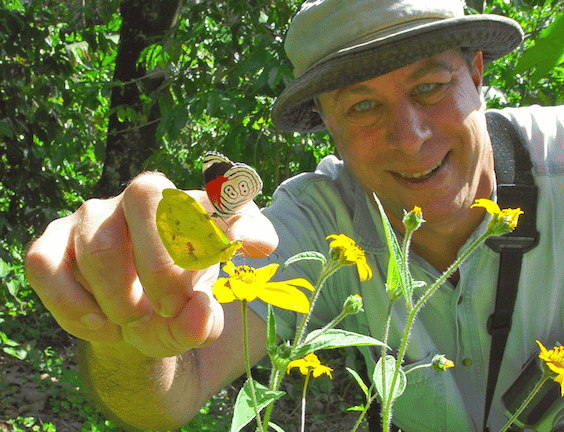
Dr. Jeffrey Glassberg, founder of the North American Butterfly Association and the National Butterfly Center –Courtesy photo
“Last time, I was friends with the congresswoman who was chair of the House Appropriations Committee—that was key,” Glassberg said in a recent phone call. “But now, I don’t know what’s gonna happen unless Congress does something to stop it….which, frankly, seems somewhat unlikely.”
Glassberg is not alone in his exasperation with the current administration’s push to permanently disrupt several of Texas’ most treasured natural areas.
In South Texas, Santa Ana National Wildlife Refuge, Bentsen State Park, La Lomita Chapel and the NBC are insisting “No Border Wall!” along the Rio Grande. About 600 miles away in West Texas, locals are now organizing to stop construction of a border wall in Big Bend National Park. Their message: “Don’t mess with our Big Bend.”
Wildlife proponents, conservation organizations and even conservative Republican ranch owners are rallying to protect the wide diversity of species and the dramatic landscape that define the western reaches of the state’s border with Mexico.
In a March 2 press release, the National Wildlife Federation said the proposed Big Bend wall along the Rio Grande threatens the integrity of one of the most remote, ecologically intact, and culturally significant landscapes in Texas.
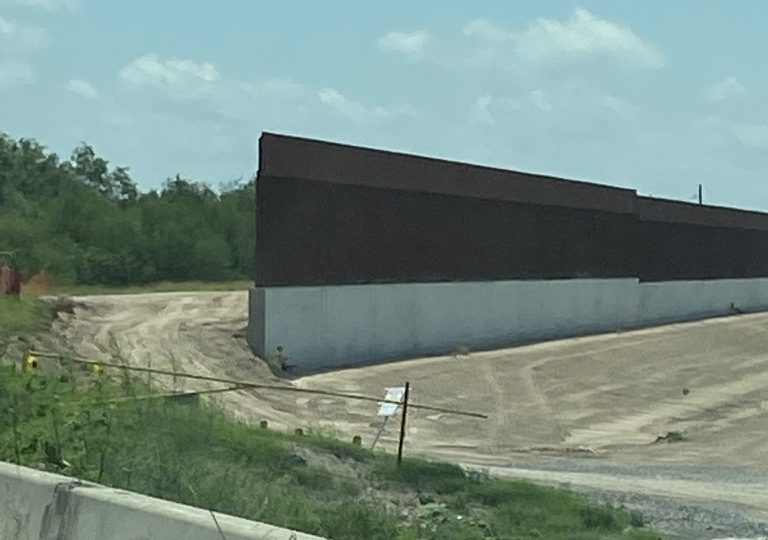
Not far from the National Butterfly Center, portions of a border wall have been built. –File photo by Monika Maeckle
“This is not a partisan position. It is a conservation position grounded in stewardship of public lands and respect for private property rights,” the statement said, quoting the Texas Conservation Alliance‘s (TCA) Grahame Jones.
Like many others, Jones cites habitat fragmentation, restricted river access, and jeopardized working ranches an inevitable consequence of any West Texas wall in or around the Big Bend National Park, a unique nd treasured landscapes that has remained largely unaltered for generations. “TCA urges policymakers to pursue border security solutions in the Trans-Pecos that safeguard both the safety of Texans and the integrity of one of our state’s most extraordinary landscapes.”
Tara Shackelford and her partner Joe Lorenz run Hidden Dagger Adventures, an outfitting business in the remote West Texas town of Marathon that specializes in Big Bend National Park outings. The couple frequently guide nature travelers on Big Bend National Park tours, as well as paddling adventures along the Rio Grande.
“In the last 10 years of guiding on the Rio Grande, I’ve seen a single illegal immigrant,” said Shackelford. “He wanted water.”
She added that effectively operating an outfitting business, or managing a national park with broad public access, would be impossible if border security were as serious an issue as administration officials, located nearly 2,000 miles away in Washington DC, claim.
“We don’t have to worry about leaving gear unattended or our cars locked 24/7,” Shackelford said. “This is, and always has been, a safe place. We’ve never had an issue.”
Before she was fired by President Trump in early March, Homeland Security Secretary Kristi Noem waived 28 laws—the Endangered Species Act, the National Environmental Policy Act, the National Historic Preservation Act, the Clean Water Act, the Migratory Bird Conservation Act, the Clean Air Act among them–to expedite construction of a 175-mile physical barrier.
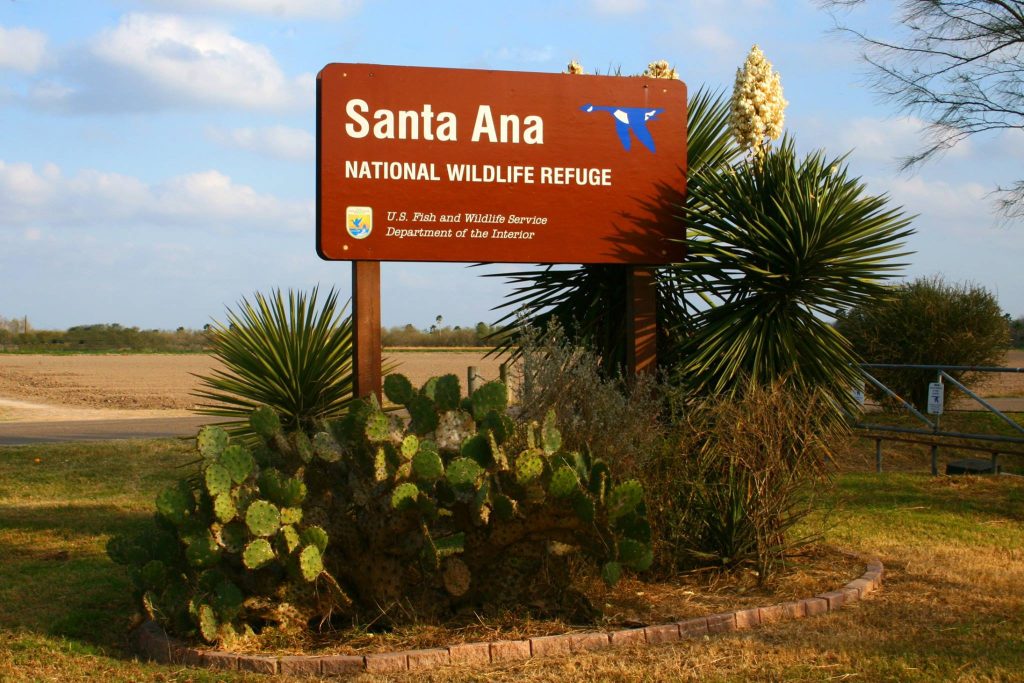
Santa Ana National Wildlife Refuge has been fighting a border for almost a decade. –Photo via Friends of the Wildlife Corridor
Texas Monthly reporter Forrest Wilder aptly noted in a February 27 article that destroying Big Bend with steel walls sounded insane. “It would be like building a power plant in front of Half Dome, in Yosemite, or constructing an Amazon distribution center at the rim of the Grand Canyon.”
Scott Nicol in the Texas Observer agreed, explaining that the destruction resulting from the building of a physical wall in the park’s protected areas “will not be magically resurrected when the White House has a less malignant occupant. Once walls are built, history shows that administrations of either party will maintain and even expand them.”
Five West Texas sheriffs, the boots-on-the-ground officials who actually enforce the law in the Big Bend area, recently sent a letter to state and federal officials opposing construction of a physical barrier.
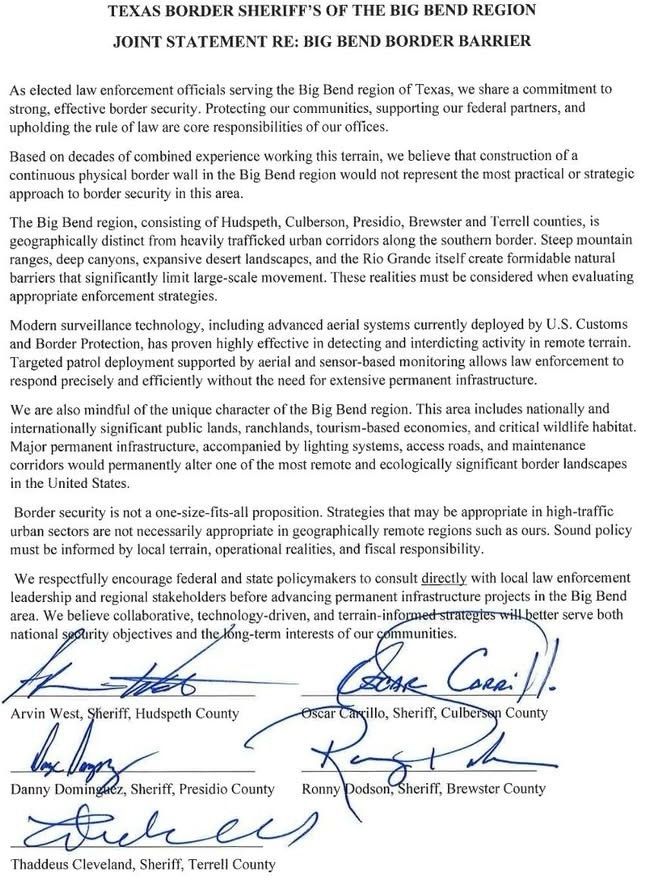
Border sheriff’s statement on Big Bend border barrier.
Pointing out that border security is not a one-size-fits-all proposition, the chief law enforcement officials of Hudspeth, Culberson, Presidio, Brewster and Terrell counties collectively suggested that federal and state policymakers should “consult directly with local law enforcement and regional stakeholders before advancing permanent infrastructure projects in the Big Bend area.”
The sheriffs cited the impracticality of constructing a physical wall in the ecologically sensitive region where steep cliffs, harsh terrain, scarce water and ornery plants already deter humans while providing habitat for plants and animals, many of which are not found anywhere else.
Resistance to the new stretch of border wall through a national park is building. Protests are planned. Petitions are circulating. State and federal elected officials are hearing fom more and more unhappy constituents. (See below for details.)
Earlier this week, more than 130 conservation groups, outfitters and rural Texas businesses urged Congress to block federal funding for construction of the border wall in Big Bend National Park and Big Bend Ranch State Park.
DHS officials recently backpedaled a bit on the wall in Big Bend, but as reported in the Big Bend Sentinel on March 6, “It’s not over: Walls are still on the map.”

Check out my books!
Just as Noem was relieved of her Cabinet position, the lines on the proposed border wall map mysteriously changed to remove Big Bend National Park from being a candidate for physical steel walls and bollards to more likely employing detection technologies.
The battle continues, and Jeffrey Glassberg remains cautious. He believes the only tool that will work is huge public outcry.
“Do I think we’re gonna be able to stop it this time? I don’t know. We’ll try, but it’s a little different this time.”
Want to help?
Or, add your name to the SaveBigBend petition on Change.org
You can also write your representative and let them know you oppose the border wall in our nature preserves.
And for those so inclined, consider joining the Save Big Bend – ATX Protest on Saturday, April 4, 2026, in Austin, Texas. The protest starts at 4 PM on the South Steps of the State Capitol and at the Governor’s Mansion.
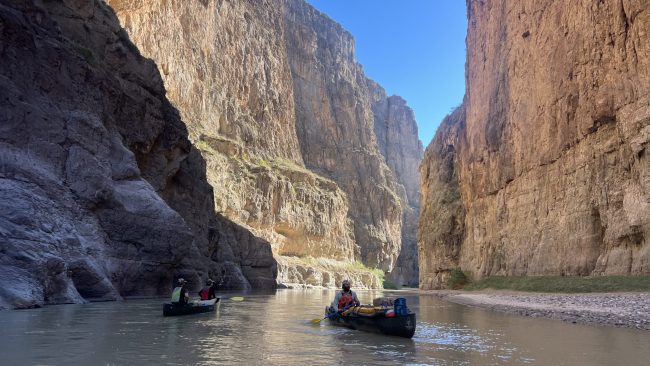
TOP PHOTO: Big Bend’s Santa Elena Canyon on the Rio Grande –Photo by Tara Shackenford
Related posts:
- National Butterfly Center shows resilience in face of border wall, other challenges
- Border Wall at National Butterfly Center violates property rights and worse
- McAllen becomes second NWF Monarch Butterfly Champion City
- South Texas a great base for sojourn of bees, butterflies and birds
- Monarch Champion status not “just talk,” will change how San Antonio manages land
- What will happen to pollinator advocacy under President Trump?
- Guidance on milkweed management confuses butterfly gardeners
- Mostly native urban butterfly garden outperforms grass every time
- Endangered Species Act: wrong tool for monarch butterfly conservation?
Like what you’re reading? Don’t miss a single article from the Texas Butterfly Ranch. Sign up for our email newsletter, like us on Facebook, follow us on Twitter, @monikam or on Instagram.
Leave A Comment