
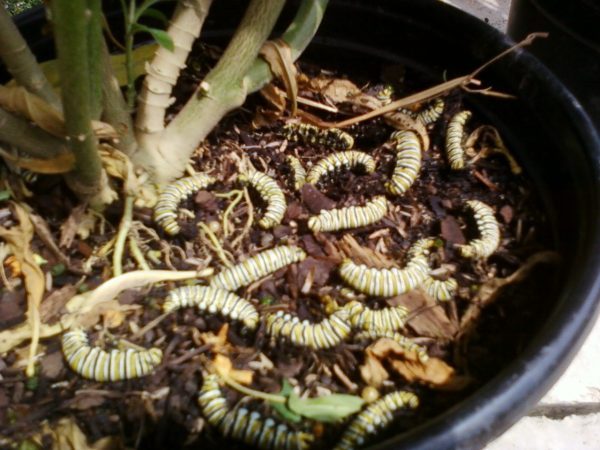
Anyone have any emergency milkweed? The 30 or so caterpillars have totally stripped mine and the nurseries don’t seem to have any. I really don’t want to lose them. –T. Kinsey, San Antonio
I, too, have run out of food (asclepias tuberosa) for my Monarch caterpillars. I have approximately 14 caterpillars ranging from the 1st through the 5th instar. The little ones can’t eat the hard stem, which is all that is left. I am scrambling around asking everyone I know if they have any butterfly milkweed and so far, no luck. –C. Nugen, Stephenville
I have a great number of monarch caterpillars on the milkweed plants in my garden, more than I have ever seen!! Only thing is, I think there are more than there is food. Will they find nearby plants to eat or start eating the stems of the plant? Please help as I am bit worried that they will not all get to the next life stage. –L. Jarvis, San Antonio
Monarch butterflies have been arriving in the “Texas funnel” for weeks, laying their first generation of eggs on milkweeds in yards, gardens, and throughout the state. But judging from emails, text and Facebook messages I’ve been getting, we just don’t seem to have enough milkweed to keep up with their voracious appetites. The creatures eat 200x their birthweight in milkweed leaves by the time they bust their stripes to form their gold-flecked jade chrysalises.
The milkweed shortage appears to be the result of the Monarchs’ early arrival and crazy weather this year. When the Monarchs arrived in March, a lot of wild milkweed wasn’t even out of the ground yet. The wet, mild winter provoked a bountiful wildflower showing, creating serious competition from more aggressive species. Then we had a slew of 80- and 90-degree days that sped up growth of both the caterpillars and plants. Result? Lots of caterpillars and not enough food.
What to do if you find yourself with dozens of hungry caterpillars and no milkweed for them to feast on? If you don’t have access to milkweed in the wild nor from fellow gardeners, your best bet is to call local nurseries and ask if they have any Asclepias in stock. Be sure to ask for Asclepias, the scientific name, since it’s not unusual for nurseries to sell “butterfly bush” or “butterfly weed” which are great nectar plants (often in the Buddleia family) for all types of butterflies, but useless for hosting Monarchs or other milkweed feeders.
Next, tell the nursery staff that you are raising caterpillars. That means the plants you purchase for caterpillar food must be free of systematic pesticides. Nursery staff will often swear they have not sprayed anything on the plants, but that doesn’t mean the grower didn’t.

Fat and happy Monarch cats devoured Sharon Sander’s milkweed patch
Two friends experienced this difficult lesson in the past week. Sharon Sander emailed with joyous photos of hundreds of Monarch caterpillars decimating the milkweed patch at the River Road Community Garden. Sander asked if I had any extra milkweed. Since I did not, I encouraged her to seek out pesticide-free milkweed at one of our local nurseries.

Beautiful Asclepias Curassavica from Shades of Green turned out to be full of pesticides
Sander located milkweed at Shades of Green Nursery in San Antonio. She explained to nursery staff that she was raising caterpillars and was told no systematic pesticides had been used. She brought the plants home and moved 200 caterpillars to the robust plants.
The next day, “They all died,” Sander wrote via text message. Sander contacted Shades of Green, an excellent nursery, and was given pesticide-free replacement plants. Still, a sad lesson.
Wendy Meyer, co-manager of Shades of Green was very apologetic about the incident and said that unbeknownst to Shades of Green, the grower had used the pesticide Dursban (chlorpyrifos) on the milkweed plants. Supposedly Dursban dissipates in 10-14 days, but in the meantime is readily absorbed into the plant tissue and anything that eats the plant.
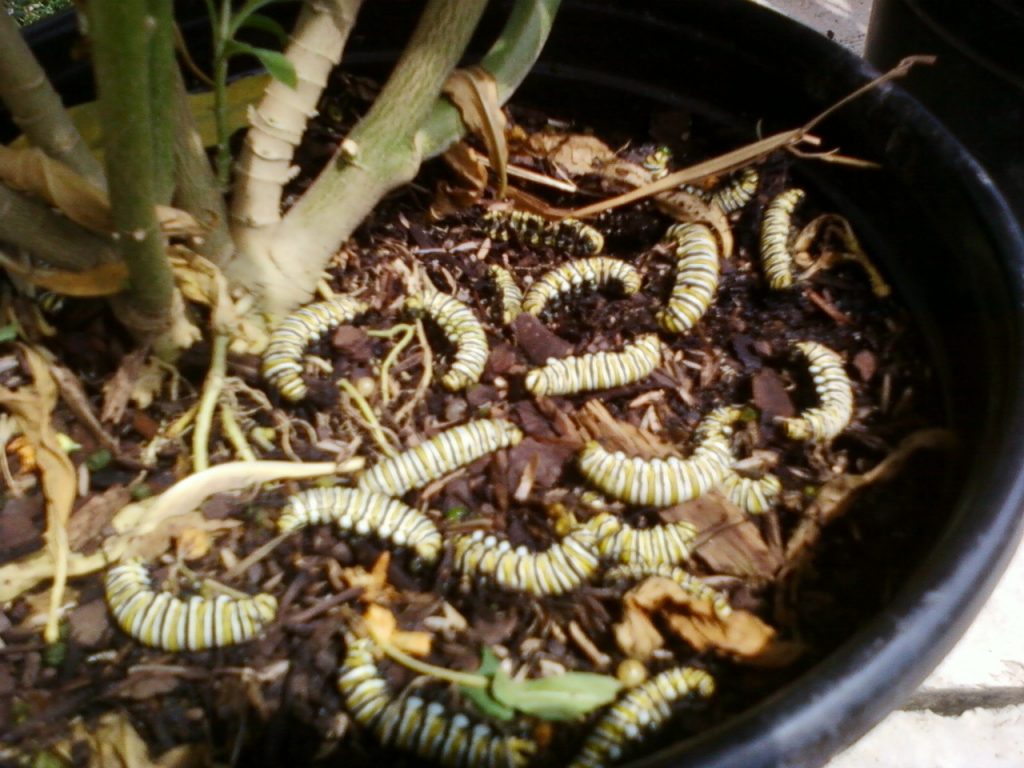
Boo-hoo! Dead Monarch caterpillars fall victim to pesticide laced milkweed
Jenny Singleton of Grapevine relayed a similar story. Upon leaving town for vacation, she stocked up on milkweed for the hungry Monarch caterpillars she was leaving behind. “I went to my favorite nursery to buy more milkweed and left the new, full plants next to the eaten up ones,” Singleton wrote in an email. “Checked on them this AM and to my horror, I’ll bet 75% were dead! I was sick!”
Unfortunately, nurseries don’t always know their growers as well as they should. And most plant shoppers won’t buy plants with bugs on them. Milkweed plants are an ecosystem unto themselves and attract aphids, milkweed beetles, milkweed bugs, various flies and wasps. Pesticides will kill all these pests–as well as Monarch eggs and caterpillars. It’s a challenge for growers who are often inclined to spray plants immediately before shipping to make them attractive and insect free to shoppers.
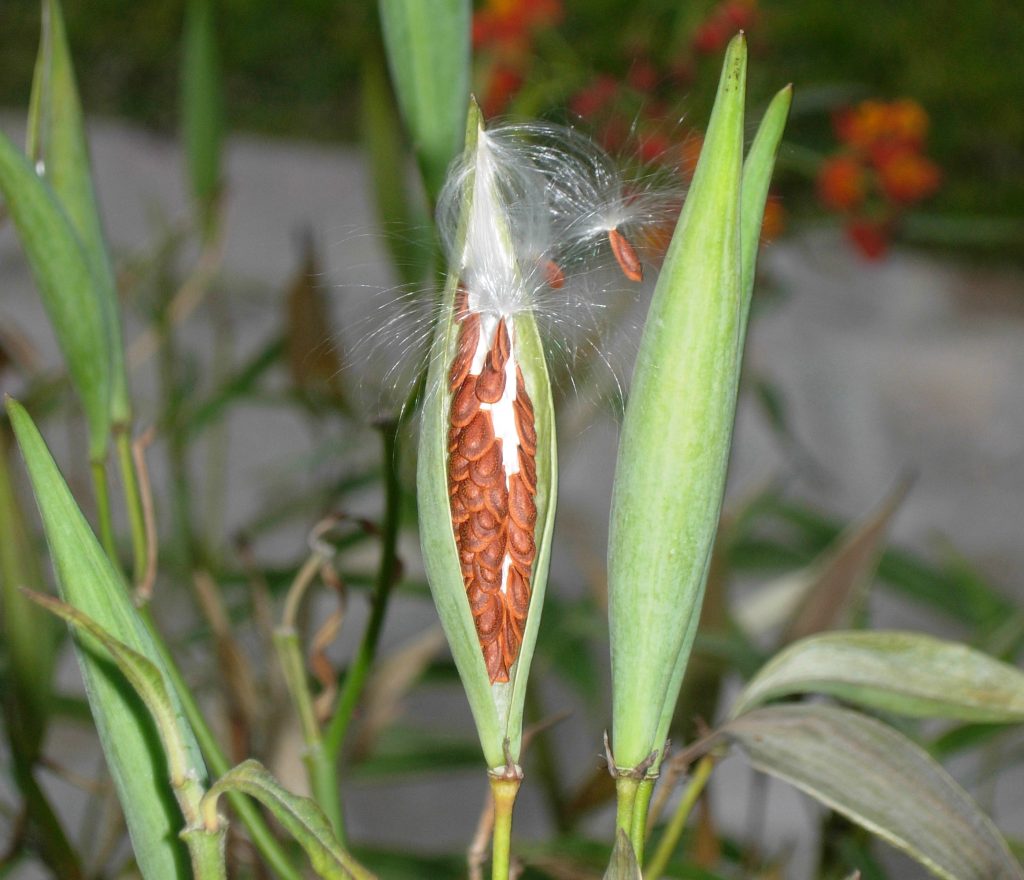
Tropical milkweed is easy to grow
If you don’t know the provenance of your host plants, the best solution is to GYO (grow your own) milkweed. Milkweed flowers develop a plump seed pod. Tropical milkweed, while not native, is easy to grow and a Monarch butterfly magnet. Remove the seeds from the milkweed fluff and sow in pots or the garden. We’ll detail that process in a future post.
Like what you’re reading? Follow butterfly and native plant news at the Texas Butterfly Ranch. Sign up for email delivery in the righthand navigation bar of this page, like us on Facebook, or follow us on Twitter, @monikam.
Drive out along the highways and country roads out-of-town and harvest your milkweed. For goodness sakes, there are tons and tons of milkweed along right-of-ways. There certainly is no need to purchase milkweed at this time of year! It is extremely abundant now. Take plastic bags and gather it. You will probably catch more eggs and larvae on the leaves. Refrigerate until you need the milkweed, or make several trips as you run out.
If you don’t know what native milkweed looks like, do a Google search.
Good advice, Mary, for those who have time to go milkweed foraging. Also make sure you’re not on private property.
MM
If you gather it on the roadside, make sure it has not been sprayed by pesticides. Milkweed is getting less abundant as many people consider it a weed, not knowing it is necessary for monarchs. I saw my first monarch of the season yesterday–on my butterfly busy–I have milkweed nearby.
I live in Houston,Tx and have had 15 caterpillars. I to have problems keeping milkweed plants. I only have 3 plants ans they can stripe a plant in 3 days. I called the Museum of Natural Science and asked for the butterfly exhibit. They have helped me.I
took them their.
I am so excited that I have 7 caterpillars! I learned from a wonderful environmental science class/teacher in San Antonio how to care for these guys and the butterflies they will become! They have sucked my milkweed dry and are doing some walkabouts to find food… I’m going to search for milkweed as Mrs. Kennedy has brilliantly suggested!! 😉
I have tons of milkweed
I like to buy some Milkweed from you, is that possible? thank you and kind regards.
They sell milkweed seed on amazon.
You won’t find them alongside the roads in Indiana – guaranteed. The farmers spray the fields and the county sprays the roadsides. I drove mile after mile looking and finally only found a dozen plants far from the roads, in an un-mowed backyard in a housing addition. Picked all I could, but can only hope the pods were mature. Bought them on the Internet last year and none came up.
It may seem cruel but if you removed the larger cats to a cage where they will be able to make a chrysalis, in a few days they usually will. Even if the chrysalis is small, you will be able to save so many more by freeing up food.
Jim, you may have already tried this, but fall planting of the seeds so that they are exposed to winer weather gives me much better germination. Also, when collecting seeds, make sure there are several plants with pods around…this ensures better germination as well. I have found that the easiest way to have plentiful milkweed is to dig up common milkweed and plant it in a place here it is free to roam around. It seems it never comes up in the same place twice, but it always comes back for me. I am in Indiana also. It is not just the milkweed. Indiana seems sterile in places when it comes to the things that SHOULD be living here.
That would be winter weather.
The roadside milkweed people are seeing is Antelope Horn Milkweed, native to Texas. I have tried to transplant some several times with no luck. Unless you are prepared to constantly be going out and picking enough leaves for a day or so for your cats, I would suggest releasing a good majority of the caterpillars y’all have directly onto the milkweed beside the roads. Obviously don’t put more than 1 or 2 on a plant unless it’s a huge plant or again they’ll run out. Just my suggestion. 🙂
I’ve tried transplanting too. No luck. That darned taproot is too deep!
Here in Fort Worth I see milkweed growing all over, but for some reason I never find caterpillars on it. It is the type with the green flowers and skinny leaves. Don’t they like all types? Also, it seems I mainly see them in the fall on their way back south. Is that normal?
There is no native milkweed growing along roadsides in & around Corpus Christi – I have a few friends that raise monarchs and tropical milkweed and we try to help each other out. Sometimes all stores are out of tropical milkweed too, and I have also had the experience of purchased plants sickening or killing the caterpillars.
I’m thankful that my tropical is coming back and I have several volunteers also. I hope I get lucky and get some visitors again like last year. 🙂
Same here. I purchased 2 beautiful milkweeds from local Lowe’s. The caterpillars I had were out of food and I was so excited to find these healthy (or so I thought) plants. I brought them home, the caterpillars starting eating and the next morning they were all dead. My daughter and I were devastated. Be very, very careful when purchasing milkweed that you did not grow yourself! We learned our lesson the hard way. 🙁
Chain nurseries are dangerous for monarch caterpillars! Use local nurseries, nurseries that know who grew their plants. Tell them itheu are for catterpillers, and have them call the grower for confirmation.
In San Diego, Mission Hills nursery
and Andersen’a garden centers are absolutely reliable.
Dursban is an organophosphate. Organophosphates are contact insecticides (sprayed on the plant) and are not systemic insecticides as far as I know. There are some translaminar insecticdes (sprayed on the plant) that are systemic.
As far as I know, Dursban is no longer available for use by the general public and it’s application is not without hazard.
http://www.livestrong.com/article/237492-dursban-warnings/
From 1st to 5th instars (hatching from the egg to the last stage before forming a chrysalis), monarch caterpillars will grow 2000 times in body weight. They are eating machines.
if you have the tropical milkweed you can cut the stems off and put them in water . this will grow leaves back on the stem as well as let the plant grow back up. the stems will root in the water as well. but i have done it with stems stripped of leaves by monarchs just to supplement the “food” for the cats. also you can freeze milkweed. so i cut mine back and freeze stems when they get big and bloom all season long so i can stock up on it in case i have alot of monarchs when they head south for winter. as well as i cut them back at the end of the season before the frost gets them and freeze then as well . i have also got it on the roadsides. but i tend to get the stems and leave the plants so it will be there if i need it. i know a nursery that ships here in ga
is the red & yellow tropical milkweed at this site .they also have it in yellow . if you need to buy some here is the web site
http://thymeafterthyme.com/
this annual grows so fast i don’t mess with the other milkweed & bfly weed because it is grows too slow . i but seeds off ebay for trpoical milkweed and it is easy to grow. i have found here it does better in part shade…the summer heat is so bad . i also started keeping it in pots since i have to water it more .
i also joied a bfly group on yahoo garden with butterflies…you might join and post there about needing milkweed and maybe someone ther ecan help from your area. here is the link below ..good luck !
http://groups.yahoo.com/group/gardenwithbutterflies/
I think growing in pots helps protect from predators…especially ants. Also, much easier to find eggs & caterpillars.
I planted the nasty, sad, emergency milkweed that I purchased in December to feed my late-year caterpillars in the garden and they have begun regrowing into nasty, sad, new plants. But the second group of caterpillars is on them and eating the ugly-looking leaves. Even though these plants look bad, the caterpillars are making it to the chrysalis stage, so do I just let them be and hope they’ll eventually turn into beautiful butterflies themselves? I do have some new plants trying to come up, but they’re getting eaten as soon as they break the soil. In addition, I now have a lined snake that’s dug a hole in my milkweed and I have to get him out because it’s a threat to the caterpillars. I’m telling you, my caterpillars have to be brave to live in my garden!
To help answer the question about digging antelope horns.
The article and photos are from the Boerne Chapter of NPSOT’s website.
http://npsot.org/wp/boerne/2011/04/14/rescues/
The milkweed did not survive, nor did the other 2 that were “rescued.”
What does it mean to rescue a milkweed?
Plants from an area were “rescued” because the area was being cleared for development.
Wow, you warriors in Texas have a much more difficult time with the milkweed than those of us in Minnesota. Keep fighting for those Monarchs so they get to us and we can do our part.
I have found monarch caterpillars feeding on fennel and dill in my organic garden. When this happens, I transfer.them to my nearby bed of asclepias (3 kinds). I’ve never heard of them feeding in anything but asclepias. Is these another caterpillar that closely resembles Monarchs?
Never had that happen. Google pictures of Black Swallowtail Caterpillars, since those are among their host plants. Make sure you aren’t confusing the Monarch with the striped BST cats.
Yes, black swallowtail and giant swallotail cats eat fennel, dill and rue. They are very similar to monarch cats
I’ve found that the monarch caterpillars also love dill weed.
Monarchs will not eat Dillweed – that’s the host plant for Black Swallowtails. Monarchs only eat milkweed varieties.
I have had them eat Dill Fennel plants this season, and unfortunately, I mistook them for horned worms in a panic and only one survived to butterfly. I’ll know better if there is a next time.
Margaret, if they are eating dill and fennel, they are absolutely not Monarchs but Swallowtails. They often are mistaken for each other since they both wear distinctive striped suits.
Sorry to disagree, the Black Swallowtail is very similar to some people but if you look at them closely(hopefully you took pictures) they will not have the two sets of feelers.
I’m in far far NW Houston, and I have a LOT of milkweed again this year, and 11 caterpillars. I can supply weed or take the caterpillars.
DoraAnderson@sbcglobal.net
Dora, would you happen to have extra milkweed now? Just came across this blog. Today, 11-5 I have 14 catappillars (monarchs) and all my plants are stripped of leaves. I will go try to shop for some untreated milkweed tomorrow but not sure i will find any. I live in NW Houston — at 290 / Cypress Rosehill.
Im in the same boat.. although i have some leaves left on my plants , im surprised they didnt freeze back last night .. but this morning i have 15 eggs .. im so afraid of a freeze killing back what plants i have left. Ive never tried cutting the stems and freezing them..but thinking i may try . Really afraid these babies wont have enough food to make it
This won’t help you now, but start immediately by cutting limbs off your your stripped plants and put them in a glass of water. Keep them in there until you see roots sprigging from the small limbs. Then put each rooted sprig in a small container of dirt. By spring you will have leafy plants for the March migration. I have created more than 20 health plants this way and continue to create more each time a plant is stripped by the caterpillars. I tried in the spring to buy plants from a trusted plant store, but they were all sprayed and the caterpillars al died.
Just keep cutting little limbs and making new plants. It’s the only safe way and before you know it you will have a jungle of milkweed . Julie
I have read the caterpillars will eat pumpkin. Its worth a try. Maybe not the first instars….but the final one, may help ready them to pupate. However by then they’ll need a ride to Mexico. Blue vine or honey vine is also a plant they will use that grows on cyclone fences. Perhaps some is near you and protected from the cold winds. Good luck.
annieinOK
I’m in Texas and have cats that has just gone into chrysalis. Our December weather has arrived a month early, and all I see in the forecast are cloudy days with day temps mostly in the 50s.
I’ve read that some chrysalis hibernate over winter…can that be induced or is it simply a specific type of butterfly that can do it?
Next question(s): if they emerge and weather doesn’t permit releasing them, how long can they survive before being fed? and is it true that sugar water on cotton balls in a shallow dish will attract them and provide nourishment for them?
What type of Milkweed does this work on?
I am trying to grow my own Milkweed from the seeds that I have been collecting from the seedpods, but I am not having much luck. I have put them in pots to start but only getting a few coming up. Please publish the instructions ASAP because I know there are many of us that need HELP.
Thank you for all you do…
Nancy Miyares (Apopka, FL.)
My new milkweed must have had systemic pesticides because all of my caterpillars have died 🙁 ~ My chrysalides are still hanging in there and 3 have hatched so I’m releasing the butterflies today. My question is: Should I get rid of this milkweed?? I haven’t planted it yet but I have lots of babies on it and also, if these new butterflies feed on the nectar from those plants, will it poison them too?
Oh, what a bummer! Hate it when that happens. If you had some successfully eclose that fed on that milkweed, then it’s probably not pesticides. There’s a slew of Monarch diseases, as well as pests that can effect successful completion of the life cycle. You can clean rinse the milkweed with a 10% bleach solution to disinfect it, but the milkweed will take a beating–and obviously don’t do that with caterpillars on there.
There definitely appears to be more sickness and diseases when caterpillars are crowded on one plant or in a cage or container. Scientists believe that milkweed that doesn’t freeze back each season is more likely to “hold” sickness producing germs, but it hasn’t been proven.
If it is, indeed pesticides, than I believe that the nectar is also effected, although it depends on how recent and strong the dose.
Sorry you had this happen, Marci. I have milkweed seeds to share. If you want to start over, contact me offline.
MM
I got around 20 through the chrysalis stage and I’ve released about 15 butterflies so far and I’m just waiting for these last 5 to emerge! It’s been really fun to watch them. When they fed on the milkweed I’ve had in my yard, they were fine. It’s the new ones that all died on that ‘pesticide-free’ new stuff. I now have two batches of milkweed and the caterpillars are going crazy on both of them but they are chomping back the unhealthy looking plants now more than the ‘healthy’ looking ones. I have plenty of seeds coming out so I’m OK there but thanks for the offer! The original milkweed is also coming back! I guess that makes sense that disease-infested milkweed would have to freeze back in order to come back disease free but would that be the same for systemic pesticides? I’m wondering if this MW is worth planting? I’m going to start w/another terrarium today. I have about 12 caterpillars on the other types of MW and they might be close to eclosing so, hopefully, I wont run out of food!
I’m in Fort Worth. Has anyone seen cats here yet? My milkweed is still pretty small and I haven’t seen any Monarchs in my garden yet.
I’m in San Antonio and found 2 Monarch caterpillars on some wild Antelope Horn Milkweed in my back yard (wild cause it sprung up on it’s own 2 years ago in the middle of the yard). One cat is very big the other one is probably 2nd instar. Brought them both inside (can’t have wasps or anything getting to them) and threatened hubby not to mow the plant over 😉
Yes, a recent research paper has found significant concentration of systemic insecticide in the plant’s nectar.
I HAVE THOUSANDS AND I MEAN THOUSANDS OF MONARCH BUTTERFLIES AT MY HOUSE! IT IS CRAZY. I HAVE NEVER SEEN ANYTHING LIKE THIS. I GOT ONLINE TO SEE IF I COULD FIGURE OUT WHY AND WHERE DID THEY COME FROM?
SPRINGTOWN TEXAS
Wow, that is amazing. Usually we get these kinds of reports in the fall when they migrate en masse to Mexico. Their spring during migration is less intense, as they trickle through at a more stretched out pace. Please send photos.
ok i got some great photos this morning in the sun! thousands of them in my fron yard. how do i send them or post them?
Email one to me at butterflybeat@gmail.com, or share them via Facebook or Flickr and send a link.
Wow! I’d like to see that too!
In my tiny garden. as soon as one group matures another one is right behind just in time to eat what little is left of the leaves from the caterpillars before them. But of the three generations thus far, only three butterflies have gotten to the chrysalis stage (I didn’t see if healthy Monarchs emerged), as the rest have all been Tachinid Fly victims in the end. They all look like plump, healthy caterpillars one minute, then later in the day they’re writhing in pain and expelling green fluid–an autopsy showing three maggots inside. So upsetting no to be able to prevent this! Getting plants is hard enough–keeping Tachinid Flies away makes it 99% harder!
I feel your pain. Tachinid flies: very sinister.
MM
How exciting. Haven’t seen any in my garden in Keller yet. Hope to see them soon! Guess I need to get more milkweed. I only have a plant returning and some seedlings so far but no monarchs. Haven’t seen any swallowtail either and I have tons of fennel.
I hope Cindy will report her amazing observation to the citizen science resource at Journey North….so important in getting a sense of the numbers over time.
Annie Oklahoma
http://www.learner.org/jnorth/maps/Gallery.html
I will try to send photos. Hard to catch them. I have been taking pictures and hard to capture that many. When i walk out of my garage they all fly like a worlwind. My trees are weeping something that they have never done. My trees are covered with butterflies. If i turn on the water hose they love it. Then they are all over me and ground. I feel so special having so many.
This may hold an answer for you in the future if milkweed goes short.
Pumpkin seems to be consumed by the caterpillars with no apparent negative effects.
These people at link are still studying.
Where do you get a pumpkin in spring then?
I suggest we all freeze a few chunks this fall, for spring 2013.
Better than nothing.
Annie, Oklahoma
http://www.butterflyfunfacts.com/pumpkin.php
1/09/2022 I still have two monarch butterflies in the chrysalis stage at my property. I grew some Arizona native milkweeds along with tropical milkweed in garden beds and pots. Not one of many cats ever went on a native plant. All on tropical milkweed. Our weather has turned cold during the night. I put the cages of Crystalis in my shed at night and take them out during the day. Don’t know if the butterflies are going to survive the cold? I still have flowers so hopefully they have enough food to get them to where they need to go. This is the first year growing the milkweed in my yard and the monarchs showed up second week of October. They have been hatching November through today’s date January 9th 2022 . I have collected a out 17 to raise and had about the same number left loose. A few fell victim to the parasitic fly before I collected them. The rest did very well. I intend to grow many more plants from seeds both native and non-native to add to my yard next year. I also plan to make larger screen and enclosures where the plants can stay inside with the caterpillars. They will then be released when they turn into butterflies. If I can collect the cat young enough they won’t have a chance to be attacked by predators.
I live in Ventura, CA. on the coast. I just released 30 Monarch butterfly’s. I order my milkweed plants live from “Live Monarch.com If you buy 20 plants they are 1.00 each. I have my pots all ready for when they come. I had the same problem when I was running out of the Tropical Milkweed. Bought one thinking it was not treated with insecticides. It was. I only lost 4 cats. The rest were fine. I tossed that plant away. I grow mine in pots and have them surrounded on my patio. This site is great as it has the habitat enclosures that I put the chrysalis in. this is my second year of rearing Monarchs. I have 4 other friends doing it also. Check out this site. Lots of helpful hints.
Hello everyone! It’s great to see so many dedicated butterfly lovers out there!
I too have searched far and wide for emergency Milkweed… I called every nursery I could think of and asked if they knew whether or not their plants had pesticides on them. I finally found a nursery that had some very beautiful Milkweed, along with 100’s of cats on them. I bought every plant they had and they even gave me every cat they could find. The next day I went outside to check on the cats and nearly all of them had died, with only a few clinging to life. It felt like someone had kicked me in the stomach.
I was furious, so I took a deep breath and calmed myself down before calling the nursery. They too seemed very upset and promised that they knew nothing about the pesticides being on the plants, saying that they specifically asked their grower for unpoisoned Milkweed for the Monarchs.
So, with that nightmare behind us, my question is “IF we buy Milkweed from nurseries, how long should we ‘quarantine’ the plants before offering them to the caterpillars? Should we ‘flush them’ with water and scrub the plant to remove the poison?” Now, let me give you the rundown on our system for Milkweed. We grow Milkweed from seeds as much as possible. We have some large Milkweed planted in our flowerbeds, but once we find cats on them, we move them to potted Milkweed for them to eat, leaving the flowerbed Milkweed intact for the butterflies to lay more eggs and feed on the nectar. We rotate plants in and out of our screened patio, giving them a chance to grow as many leaves as possible before we move the cats to them to feed on. We also have a huge problem with Green Anole lizards thriving in our yard, and are pretty sure they’re one of the reasons some of our cats end up missing or chrysalis’ disappear or get chewed on.
I have made several large screened cages to put the pots of Milkweed under, to protect the cats and newly emerged butterflies from predators. Our “system” of rotating the plants has been working so far. We’re seeing more and more butterflies, and constantly having to grow more Milkweed. It’s been tough keeping up with the demand, and a lot of work, although it’s been enjoyable and rewarding “work”. There are nurseries in our area (Houston/Galveston) that are having some awesome sales on their plants and their Milkweed is tall, bushy and beautiful!
Which brings me back to my question… How long should we ‘quarantine’ nursery-bought Milkweed, to be sure we’re not poisoning our precious cats??? Also, thanks goes out to each and every one of you for doing what you do to help these butterflies! I appreciate YOU!!! Keep up the Good work! 🙂
P.S. – We have also been fortunate enough to have lots of Gulf Fritillary and Giant Swallowtails choose our yard to go through their amazing transformations, on our Passion Vines and Citrus Trees!
Hey there Jorge,
Sounds like you have a fantastic butterfly garden at your house. Congratulations!
As for how long to quarantine milkweed, the only safe bet is a year, according to my friends at the International Butterfly Breeders Association. Systematic pesticides can stay in the plant for up to 12 months. It’s a drag, isn’t it, when you spend $5 -8 per plant and then they kill your caterpillars.
It happened to me early this summer. I ran out of milkweed and went to my favorite local nursery, Fannick’s. They swore the milkweed was clean, but my caterpillars died within 48 hours of putting them on the plant. The four plants cost more than $30, but Fannick’s did not offer to replace them or refund my money. I cut them to the ground and am letting them regrow–separate from my other milkweed pots. Before I unleash any number of Monarch caterpillars on them, I will put ONE on, and let it complete it’s life cycle.
As for rinsing plants, my understanding is that you CAN rinse off certain types of sprays, but I’m not sure exactly which ones. I will do some research and write a future post about that.
Thank you for writing and sharing your experience.
MM
I just bought a tray of milkweeds and put my 7 caterpillars on them. All but three have died. Poisoned. I should have looked for the little yellow bugs before I them. Anyway, I moved the remaining 3 to an old plant with some leaves. I have read about the 10% bleach solution. Is that still the best way to clean the plants before further butterflies lay their eggs?
We live in New Jersey and for the first time grew the Pink Milkweed plant, from seed, to encourage the Monarchs to our garden. We have several cats, they are just munching away at the leaves. But, being the novices we are, do the cats need to form their cocoon on the milkweed plant or do they roam to other plants in the garden? Also, what method is the safest for moving the cats to a “protected” milkweed plant?
I’ve really enjoyed reading this website, thank you for providing such great information and inspiration. Barbara
“Do the cats need to form their cocoon on the milkweed plant or do they roam to other plants in the garden?” The caterpillars will do both – they’ll either form their chrysalis on a milkweed leaf or they will crawl off and end up on another plant, under the eave of your house, on a fence, railing or other protected structure.
“Also, what method is the safest for moving the cats to a “protected” milkweed plant?” I usually pick the leaf that the caterpillar is on off of the plant and lay it at the base of the plant I want the caterpillar to be on. That way you don’t have to touch it and risk injuring it.
Good luck!!!
Thanks, Lisa. I was getting worried. We’ve had 5 or 6 cats, chubby and healthy looking just “disappear”. Now I feel better.
Another question: our plants have a huge amount of yellow milkweed aphids on them. We haven’t sprayed anything on the plants except a gentle spray of water to get rid of them. But, they keep coming back. The plants will die back to the ground during our NJ winter and that will kill the aphids for this year. Any ideas?
If any of you want me to send common milkweed seeds please email me. I have a ton of them up in Ohio that I would be happy to mail. I can send the entire pod, but you will have to refridgerate them for several weeks before planting them. (Cold Stratification Method) Simply put, they will not germinate unless they have been fooled into believing they have over wintered. Careful though…these plants can spread quickly so you will need a decent sized area for these grow. 🙂
That’s a generous offer, Teresa, but everyone needs to be mindful to try and plant species native to their area and specific ecosystem situation. What species do you have available? =–Monika
I have kept a butterfly garden for about 10 years and enjoy watching the process of “making” new butterflys. I continue to learn and enjoy the websites others post. Good info for us amatures. I have wood chip mulch all around my milk weed plants and try to keep weeds from popping thru so I continually pluck up any thing “green” showing thru. Now while looking at a site on growing milkweed from seeds, I think some of what I’ve been plucking us is more milkweed trying to come thru. I will deffinitly be more careful and let some of these little green things develope.
I am new to raising butterflies and I recently went through the too many caterpillars not enough milkweed scenario. I lucked out and found more milkweed plants at a local nursery (thanks to Facebook friends) and I have been propagating more from cuttings.
I had an indoor habitat for the caterpillars during the crisis period and a cutting I had placed in a plastic tube with water actually rooted. (One I placed in the soil of a mature plant has grown new leaves!)
These are great alternatives when your caterpillars devour the flowers as well and you don’t get seeds.
How did your problem finally resolve itself? Were you able to get more milkweed plants somehow? Did you get any caterpillars to chrysalis/butterfly? We have never had the problem of having so many ‘pillars that they stripped the plant. Or one of the posts in our website, http://www.butterflylifecycle.net talks about conservation and planting host and nectar plants for the local and migrating butterflies. Please visit us.
I constantly have that problem! I have gone out twice to get replacement milkweed plants. I’m now propagating it from cuttings and I have my current plants covered so I don’t get anymore eggs for a while.
My mom and I got three plants in June; I took one and she kept two. Her plants are huge and mine are stumps. Round two, the same thing happened again. For some reason I end up with all the caterpillars. At present I still have seven monarch caterpillars and two swallowtails in my makeshift habitat.
In an emergency situation where the milkweed is completely stripped bare and the caterpillars are starting to leave the plants in hopeless search for more you can keep the caterpillars in a container and feed them pumpkin or cucumber; these 2 vegetables won’t save smaller caterpillars but if they are large enough they can safely eat them and go on to successfully transform.
also one other note is that cucumber and pumpkin will mold if left long, which will kill the caterpillars. You need to be diligent about switching out old for new.
Good to know! I’d read about using summer squash and pumpkin, but didn’t know about cucumber – which is much easier to get year-round. I’ve had to round up my caterpillars in a container (or two) and drive them across town to where I could source more leaves.
I’ve learned that milkweed leaves keep a long time in a plastic bag in the refrigerator. I’ve also learned to cut a stem or two when I get a new milkweed plant to keep in water indoors to preserve some leaves just in case and to root for a new plant.
Various gourd species work as well though it’s only a last ditch effort, I’ve used this method 3 times and it only works safely with late stage caterpillars. If they spend more than 48 hours eating vegetables their survival rate tends to drop dramatically. I tried this 2 weeks ago on 20 caterpillars, 2 went into chrysalis within the first night and came out in perfect condition. The other 18 took between 2-4 days, some dying trying to transform into chrysalis and others dying during. Ultimately only 5 of the 18 survived the whole process which was disheartening but it was the best I could manage after having an unusually large amount of eggs this year, stripping all 8 of my large milkweeds completely bare.
Thanks for that valuable information! I have all my milkweed plants in quarantine to allow them to leaf out again. Once this happens I plan to only set one out to be available for egg laying so I’m not overwhelmed with caterpillars. (I only have three plants that are mature enough to provide food to hungry caterpillars at the moment, and I foster swallowtails as well.)
Hello,
I found valuable information here. I grow my own milkweed, but will remember this if I have to buy from a nursery! I have a question regarding pest on the milkweed. I have aphids. I read that a female will avoid laying eggs on a plant with aphids. Do aphids eat the eggs or just weaken the plant? Also, I have seen orange and black bugs on my plants. I read that they are milkweed bugs. Do they eat the caterpillars? I have been trying to knock them off the plants, but not killing them. I have only found spiders, lizards and wasps listed as predators…
Thanks for writing, Judy.
Aphids suck the juices from the plant and compromise its health. They don’t eat eggs or caterpillars–however the presence of aphids draws ladybugs, spiders, wasps and ants. Those insects DO eat eggs and sometimes caterpillars. I believe Monarch moms try to choose healthy host plants if possible and they also seem to prefer to deposit eggs on the tenderest leaves so when the tiny cats hatch they aren’t left with only a tough old leaf that might be hard to chew for such a small critter. But I have seen many eggs and caterpillars on aphid infested milkweed plants.
The orange and black milkweed beetles and bugs eat milkweed plant parts and not caterpillars (I guess they are vegetarians?), and thus can hurt the plant if infestations get out of control. They also may attract other predators so you’re right to pick them off if they seem too dominant.
Good luck and let us know how your caterpillars turn out. –MM
Thanks for the info! We have successfully raised 14 Monarchs so far. I collected some young cats and brought them inside to help protect them from predators. I only lost one chrysalis, which looks like, due to a Chalsid wasp. I released 14 Monarachs last weekend and have seen Monarchs flying about feeding on nectar plants and milkweed blooms. We also have a whole new crop 🙂 of caterpillars appearing on the milkweed. Again, I have brought about 15 inside to help keep safe from predators. However, we do still have quite a number of them on the milkweed outside. I am curious if the ones that I released last weekend will migrate or will mate,lay eggs then die…and it will be their offspring that migrate?? OR do all Monarchs that hatch in the fall migrate and technically it isn’t fall yet…Sept.22.. 🙂
From what I understand, the monarchs that migrate north to south make the journey in one generation, but the ones that travel south to north take several generations. I live in western New York and saw another monarch headed south yesterday, so hopefully it will reach Texas safely. I just read an article on the web that said some monarchs overwinter in Texas, but others travel through Texas on a single flyway to Mexico. I planted several butterfly bushes near my milk weed plants and, also Joe-pye weed, to help them fuel up before migrating. It sounds like you are doing a great job helping monarchs!
Paula
If you want to find out if your butterflies are making it you can always tag them. Here’s a link if you’re interested:
http://www.pinterest.com/pin/321796335845497801/.
I live near Conroe, and my milkweed is being decimated by 100s/THOUSANDS of larvae of a critter I can’t identify. It’s a light green worm that lives in a web on the underside of the leaf during the day and then feasts on the leaf at night. In a week’s time, they’ve all but obliterated 15/18 medium-to-large milkweeds.
Any ideas what this Thing might be??
Are you sure it’s not the first instar of a monarch?
Yes, 1000% sure!
In fact, I’ve rescued just-hatched (and older) Monarchs off leaves these larvae are eating.
It could be the larvae of the milkweed beetle or milkweed tussock moth–can you scrape them off into a container?
http://www.plants.usda.gov/core/profile?symbol=CYLA
Monarchs will use….
HONEY VINE OR BLUE VINE
what are some of the pesticides that kill monarch butterflies and catapillars?
It’s important not to use any pesticides on milkweed.
Here in south-central Indiana, milkweed is next to impossible to find. The farmers and county are constantly spraying. I finally spotted a group or 50 or so plants in a small lot next to a house. After getting permission to harvest the seeds, I found the lot had been mowed once already so I don’t know if the 2nd growth seeds have had long enough to mature. My question is – do I need to freeze them or just keep cool ? I tried buying seed last year and out of maybe 100 seeds I had 2 develop.
You’ll probably get good information/suggestions from Indiana Native Plant Society – http://www.inpaws.org/
Also, the Xerces Society has begun a Project Milkweed and has useful info and encouragement
http://www.xerces.org/milkweed/#
I have some unidentified plants by my pond. They appear to be a form of milkweed, but the seed pods are odd. Each five inch long pod will be split into 2 long sections, each no wider than a #12 wire, and joined together at top and bottom, free in the middle. One butterfly source said they were not milkweed, but I still think they are. They grow 4′ tall, and the pods have a small amount of seeds with the typical cotton ball on top. Zone 5 in Indiana.
You can get free milkweed seeds or order plants for just $1 each here: https://www.livemonarch.com/free-milkweed-seeds.htm
Definitely worth checking out!!
Thanks for the great article and for so many informative comments as well! I urge people to take the time to research which milkweed species are native to your region, and obtain seeds from only those species to grow. I am seeing a lot of reports that Tropical Milkweed is causing many problems; please Google it. If you are spending your time and effort to grow milkweed, it’s worth spending some effort on research to ensure the greatest return on your investment. God bless you all for your care and stewardship of the land and its creatures.
I live on the Treasure Coast in Florida and have just put in a Monarch butterfly garden. We rarely get Monarchs here, but I was able to rear and set free 7 of them recently. I went from having 2 bushes to 7 and had a lot of trouble finding the Milkweed plants! 2 Home Depots and 3 Lowes were completely out! I finally found two large ones at the produce market that my Husband and I frequent. Either there are a lot of people trying to help repopulate the Monarchs or the stores are not ordering Milkweed.
I live on Florida’s treasure coast and recently planted milkweed in my garden This afternoon I noticed there were no leaves on some of the stems however there are no caterpillars either anywhere I could find any. I have 8 to 10 inch lizards , both greenish and copper colored. I think they are eating the milkweed., I put lettuce out today to see what would happen. Anyone have any ideas?
I hate to begin with the voice of doom, but since the milkweed is new, are you sure it was “safe” and not one of the pesticide-laden plants sold by most nurseries these days?
With that in mind – and as much as I wouldn’t want to – I’d look on the ground to see if there are any dead cats lying under the plant.
And, of course – still more bad thoughts – there’s always the likelihood that the cats were eaten by a predator.
BUT – finally looking on the bright side! – if Monarch cats were eating your plant, they could have gone into chrysalis.
Or some other caterpillar could have fed on the plant..
I can’t find any info that lizards eat milkweed.
If you have plenty of safe milkweed to feed cats, consider rescuing any eggs or cats you find and raise them safely indoors. It’s time-consuming, but a most rewarding “hobby”. Release just one beautiful butterfly you’ve raised, and you’ll understand what I mean.
Really enjoyed reading ur blog.
You can get free milkweed seed from LIVE MONARCH in Boca Raton, Florida. They are so great! Look them up on the web. They will send you excellent geographical appropriate seed and extensive growing and Monarch care info. They even have a toll free help line! Don’t forget to enclose a self addressed stamped envelope. Please pay the suggested $3.00 donation, if you can. I live in California and am in no way affiliated with them. I am just a fan of their amazing work. My plants are beautiful and I know their provenance. I have had seed sent to many friends and relatives all over the United States. And gotten more for myself twice. Good luck fellow friends of the caterpillar and champion of the butterfly!
I have had so many of my questions answered by you all! Thanks for all the information and experience. I have cut some stem and placed it in water already. I have four 25 gallon pots full of growing milkweed. I just want it to grow faster. I have at least 20 to 40 catapillars to pick up at least three times a day. I planted weed all over my property and have had so many new butterflies I’ve lost track. All sorts are on my 10 thousand square foot property. I feel like the North migration from Mexico has arrived all at once. I live in Oceanside, CA and would happily share catapillars with others in my North San Diego County area.
Hi Donna, I know your post is from a few years ago, but thought I’d try. I have a dozen naked milkweed plants and a million caterpillars. Do you have any idea where to get more milkweed in San Diego? I live near Mission Bay, fyi. If you have any suggestions my email is DaveTebo@gmail.com. Thank you! Dave
I live in Central Texas and have been growing tropical curassavica milkweed for several years. Last December we brought in our 2 potted milkweed when it started getting cold because we had about a half dozen cats. We watched them for about a week while they systematically devoured all the green leaves and even ate down the tops of most of the stems. We wound up releasing 5 full grown butterflies in the middle of December. We got lucky and had several days of 60+ temps. I am an amateur photographer as well and took lots of pictures throughout the process. If anyone wants some of these pictures email me and I’ll send you some pics.
This year I have 4 pots outside with good vigorous growth. We have seen some Monarchs come by and lay eggs already but I have yet to spot any cats so far. We are excited to continue this process here in Central Texas hoping to help the overall population growth of these wonderful beauties.
I have gotten lots of good info from this forum and will try the Pumpkin option if needed. I also make pumpkin pies from fresh pumpkin and have lots of baked, and pureed pumpkin in the freezer for possible emergency feeding.
Does anyone know if other varieties grow in Texas other than the Tropical curassavica variety? I might be interested in trying different ones if they will grow here.
Thanks to everyone who posted to this forum.
Around here (Southcentral Texas, A. asperula and A. texana are the most useful milkweeds that grow in the wild. I’m into native species of Texas and usually can locate the wild milkweeds in my area, although at certain times of year, A. asperula can be dormant.. http://www.asclepias.org/
Can you get some of the A. Texana seeds and send to me? I have discovered some wild A. asperula around here and I think I have some growing in pots now.
I will be harvesting around 5-800 bulk lbs of Asclepias tuberosa if anyone is interested.
I’m interested in a lb or maybe two. Let me know how you want to do this. I’ll send my address when you are ready.
Thanks very much,
Lee Stalnaker
Hello everyone,
It is winter but I still have a large batch of cats. They ate up all my tropical milkweed and I am taking the plants out to replace with native. I have been able to give them cucumber, per other reader recos, just to get this last batch of cats up and out. They only eat it if I put it on a stem. Just a reminder!
I have a bunch of viable tropical milkweed that the Cats would love. I am in Round Rock Texas. Where are you?
I live in far west Texas in the mountains. I have seen monarchs here in the past. I purchased some A. tuberosa seed. It is very tiny. It will be cold here for another month or so. If I broadcast this seed on good soil in the sun, would it have a chance of germinating?
Westwood Natives Nursery grows native milkweed plugs. We offer Asclepia viridis.
Where are you located?
We are located in Lockhart, TX. My avatar name is a clickable link to the website. Give us a call.
I have read every response looking for this answer. The hard question: what do you do if you absolutely have more cats than milkweed and absolutely cannot get more? Sadly, should I thin the herd?
I know this is an old post but it seems to be not very well known that monarchs will eat (and I’ve read that they even prefer) milkweed vine…those nasty things that pop up in every yard and garden here in St. Louis. I’ve raised many monarchs on that alone. You wouldn’t want to plant it, because it’s invasive, but if it grows in your area, you can likely find some that nobody will mind you picking. It goes by other names including honeyvine. I’ve also read that older caterpillars will eat pumpkin and other squash in an emergency. (google it).
info on milkweed vine with pictures:
http://forums.gardenweb.com/discussions/1794614/monarchs-eating-something-besides-milkweed
http://stlwildones.org/monarchs-prefer-this-inconvenient-vine-in-my-yard/
Read more: http://davesgarden.com/guides/articles/view/2911#b#ixzz3jw9maW8m
http://mdc.mo.gov/discover-nature/field-guide/sand-vine-climbing-milkweed-blue-vine-honey-vine
I have the same question as Cyndy. Should I remove some caterpillars from plants in order that some may survive? I have eight cats on 4 scraggly plants. I need to decide soon-Neil
Neil, I’m not sure where you are, but in St. Louis, milkweed vine (also called honeyvine and many other names) is abundant anywhere that gardeners are not constantly pulling it up…schools, parks, alleys, my yard. That’s all I feed my cats (and I found lots of eggs and cats on it). I did a quick search and I don’t know if this variety is in Texas, but there is a milkweed vine with a pearl flowered center that they will ear. Also, late instars will eat pumpkin and other squash….google it. So you could leave the milkweed for the babies. Good luck.
Thanks. I am in Houston. I guess I can get some pumpkin (it is in season) as a backup.
I lost over 50 this year after I purchased plants from Lowes to keep them fed while I was gone for the weekend. I was saddened to lose all but two. Question: can the leaves be frozen and saved for later?
This season my first time to purchase milk weed plants to see if they could attract Monarch butterflies. Well they did alright and at first I had so many caterpillars I began to worry about the shortage of food for them. Then the caterpillars disappeared and after reading about them via-the inter net, I discovered there are many possibilities of what happened. During this time I started collecting as many of the milk weed seeds as I could (just in case?) to start more plants. Next I started collecting what I thought could be butterfly eggs and bring them into my sunny laundry room to see if I could raise them there. So far I have 4 tiny caterpillars. All my milk weed fully grown plants are good and healthy so I am going to make sure there is a daily supply of fresh leaves for my new caterpillars. I am finding this to be quite a challenge and can be disappointing at times but decided I am not going to give up. Not yet anyway!
UGH I’m so sad, this happened to me this weekend. I went to Rainbow Gardens and bought 5 new plants – two tropical, three golden/butterfly weed. I put the golden in the cage and ALL of my cats are dying. Rainbow took a picture of their tropicals getting eaten alive by cats so i suspect it was the golden 🙁 i’m sure the pesticide will wear off for the next migration but holy cow, i was so excited. i had ~30 cats gathered from Friday after they had decimated the plants in my garden and was happy to have an excuse to buy more plants.
BUYER BEWARE. Even our beloved local nurseries can’t always 100% guarantee plants, even pollinator-friendly plants, are pesticide free.
Hi Bonny,
First off, we are very sorry to hear about what happened to your cats. In an effort to serve the growing demand for milkweeds and other pollinator plants, we are looking for independent and local Texas growers.
The golden milkweed was bought from a newly sourced native plant supplier and this was our first order with their nursery. The golden milkweed was apparently sprayed with a pesticide unbeknownst to us. Our locally sourced tropical milkweed is pesticide free and we use it in our butterfly beds here at the nursery.
Our customers count on us to provide pesticide free milkweeds and pollinator plants. We will not be purchasing any more milkweed from this supplier until they can prove their product is pesticide free. In addition, I pledge to investigate any new potential milkweed suppliers to ensure this does not happen again.
Regards,
Brandon
Just some information, when all the milkweed plants are bare, buy you some cucumbers and or Butternut Squash, and the caterpillars will actually eat them and finish their life cycle. I change them out daily because they poop everywhere. Hope this helps!
That is great info! Thank you!
[…] at your local nursery, but be sure to ask that they are pesticide-free. Some pretty sad photos here. Or, of course you can buy seeds and start them inside in March or […]
I’m in such turmoil. I’ve had 4 cases in the last week of Black Death and at least a dozen have died from OE and another 8 from Tachinid Flies. I read on one forum that the Tropical Milkweed will produce cats more susceptible to one of these killers, but I can’t find the link now. (I’m new to this world, can’t remember).
So my question is, why aren’t we given the native milkweed to purchase, instead of this Tropical one that isn’t as good for them? Any advice would be gratefully appreciated.
Ooh, I came to this website, because my milkweed leaves are stripped bare. I have an extraordinary amount of cats outside- no inside ones though..
Scrolling down, I see that Vanessa wrote that the caterpillars will eat cucumbers or butternut squash in order to finish their life cycle. I have never tried that, but desperate times call for desperate measures.(!)
As to the milkweed, it is difficult to grow the native plants. I have tried growing for my own caterpillars, and they don’t transplant well. Best to disperse the seed and let it grow where it falls. The tropical is better than nothing when you have hungry caterpillars and need to purchase container plants.
If you have a milkweed that was treated with pesticide, please throw that plant away. Sometimes people think that the plant will be non-toxic at some point. It can take a year or more for the toxicity to dissipate. And even a small amount of toxin has an effect on the caterpillars. Even if they don’t die, they may have a hard time forming their chrysalis or emerging from it. Also, even if they don’t die from the small amount, the pesticides weaken the insect, and I hypothesize this makes them more susceptible to bacteria, as well as viruses.
what is the best way to plant the milkweed? I have been told to leave in pot.
In a pinch, pumpkin and cucumber skins can be peeled and used as food for monarch caterpillars. There seems to be no detrimental effect as long as they got started on milkweed. Dont have the link so google it.
Oh man, I’m so exited! I have 6 monarchs in my terrarium, two are cocoons!!! I can’t wait happy day
I’m in LA. It is cold. Temp will go down to 43* tonight. Tomorrow back to 66*. Colder yesterday when it rained. In the large mesh butterfly tent in my outside porch I have two Monarch chrysalises for the last 12 days. (One on a dead Milkweed leaf and the other on the inner tent top. )I totally cover the tent at night with towels, etc. and uncover it in the morning for 8 hours of daylight. I’m so concerned because of the cold and the chrysalises are still solid green. It took the twins longer to create their chrysalises than if it was warm. Eggs were laid on 11.15.20. Today is 12.29.20. Will they make it??? I’m getting disallusioned. Thankfully a friend gave me two potted Milkweeds from her garden after the first one was stipped. The twins went through 2.5 plants. They were so cute. Don’t think I’ll do this again, as it is heartbreaking. Every time they were still I thought the worst… (I did not know about ‘instars’. ) Your comments are sad, and helpful. Sorry for your huge losses.
Don’t give up!!
My chrysalids are out on the porch as well. I’m in the San Diego area. The caterpillars formed their chrysalids outside in the cold, and had to j-hang for two days, when it normally takes one. My previous set of chrysalids took a full month from the time they formed their chrysalis to when they finally emerged this month, from December 12th to the 24th. I’m guessing this set will be about the same.
Last winter I would bring the chrysalids indoors when the temperatures were predicted to go below 40 degrees F at night. One night the temperature was unpredictability low and I hadn’t brought them in. I was totally worried – for no reason. The chrysalids were just fine.
They are very temperature sensitive. They slow down considerably in the cold. My only suggestion is to not cover their enclosure. I believe that they need to know that the days are getting longer now, so they head in the right direction when they emerge.
Gosh, so sorry you didn’t know about instars! Goodness, that can look worrisome when they molt!
Best of luck!
HI Kris and all, Thank you for being supportive. I’m ‘hangin’ in’ like the chrysalides. Can’t believe your babies were OK when temp went down. I have continued to cover tent with towels from about 5pm to 7AM. Now I’ve added silver foil (from food bags) at an angle on ground to direct reflective sunlight. I created that idea. Then I figured maybe I am cooking them, but I don’t think so. Here’s my write-up today.
I see a little HOPE with the outline on Chrysalis #1 on leaf, of what looks like WINGS. CHRYSALIS initially formed 12.18.2020, 18 days ago.
Normal emerge is 7-10 or 14 days. I’ve read of 5 weeks and 5 months…
I carefully opened the tent zipper to remove more aphids I saw today on plant, and shot photos of the twins.
I could remove the heavy large tall 3rd Milkweed plant but the bamboo plant ladder is stuck for support into Wilkweed container. The fig branch is supported by the ladder!
IF there’s a place to uplodad photos – Enjoy VIEW of Chrysalis #2 from outside tent looking in. You can see the caterpillar’s silk spun for button onto mesh tent to hang the ‘cat’.
© Joy Krauthammer 1.5.2021
P.S. YES, Not knowing about the ‘molting’ had me heartbroken over and over again.
Milkweed was from a friend’s garden so NO pesticides. She too didn’t know about instars.
Happy New Year
Good! So glad you are hanging in there! I have four chrysalids now from December. They went in over the same time frame the previous ones came out! We are supposed to be in the 70s next week, so I have a feeling that the earliest one may emerge then. Next week on Friday will make four weeks for my earliest.
I thought some more about your one on the dead leaf. I’ve had them on dead leaves before. One almost fell because the leaf almost withered off the plant! So I clipped the leaf to a sturdier branch, and it was fine.
Yes, the foil might give them a bit more light/warmth. Keep us posted! Happy New Year to you, too!
Hi All,
Current concern on my two chrysalides is that I see on the close photos, that they are covered in tiny BLACK DOTS. Is this normal? or a problem? I do see the faint wings outline on one photo of the two. I can’t get close in the mesh tent. What are the pretty gold dots on outside of Chrysalides?
Good luck KRIS, on your 4 upcoming ‘coming out’ parties. Look forward to hearing good news.
Here too in LA the temp. is warmer in day. 68* at noon now. Hope that will be helpful to my little guys.
How did you attach your wilted leaf to branch?
I had used pins to attach Milkweed leaf to a separate fig branch in tent.
Be well, everyone. Joy
HAPPY BIRTHDAY #1 BUTTERFLY. Monarch butterfly emergence 8am, Jan. 8, 2021. 70* F at 11am. LA, CA, USA
3 weeks as Chrysalis. Eggs laid 11.15.2021
Uncovered tent at 7 AM for sunshine and had 2 chrysalises and NO idea if and when I’d see a butterfly. .
An hour later I went into shock , stunned seeing a butterfly hanging onto empty chrysalis.
Crumpled, straightened, flapping, flying wide within tent.
I added roses, jade flowers, Mother of Thousands red flowers.
How best to FEED?
Through mesh tent, with little toes on mesh, I touched grape juice soaked tissue to whet appetite, as I understand the Monarch tastes through its feet. YAY.
?? OH, While holding chrysalis, drops of fluid dripped from butterfly. What is that?
?? When do I OPEN the tent flap???? for Freedom.
Took a million photos.
Fabulous! Congratulations!
Don’t worry about the fluid. It’s part of the process.
You can open the flap anytime. They will decide on their own when to leave. Some are raring to go; others are timid.
Don’t worry about feeding them, as they don’t usually eat the first day. I have lantana and butterfly bush growing for the timid ones – or the ones who encounter inclement weather. I allow them to crawl on my hand, and then I put my hand next to and below the flower to climb on. They like to go up, so it’s easier for them to disembark climbing up onto the flower. Hope that all makes sense.
It’s gorgeous weather here, I’ve seen a few butterflies floating around today. Hope it is great there for your new little friend!
Thank you, Kris. Halleluyah. #2 born 24 hours ago. Both flying in tent. Not eating my feast. Will release within next hour by 10 am. Weather warming over 60* but windy. My lantana is hibernating. Hope they like red roses, and purple irises, maybe purple Mexican Sage. That’s all in the winter garden.
Do you know what the fluid is? I’ve seen a few tiny bits of yellow on mesh where they hang out… wings against wall.
They constantly climb up wall. Fly down. Yesterday were sort of falling down. #2 is more feisty than #1, as SHE was as caterpillar. Both females.
Thank you, be well. Yo soy mariposista. – Joy 🦋 🦋
Wonderful!! Glad they both made it! My chrysalids are still quite green.
No, I don’t remember. I read somewhere what the fluid is.
Shucks, I would have released them already. The first day they don’t need to eat, and they use their stored energy to find something. I’m thinking they do need something to sip at this point. If they are too weak to fly when you release them, you will need to research. I seem to recall they can sip from orange slices. Mine do like the Sage/salvias when they are in bloom.
Best of luck!
My two LADIES. Deed is done. I took out my pink butterfly Pura Vida t-shirt from Costa Rica and put it on. There’s an old Yiddish saying, “Man plans and G*d laughs.” My plan was for the sisters to fly out to freedom together! (And with my sister present FOR THE BUTTERFLY RELEASE PARTY.) I knew where I intended to carry the tent to pretty flowers in front of house, but I read that Monarchs don’t love roses. I saw that my neighbor still had Lantanas so I crossed over and asked for some and brought them home. Opening the tent, the more feisty butterfly which I think is #2 but maybe not, FINALLY agreed to touch my fingers holding the lantanas. So happy that finally her probiscis appeared and drank well the lantana from my fingers that were inside the tent with the flap open… I was ecstatic that butterfly finally drank the nectar, and then Ms. Debbie flew through the open flap. (Named for Debbie who gifted me the Milkweed plant where the gals were birthed, and then more plants to feed the voraciously hungry caterpillars.)
Ms. Judith was hesitant, timid, didn’t like my fingers nor flowers and cowered in the corner. I was sorry that I scared her. I took all the food plates and 2 vases out of the tent and removed the “poo poo platter”, and turned tent horizontal with open flap facing skyward. Did not make a difference. Poor little gal. By now my masked sister appeared. It took awhile… and the flapping was not as strong, but the flight to freedom with hopefully more generations to come- circled the back yard as had the hour earlier flight, with sadly barely any blossoms in vew. I made blesSings for the beautiful little gals as they went on their journey, separately. I hope they find each other.
Wish I knew where during this freedom process, that I had placed my costly new necessary eye glasses that are not visible anywhere at all. Neither are the butterflies that I loved since two months ago when their souls were born. BlesSings, Joy Krauthammer 1.10.2021
Yep, so true sometimes about our plans, especially when it involves Nature! I’m glad they flew and I’m sure they found something with nectar in the vicinity, probably your neighbor’s lantana! They all have their own timing.
The first of my four guys emerged today. He went into chrysalis on December 15th – so almost five weeks. He was on my front porch the entire time, which is on the north side of the house. Takes a while to warm up in the mornings, but he finally made it! Still sunny here, so I will open the door when he moves from the chrysalis to the ceiling of the enclosure. Maybe he will meet up with your two girls!!
My other three are further behind. The next one went into chrysalis on December 20th. We have cooler weather approaching, so I hope he waits it out! I’ll keep you posted!
Question, What to do when caterpillars are born in your very young milkweed?
Zoraida McNulty, in Alameda California
thanks that helps a lot!!!!!!!!!!!!!!!!!!!!!!!!!!!!!!!!!!!!!!!!!!!!!!!!!!!!!!!!!!!!!!!!!!!!!!!!!!!!!!!!!!!!!!!!!!!!!!!!!!!!!!!!!!!!!!!!!!!!!!!!!!!!!!!!!!!!!!!!!!!!!!!!!!!!!!!!!!!!!!!!!!!!!!!!!!!!!!!!!!!!!!!!!!!!!!!!!!!!!!!!!!!!!!!!!!!!!!!!!!!!!!!!!!!!!!!!!!!!!!!
You have other options for food. For instance they love cucumber peelings.
I have raised monarchs for 2 1/2 years. As of today I have released 2.651. I also had a learning curve. I was caring for 200-300 cats at a time. I did research. This year I go to all my milkweed plants and remove (squish) the egg. I have to keep in mind that I have to have enough plants to feed the cats to chrysalis stage. If I do not eggs are in second place. This has worked wonders. I work full time but I also document every chrysalis and note the gender.