Tales of a Butterfly Evangelist: TEDx San Antonio Talk on Monarch Butterfly Migration Finally Published

The “Tales of a Butterfly Evangelist” presentation I did last fall for TEDx San Antonio, the local version of the lauded TED Talks, has finally been published.  Take a look, below.

The event took place October, 13, 2012, at the Arthur and Jane Stieren Auditorium of Trinity University.  More than  400 people spent that Saturday (my birthday!) watching presentations made by me and 22 other presenters.  We shared stories and slideshows of inspiration, passion and creativity on topics ranging from the power of silence and the community of drumming to worm composting and the need to build San Antonio’s broadband network. What an amazing experience.

The process began in May when, after being invited to apply, we sent in applications describing our potential talk.  After being selected, we worked for weeks with our assigned TEDx coaches and mentors, crafting our final shows to fit the constructs of our given timeframes.  My coach was the always reassuring Ana Grace, who offered warm support and useful guidance in addition to frequent hugs and pats on the back.  Thank you, Ana!

The day of event, of course I was nervous–and slightly hepped up on decongestants, which help explain my cracking voice.    Allergies arrive every October right alongside migrating Monarch butterflies.

Monarch tagging demo at Trinity

Happy birthday to me! Monarch butterfly tagging demo followed the TEDx San Antonio event at Trinity University on Oct. 13, 2012. –photo by Nicolas Rivard

Technical difficulties plagued the day at Trinity University and caused special stress for those of us shy of microphones and video cameras.  My fellow presenters and I wrung our hands in angst as some took the stage to face the unpleasant surprise that a power outage and incongruent technologies prevented our slideshows from loading.

Dr. Karl Klose, a professor of microbiology at the University of Texas and director of the South Texas Center for Emerging and Infectious diseases,  deserves a medal for heroically winging his presentation on antibiotic resistant bacteria with absolutely no slides at all.  He was so compelling and didn’t even flinch.  Well done, Dr. Klose.

After the fits and starts, postponements and power glitches, my presentation ran relatively smoothly.  Despite many obstacles, the show went on and will hopefully inspire others.  Just like the Monarch butterfly migration.

To see the full roster of TEDx San Antonio talks and learn more, check out the TEDx San Antonio website.

Like what you’re reading? Follow butterfly and native plant news at the Texas Butterfly Ranch. Sign up for email delivery in the righthand navigation bar of this page, like us on Facebook, or follow us on Twitter, @monikam. You can also read our stuff on the Rivard Report.

Founder of the Monarch Butterfly Roosting Sites in Mexico Lives a Quiet Life in Austin, Texas

I am the only living member of the team who discovered the Monarch Butterfly overwintering sanctuaries in Mexico in 1975.  The discovery was published by National Geographic Magazine in August, 1976.  My picture is on the cover.  I was referred to as Cathy back then…I have been here in Austin living a quiet life and I am interested in participating in your Austin Butterfly Forum.

 –Best regards, Catalina

Catalina Trail, January 2, 1975, the day she and Ken Brugger "discovered" the Monarch butterfly Overwintering Sites

Catalina Trail, January 2, 1975, the day she and Ken Brugger “discovered” the Monarch butterfly overwintering sites Photo copyright Catalina Trail

The best and brightest Monarch butterfly entomologists and citizen scientists gathered in Minneapolis in late June for the annual Monarch Butterfly Conservation Meeting hosted by the University of Minnesota. More than 100 Monarch aficionados, conservationists and citizen scientists joined academic heavyweights like Chip Taylor, Lincoln Brower, and Karen Oberhauser at the three-day “Monarch Geek Festival.” Participants enjoyed sessions on  topics ranging from rearing Monarchs to conservation habitat management.

Yet one key player in contemporary Monarch history, a soft-spoken woman whose pivotal role helped unravel the mystery of the Monarch butterfly overwintering sites, was not in attendance:  Catalina Trail of Austin, Texas.

Catalina Trail, then known as Cathy Aguado, was the woman on the cover of National Geographic in 1976

“Cathy Aguado,” as she was known in 1975 when she and her partner Ken Brugger worked as “research associates” for Dr. Fred Urquhart, remained at her South Austin home.  Trail now performs social work as a case manager for an Austin nonprofit organization, helping people face some of life’s toughest challenges.  In her limited spare time, she tends her vegetable garden.

“I live a quiet life,” she said during a recent interview at a South Austin restaurant.

When Trail left a comment on the Texas Butterfly Ranch blog on May 24, I gasped audibly.  Really?  The woman busting through the magical wall of Monarch butterflies on the cover of the August 1976 National Geographic Magazine lives and works in Austin?  Why have we never heard from her?  And how many times had I looked at that photo and wondered:  Who is she?  What was she thinking? How did it happen?  She’s so lucky.

Born on a ranch in the mountains at El Salto, in the Mexican state of Michoacan in 1949, Trail grew up outside Morelia, the state capitol.  She and her partner Ken Brugger would be the first Westerners to walk among and make sense of the millions of Monarch butterflies roosting in the Oyamel trees of the Michoacan forest in Cerro Pelón, about 120 miles east of her birthplace.

Their “discovery”–and I use the quotation marks deliberately, since native people knew of the overwintering sites for centuries before Westerners pieced the migration puzzle together–occurred on January 2, 1975.  Trail was 25 years old.

Catalina Trail, always a bit of a free spirit, traveled the hemisphere in the 70s.

Free spirit and itinerant traveler Catalina Trail traveled the hemisphere in the 70s. Photo copyright Catalina Trail

Trail had always displayed a sense of curiosity and adventure.  As a child, she would sneak off to the library at the Universidad de San Nicólas de Hidalgo to peruse books on science.   “I was the girl that played with insects,” she said, adding that after mountain rains, she would observe Mexican blues, Gulf Fritillaries and miscellaneous Swallowtails puddling in a seasonal stream near her house.  ”I’m not a scientist.  I’m a gardener that likes insects.”

El Salto to Cerro Pelon

A = Birthplace of Catalina Trail; B = Discovering of Monarch roosting spots. Map by Google

When she was almost 12 years old, Trail moved with one of her five sisters from the ranch to Morelia.  By age 17, she was living in Mexico City, working at a pharmacy and later in sales for Philips Comercial.

During the 70s, she roamed the hemisphere, a fearless,  free-spirited young woman who explored Mexico, Guatemala, El Salvador and many points south.  She traversed the United States and Canada–alone and with friends.  They rode buses and slept in cheap hotels, sometimes camping along the way, satisfying their wanderlust and search for adventure.

Trail was only 21 when she met Brugger, a smart, charming norteamericano, who worked as a self-taught engineer at textile giant Rinbros in Mexico City.   Brugger loved trading the brutal winters of Wisconsin  for the warmth of Mexico.  He took every opportunity to explore the country from his Winnebago.  A Canadian friend introduced the two in Acapulco when Catalina was taking a break from her Mexico City job and was visiting the Pacific Coast resort to attend immersion English classes.

Naturally, the 53-year-old Brugger found Trail captivating.  ”He followed me around,” said Trail. When she departed for a trip to El Salvador, “he wrote me letters on the back of a tortilla.”

Catalina Trail in her South Austin vegetable garden

Catalina Trail in her South Austin vegetable garden.

Trail said she and Brugger first started looking for Monarch butterflies in 1973, a year before their marriage in Austin. Ken had seen an ad placed by Dr. Fred Urquhart in the Mexico City News, an English language newspaper, seeking “research associates” to help track Monarch butterflies.  The job was voluntary at first, and Brugger thought it would be fun. ”C’mon, want to do it?” he asked her.  At first she hesitated.  ”Good luck with the campesinos and the Mexican government,” she said.

Ultimately, Brugger convinced “Cathy” as he called her, a name she never liked, to join the Monarch quest.  Luckily she did, and surely her native smarts and Spanish fluency, plus her familiarity with the people and the countryside, proved key to locating the overwintering sites.   Anyone who’s traveled in rural Mexico can attest to the suspicion native residents have toward outsiders.   One could argue that were it not for Trail, the Monarch butterfly roosting sites would not have been revealed to the world in 1976.  It would have happened, but later.

Monarch butterflies in Cerro Pelon, Michoacan, Mexico

Cerro Pelón in 2011. This was the first roosting spot found by Trail and Brugger in 1975.

Brugger and Trail took weekend trips to Morelia throughout 1973 to look for Monarch butterflies. It wasn’t until 1974, as they came closer to finding the roosting spots and after reporting regularly to Urquhart of their progress, that the couple received compensation for their time — room, board, expenses, and car rental.

“That’s when we started taking it more seriously,” said Trail.

In October 1974,  Brugger and Trail saw pulses of Monarchs moving west from Mexico City.  Urquhart had also received reports around that time that at least some of his experimental Monarch butterfly tags had been recovered northwest of the capitol.  Evidence mounted that Monarchs were heading to Michoacán.

“We decided to go get supplies and topo maps,” said Trail.  Because of work obligations, they had to squeeze their research into weekends and days off.  ”We knew where we had to look.”

Trail described several wild adventures, including Winnebago breakdowns and arduous climbs up difficult mountain trails.  On their research excursions, she always carried photos of  Monarch butterflies in their various stages, asking every campesino and viejo:  have you seen these?

“Fred gave us some pictures from his collection, a mounted butterfly, and photos of butterfly, chrysalis and caterpillar,” said Trail.  ”I always told them:  we’re doing it for science.”

Nobody they asked ever admitted to seeing the butterflies, she said.  And this is where her story departs from accepted Monarch history.  In the book Four Wings and a Prayer, author Sue Halpern relates a conversation with Brugger in which he describes dangerous encounters.

Catalina Trail, A Founder of Monarch Butterfly Overwintering Sites, 1975

Catalina Trail in Cerro Pelón, 1975, the first site “discovered” by she and Ken Brugger.  Photo copyright Catalina Trail

“‘We went through a lot of dangerous territory.  People threatened to shoot us.  They told us that Zapata had hidden some gold up there and they thought we were looking for that,’” Ken Brugger told Halpern in the book.   In the National Geographic story, Urquhart describes a scene in which “Mexican woodcutters, prodding laden donkeys, had seen swarming butterflies and had helped point the way” to the roosting site.

Trail tells a different story.  ”We went all along Route 15, Macho de Agua, El Capulín, Popocatepetl, and Nevado de Toluca areas, asking everyone. Nobody admitted to seeing butterflies like that–they didn’t know what we were talking about.” Trail said her former husband was not well in his old age.  By the time Halpern interviewed him, sometime before the book’s publication in 2001, Brugger often spoke nonsensically.  ”That’s not the way it happened, and Ken never corrected that.  I told him it was wrong and he said it didn’t matter.”

Trail said she and Brugger had hired a local “so we wouldn’t be alone” and routinely hiked 18 kilometers a day over the skirt of the mountain and back to their camper or inn at day’s end.

Finally, on January 2, 1975, the couple came upon Cerro Pelón, a dramatic high elevation summit that spills into an arroyo, or dry streambed.  ”That’s when we saw them,” recalled Trail.

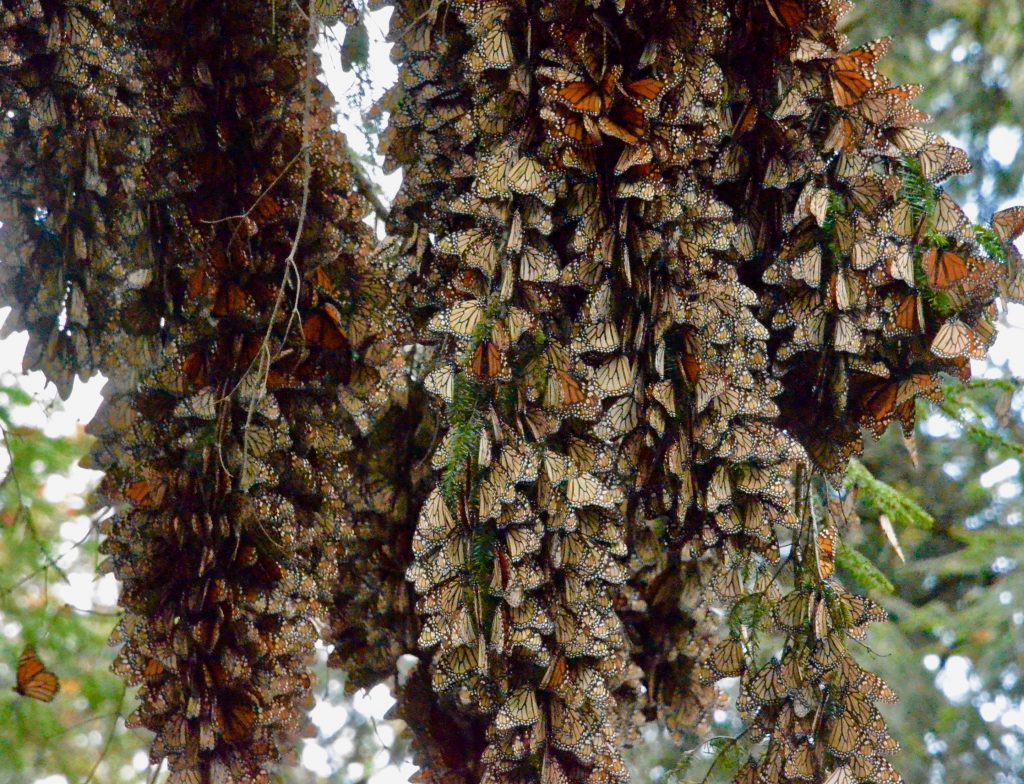
The location hosted what seemed to be a Monarch butterfly superhighway and fir trees laden with millions of the roosting creatures.   Occasional dead butterflies littered the forest floor.

Catalina Trail, then known as Cathy Aguado, in Cerro Pelon on January 2, 1975

Trail was first to the site at Cerro Pelón on January 2, 1975. Photo copyright Catalina Trail.

Trail was first to the site.   Brugger and their helper (you can see him behind Trail in the photo above) brought up the rear with food, water, and gear, including a camera that snapped the photographs reprinted in this story.

“I see them! I see them!” she yelled.

Two days later, they came upon Chincua and El Rosario.

“That second day, it snowed,” Trail remembered.  Brugger and Trail found five colonies on that trip and raced to Tuxpan to relay the news to Urquhart by phone.  Urquhart recalled the phone call in the story he wrote for National Geographic.  ”On the evening of January 9, 1975, Ken telephoned us from Mexico. ‘We have located the colony!’ he said, unable to control the excitement in his voice. ‘We have found them–millions of Monarchs–in evergreens beside a mountain clearing.’ ”

An entire year later, Fred and Nora Urquhart, and photographer Bianca Lavies joined Trail and Brugger in Mexico to visit the roosting sites. The fantastic photo of Trail graced the front of the magazine, her historic role in the discovery reduced to cover girl and a vague reference by Urquhart to a “bright and delightful Mexican, ‘Cathy.’”  The explosive story and dramatic photos inside rocked the world of lepidoptery.

Trail and Brugger returned to Michoacan in 1978 together for the last time.  ”I was almost sad that we had found them because everything was in such disarray in the first few years,” said Trail recently.  ”And there was a lot of controversy,” she said, referring to myriad disagreements about scientific credit-taking that followed.  The drama and disagreement explains why Trail dropped out of the Monarch story for decades. Halpern’s book, Four Wings and a Prayer, chronicles the saga.

Trail and Brugger, married for 18 years, separated in 1991.  Her desire to earn a formal education at Austin Community College seemed to unnerve her older husband and caused problems.   They eventually divorced, and in 1995 Trail married a fellow social worker, George Trail.  In 1996 Trail graduated with a degree in social work from the University of Texas at Austin.  Brugger died at age 80 and his grown son by Trail, whose privacy she chooses to protect, also lives in Austin.

Trail returned to the roosting sanctuaries in February for the first time in 34 years.  Canadian filmmakers invited her as their guest in the course of filming the documentary, Flight of the Butterflies.    ”During the trip from Mexico City Airport to El Rosario, federal and state police patrolled the roads and the sanctuary,”  she said, describing “mixed feelings of safety and dread, which surprised me as a native Mexican in Michoacan.”  Trail missed an opportunity to meet President Felipe Calderon who took part in the IMAX film, since her return to Austin was scheduled prior to his arrival at the Monarch sanctuaries.

For Trail, as for many of us, a fascination with Monarch butterflies is almost impossible to shake. She’d like to get involved in Monarch conservation again and plans to attend future meetings of the Austin Butterfly Forum.  Since she doesn’t spend much time on the computer, she doesn’t participate in the hyperactive online Monarch butterfly information exchange.  ”I’d rather look at the tassels of my corn and hope the pollen will fall down and pollinate,” she said.

Her journey to find the Mexican mountain home for Monarch butterflies, and her place in Monarch history, remain.   A few years ago, about 100 Monarchs roosted in her garden one fall evening.   It was a reunion of sorts.

“I had my own little colony, and I stayed up all night.”

Like what you’re reading?  Follow butterfly and native plant news at the Texas Butterfly Ranch. Sign up for email delivery in the righthand navigation bar of this page, like us on Facebook, or follow us on Twitter, @monikam.  You can also read our stuff on the Rivard Report.

Number of Monarch Butterflies Down as They Leave Michoacan and Head through Texas

The Monarch butterfly population status report was made public this week. Given last year’s perfect storm of bad conditions–late freeze, historic drought, raging wildfires–butterfly followers were expecting bad news.  It was.  Overall Monarch butterfly numbers were down 28%.

Monarch butterflies are leaving Michoacan and heading to....Texas!

Monarch butterflies are leaving Michoacan and heading to Texas.

The much anticipated document issued each spring by the World Wildlife Fund assesses the overall health of the migrating population by calculating the physical space they occupy in the Oyamel fir forests of Michoacan, Mexico.  This year, the millions of butterflies occupied a little more than seven acres.   The average is almost 18 acres.

Monarch Watch, a Monarch butterfly monitoring program based at the University of Kansas at Lawrence, put a positive spin on the findings, tagging the report “relatively good news,”  given dismal expectations.  ”Nevertheless, this represents another low population – one well below the long term average near seven hectares,” the citizen scientist and academic collaborative reported.

The report was issued especially late this year, on March 15, an act that aggravated scientists and left others wondering why it took so long.  ”The international scientific community is baffled why it  took so long for WWF and others to release the colony data for the current overwintering season,” wrote renown Monarch butterfly scientist Dr. Lincoln Brower in an email to the DPLEX list, a butterfly listserv followed avidly by

Monarch butterflies are on the move in Texas

Monarch butterflies are on the move in Texas

butterfly enthusiasts and scientists.  ”The long delay actually hampered research planning for important molecular studies by the scientific community.”   Brower challenged WWF officials on the reasons for the decline, suggesting that while crazy weather and habitat loss tied to herbicide tolerant crops are factors, illegal logging and “severe degradation of the Oyamel forest ecosystem has been and still is occurring.”

Interestingly, a spokesperson for PROFEPA, the equivalent of the Environmental Protection Agency in Mexico, said earlier this year that illegal logging at the roosting grounds had been contained to 3.7 acres.

The good news is that the butterflies have left their Mexican roosts and are coming our way. Reports from Twitter, Facebook and butterfly listservs detail FOS (first of season) sightings of the migrating butterflies flitting through Texas, laying eggs on native and tropical milkweed plants, delighting gardeners and butterfly fans.

Kip Kiphart, a volunteer for the Monarch Larvae Monitoring Project at Cibolo Nature Center in Boerne reported via email that he found 27 eggs on his native milkweed plants in Bergheim, Texas this week.  Others chimed in:   “Saw two in my  yard in southwest Austin,” said Helen Boudny Fremin. “We’ve had a couple in Marathon this past week,” reported Mathew York.  ”Pretty sure I saw a Monarch butterfly yesterday,” tweeted Mike Leggett, an outdoor writer in Austin. Those migrating Monarchs presumably will visit San Antonio’s local colony over at the Museum Reach Milkweed Patch for some mixed company nectar sipping.

Monarch butterflies have left Michoacan and been spotted all over Texas

Monarch butterflies have left Michoacan and been spotted all over Texas

Texas has been called the “most important state” to the Monarch butterfly migration because of its strategic location between the roosting grounds and the milkweed beds and nectar prairies that serve as hosts and food sources for the famous insects.   Millions of Monarchs pass through Texas each spring and fall as they make their multi-generation migratory flight from the Mexico to Canada and back.  Spring in Texas is a critical time for the Monarchs, as they seek out milkweed plants–their host, and the only plant on which they will lay eggs–to continue their multi generation migration north.

With our exceptional and well-timed South Texas rains this winter, the Monarchs will have plenty of wildflowers for nectar and milkweed  for reproducing. Time to plant more milkweed in our gardens to get the migration off to a good start.

Like what you’re reading?  Don’t miss a single post from the Texas Butterfly Ranch. Sign up for email delivery in the right navigation bar on this page, like us on Facebook, or follow us on Twitter, @monikam.

Mexican President Felipe Calderon Visits Monarch Butterfly Preserves in Michoacan

President Felipe Calderon of Mexico visited the Monarch butterfly preserves in Michoacan last week to film an IMAX film and call attention to the importance of the butterflies’ unique ancestral roosting spots to the sustainable economic development of the impoverished communities surrounding them.

Mexican President Felipe Calderon visits the Monarch butterfly sanctuaries in Michoacan

Mexican President Felipe Calderon visits the Monarch butterfly sanctuaries in Michoacan--photo by La Voz

Late February and early March are ideal for visiting the sanctuaries since rising temperatures warm up the butterflies and make them more active.

Unfortunately, tourism at the roosting areas, including visits from scientists who make such pilgrimages the basis for their life’s work, has fallen dramatically in recent years because of narco violence and instability in the region.   U.S.-based tour operators have pretty much ceased offering Monarch butterfly sanctuary tours because of potential liabilities.  (An exception:  Bill Toone’s EcoLife Foundation.)

Deforestation in Mexico is still a problem

Deforestation in Mexico is still a problem

The U.S. State Department advised Americans to avoid “non-essential travel” to 14 of Mexico’s 31 states in an amped-up  travel warning on February 8.   The warning came on the heels of a 15-ton meth seizure outside Guadalajara and expanded on previous advisories that has Mexican tourism authorities annoyed.

While informal reports of this years’ visitor count to El Rosario Sanctuary list slight increases ecotourism (up to 100,000 from 80,000 last year), the butterfly preserves need all the help they can get.  Fewer visitors means locals will have to seek other ways of earning a living, including illegal logging.  My husband and I braved Mexico last year to visit the sanctuaries and it was a memorable, monumental trip;  however, not sure I would do it again until the situation changes there.

It’s unfortunate, but travel in Mexico right now is just too potentially dangerous.  Driving through the Mexican provinces, once a common adventure for many Texans, now is fraught with risk, sometimes death.  Says the advisory:   “TCOs [Transnational Criminal Organizations] have erected their own unauthorized checkpoints, and killed or abducted motorists who have failed to stop at them. You should cooperate at all checkpoints.”   Doesn’t sound like much of a vacation.

The good news is that migrating Monarch butterflies are already on their way to Texas.   The active DPLEX list, a Monarch butterfly list-serv that charts the creatures’  every move, has reports of first-of-season sightings and egg-laying on South Texas milkweeds, which are emerging early this year because of our warm winter.

As the Spring Equinox approaches and the migrating insects leave Mexico, they’ll nectar up for their journey north,  head our way, and grace us with their joyous presence.    On March 15, the state-of-the-union report of the Monarch butterfly population for 2011-2012 will be released by Mexican authorities.   We’ll keep you posted.

Like what you’re reading?  Don’t miss a single post from the Texas Butterfly Ranch. Sign up for email delivery  on the right navigation bar of this page, like us on Facebook, or follow us on Twitter, @butterflybeat.


Occupy Michoacan: Monarch Butterflies Move West Because of Deforestation and Climate Change

Monarch butterflies seem to have taken a cue from our Wall Street protesters and moved to more friendly environs for the winter.  The migrating insects, numbering in the millions, have moved slightly west in their roosting sanctuaries, from Mexico state to Michoacan, says a report in El Diario Michoacan.

Monarch butterflies in Michoacan

Monarch butterflies in Michoacan

“It appears the butterfly now prefers the forests of Michoacan to those in Mexcio,” stated a dispatch on the website of the daily publication based in Uruapan, the municipal seat for Michoacan province.

The article quoted Oscar Contreras Contreras of the Monarch Butterfly Conservation Foundation (Funacomm) who said climate change and human activity such as illegal logging have been causing changes in the butterflies arrival and departures dates and population size for the past five years.

El Diario quoted another source who said that in the La Mesa sanctuary, in the town of  San José del Rincón, the butterflies only stayed for two months “because now the conditions for their hibernation and protection no longer exist.”

The butterflies typically occupy 12 sanctuaries that straddle the mountains of the Southern Sierra Madre and Transvolcanic Belt in the Mexican states of Michoacan and Mexico.  Their whereabouts change from year-to-year, and they move within and between the sanctuaries before taking flight in February and March to begin their migration north.

But this year seems different.

Monarch watchers are predicting a dreadful count, as a result of drought and wildfires in Texas, general habitat loss throughout the country and tough conditions in Mexico–environmentally and economically.  The budding ecotourism industry built around the migration has been stopped in its tracks by narco violence, which has caused many tour operators to cease organizing Monarch butterfly watching tours for fears of safety.  It would be no surprise that local Michoacanos might return to illegal logging as a way to feed their families and warm their homes.

We await official reports on this year’s population status, usually made available in February or March.   Like the Occupy Wall Streeters here in the U.S., there’s no question the butterflies will return this spring–but in what numbers?

Like what you’re reading?  Don’t miss a single post from the Texas Butterfly Ranch. Sign up for email delivery in the right navigation bar on this page, like us on Facebook, or follow us on Twitter, @butterflybeat.

Monarch Butterflies Arrive in Michoacan, Mexico, Just in Time for Thanksgiving

As we all sit down to feast and say thanks today, reassuring news arrives from our friends in Mexico:  the Monarch butterflies have arrived in Michoacan.

As this video by El Universal, a respected Mexico City daily, reports, butterflies began pouring in to the Oyamel forests surrounding Morelia  this week.   As reported earlier, the sanctuaries opened to the public on November 18.

Monarch Butterfly Sanctuary in Michoacan, Mexico

Monarch Butterfly Sanctuary in Michoacan, Mexico--photo by El Universal

Monarch butterfly scientists predict one of the smallest Monarch butterfly roosting populations in history this year because of the harsh conditions that prevailed in 2011:  a brutal freeze followed by a late Spring, historic drought and raging wildfires.

“Keep your fingers crossed that there are no winter storms in Mexico that could make matters worse,” wrote Dr. Chip Taylor in his annual state-of-the-Monarch-butterfly report on the Monarch Watch blog in September.

We’ll keep you posted on the status of the overwintering population as reports unfold, but in the meantime we can all say “gracias” to the fact that despite the challenges, the Monarch butterfly migration continues.  For now.

Like what you’re reading?  Don’t miss a single post from the Texas Butterfly Ranch. Sign up for email delivery in the right navigation bar on this page, like us on Facebook, or follow us on Twitter, @butterfly beat.

Accidental Massacre of Monarch Butterflies near Monterrey, Mexico Magnifies Challenges to their Migration

A deadly blast of Dengue fever insecticide sprayed on trees just outside Monterrey this week cut the migration short for several hundred Monarch butterflies.  The unfortunate massacre illustrates the challenges of balancing reasonable insect control and management with conservation efforts.

The report below by Gerardo Boruga of Info7, a news service of Azteca Noreste, shows hundreds of Monarch butterflies writhing in the street after a fumigation truck passed through the Santa Catarina neighborhood of Monterrey in Nuevo Leon province and sprayed their roost in an effort to control the spread of the sometimes fatal Dengue virus.

Hundreds of Monarch butterflies killed in Mexico

Hundreds of Monarch butterflies killed in Mexico

Dengue fever, caused by a virus carried by mosquitoes, continues creeping north from tropical climes to U.S. cities.   “The global resurgence of Dengue virus is a real issue,” Dr. Marty Cetron, director of the Center for Disease Control’s division of global migration and quarantine, told a Boston news service this week.

No cure for Dengue fever exists, but scientists continue work on a vaccine.

Monarch butterfly massacre in Santa Catarina, Mexico

Hundreds of Monarch butterflies were killed in Santa Catarina, Mexico, about 500 miles from their ancestral roosts in Angangueo, Michoacan

The primary management tools for controlling the spread of Dengue fever–insecticide use and habitat removal–also threaten the health of the Monarch butterfly migration. Gardeners know this quandary well.  Indiscriminate spraying of insecticides kills desirables as well as pests.

The Santa Catarina Monarch massacre serves as a sobering reminder of the complex aspects of conserving our beloved Monarch butterfly migration.  As we butterfly fans detail daily sightings of late season stragglers throughout the eastern United States on Facebook and on the D-PLEX*, let’s not forget the conservation challenge at hand.

Fumigation programs combat dangerous diseases, but the fallout can be a pile of dead butterflies.   Illegal logging at the Monarch roosts in Michoacan results largely from a lack of economic opportunity;  people must feed their familes and heat their homes in those remote Mexican mountains.   Some (not me) might cast the development of herbicide tolerant crops, a practice that has decimated native milkweed (the Monarch butterfly host plant) in our heartlands, as another economic development issue.

Education and coordination can make a big difference.  As reporter Boruga says in his report, the episode could have been avoided with a simple change in the fumigation schedule.  ”They’re only here for a night or two,” Boruga points out, suggesting a day or two delay in fumigating could have allowed the Monarchs to make it to Michoacan.

*The D-PLEX list, so-called for its namesake’s Latin designation, Danaus plexipus,  is an old fashioned email listserv started by Monarch Watch founder Chip Taylor of the University of Kansas at Lawrence.  The D-PLEX includes about 650 scientists, conservationists, enthusiasts, and others, including some very interesting characters.   Anybody can sign up to receive Dplex emails on the Monarch Watch webpage.

Hola Mariposa Monarca! Migration update: Monarch Butterflies Spotted in Saltillo and Monterrey, Mexico

Reports of Monarch butterflies this week are all over the map as they continue their migration south, but it appears they’re arriving in Mexico today.  A story in the Saltillo Herald trumpeted the news, describing the Saltillo sky as “painted orange and

Hola Mariposa monarca in Juarez, Mexico

Hola Mariposa monarca! Photo taken in Juarez, Mexico by Paulina Marquez via Twitpic

black.” Sources at the roosting sanctuaries say the Monarchs have not arrived yet. Officials at the largest sanctuary, Zitacuaro’s El Rosario, announced last week  the preserve will open to visitors on November 12. 

A quick check of Twitter search has Monarchs spotted in Monterrey and Saltillo, Mexico, including the photo above snapped by Paulina Marquez of Juarez and sent via Twitpic. With a cold front blowing winds of 30 mph through Texas and knocking temperatures down into the 40s this evening, our neighbors to the South should see a blast of Monarch butterflies over the next few days.

Twitter: Monarch butterflies arrive in MexicoHere’s several translated tweets:

“Wow, impressive the quantity of Monarch butterflies crossing here.” –Veronica Sanchez, Monterrey.

Is it Monarch butterfly season or something?  There’s so many in the UDEM (University of Monterrey).”–Lillian Martinez, Monterrey.

“Just like every year, the Monarch butterfly honors us with their presence in Saltillo.  We appreciate their beauty and please, don’t harm them.”–Edgar Martinez, Saltillo, Coahuila.

Twitter’s realtime search has helped citizens worldwide track the Arab spring and news like the death of Osama bin Laden.  It makes perfect sense that citizen scientists would use the new media tool to track the Monarch migration.

To track the migration in realtime, try these two Twitter searches:

1. Mariposa monarca (in Spanish)

2. Monarch butterfly migration (in English)

Wildfires in Mexico Contribute to Growing List of Threats to Monarch Butterfly Migration

After our visit to the Monarch butterfly sanctuaries in Michoacan this spring we’ve been monitoring conditions there from afar.   The news has not been good.

A Google search of “mariposa monarca” the Spanish translation for Monarch butterfly, returns disturbing headlines.

Wildfires in Michoacan

Wildfires in Mexico: bad news for Monarch butterflies--photo, El Cambio de Michoacan

“Monarch Zone in Danger,” was the headline June 5 in El Cambio of Michoacan.    The article describes how a wildfire at Zitacuaro’s Cerro Cacique, not far from the Monarch’s ancestral roosting sanctuaries and the town in which we stayed during our recent visit, was finally extinguished after three days.  The writer suggests a connection between overzealous logging in the area and the hyperactive wildfire season in Mexico this year.

Other articles address the effects of fires-gone-wild in Michoacan:

A June 16 dispatch from Primer Plano, an online publication also in Zitacuaro, bemoaned the “irrational exploitation of our natural resources” claiming that it will take almost one billion pesos to restore the destruction of the forests that host millions of Monarchs each fall.   Illegal logging, climate change, and now raging wildfires throughout the region complicate the challenges of preserving the unique ecosystem the butterflies consider their home.

And on June 10, El Sol de Morelia, reported from a forestry conference held there.  Thanks to logging and wildfires more than 80,000 acres of forest and 12,000 acres of jungle have been lost in the last 30 years–JUST in Michoacán.  The story was illustrated by a color photo of an enormous, fallen tree on the roadside, the apparent victim of a new road.

“This equates to a level of deforestation between .47 and .65 percent–high in comparison with other areas of the country,” wrote reporter Silvia Hernández González.

The news is painful for Monarch butterflies, those of us enchanted by them and our Mexican neighbors.  Nonprofit organizations and the Mexican government have spent millions of dollars building a viable ecotourism economy in recent years.   Drug violence in Mexico has kept tourists away, and nature has colluded to paint a dreary forecast for the Monarch migration this year and beyond.  The unique and irreplaceable ecosystem that hosts millions of Monarchs each year is literally under fire.

The fall migration will tell more of the story, but it seems likely we’ll have a repeat of the dreary 2009 season.