IMAX Film on Monarch Butterfly Migration may be as Good as it Gets for Seeing Migrating Monarchs This Year

A new 3D IMAX film, “Flight of the Butterflies,” may provide the best chance this butterfly season to capture the magic of the Monarch butterfly migration, as many Monarch butterfly followers are bracing for what may be the worst on year on record for Monarch numbers.

The 3D IMAX film, “Flight of the Butterflies” depicts the magical story of the Monarch butterfly migration. 

Peak migration for our latitude should be October 2 – 16, according to Monarch Watch.  So far, Monarch sitings in Texas have been far below average.

Monarch butterflies roosting in Canada

Monarch butterflies roosting in Canada last week. They’re on their way here.     Photo by Journey North

Last year’s drought set the stage for a small population (the smallest since records have been kept).  Crazy weather, spikes in temperature that confused host plant growth cycles, drought, wildfire and even massive aerial insecticide sprays aimed at West Nile virus-carrying mosquitoes in the strategic North Texas migration flyway — all have conspired to make it a tough year for Monarch butterflies.   Dr. Chip Taylor, founder of Monarch Watch, labeled 2012 a year “like no other” in his annual state-of-the-Monarch-migration blogpost.

Catalina Trail, January 2, 1975, the day she and Ken Brugger "discovered" the Monarch butterfly Overwintering Sites

Catalina Trail, January 2, 1975, the day she and Ken Brugger “discovered” the Monarch butterfly overwintering sites.     Photo copyright Catalina Trail

When the Monarch butterfly puzzle was finally pieced together in 1975 after more than 40 years of research, things were different. Catalina Trail and her partner Kenneth Brugger walked into the remote Oyamel tree forest in the Mexican state of Michoacan on January 2 of that year, and massive numbers of Monarch butterflies crowded the trees, like overlaid clusters of grapes. “I suspect the early colonies may have collectively contained a billion in some years,” said Dr. Lincoln Brower, renowned Monarch butterfly scientist.

Today, their numbers are less than half that. In 1975, threats to the migration were less severe than today–the fir forests where the butterflies roost were largely intact, genetically modified organisms were the fantasies of science fiction writers, and theories on climate change were just warming up.

“Back then, it appeared that those places were so isolated, they were pretty much left alone,” said Trail, from her home in Austin recently. “You didn’t see the big operations with big trucks, taking away huge fir trees,” she said of the illegal logging that has only recently come to a halt thanks to efforts by the World Wildlife Foundation and partnerships between the Mexican and U.S. governments.  Read the full story of Catalina Trail and the “discovery” here.  (Quotation marks are deliberate, since native people knew of the overwintering sites for centuries before Westerners pieced the migration puzzle together.)

Trail, the only living member of the crew who found the roosting sites and made them known to the world, now lives a quiet life in South Austin.  She just returned from a screening of “Flight of the Butterflies,” a 3D film produced by Canadian filmmakers SK Films, that debuted in Washington, DC last week.

The IMAX movie, Flight of the Butterflies, was released last week, and chronicles the "discovery" of the Monarch butterfly roosting spot.

The IMAX movie, “Flight of the Butterflies,” was released last week, and chronicles the “discovery” of the Monarch butterfly roosting spot.  Photo courtesy SK Films.

The 3D film chronicles the natural history saga, which includes the tenacious Dr. Fred Urquardt, Brugger, an eccentric American expatriate, and  Trail, a spirited young woman.  ”Flight of the Butterflies” is being released in IMAX theaters nationwide this month and will screen in Houston October 5 and Galveston in March, according to Eddie Ward, SK Films spokesman.  No San Antonio or Austin screenings are scheduled yet, he said.

“I absolutely loved it–in 3D it was like you could almost reach out and touch them.  Very inspiring,” said Trail. “They did a very high tech rendition of the pupae transformation and metamorphosis via Cat Scan–that was really exciting and beautiful to see.”  Dr. Brower, who also attended the Washington debut at the Smithsonian Institute, called the film “beautiful….the 3D shots of overwintering are superb.”  He called the story, “a fine narrative and emotionally appealing,” adding, “the conservation issues were weakly presented.”

San Antonio’s Milkweed  Patch on the Museum Reach, the riparian restoration of the San Antonio River Mission Reach, and the San Antonio Botanical Garden (SABOT) are all great vantage points for observing the storied insects in the coming weeks. SABOT horticulturist Amanda Wielgosh reported seeing six Monarchs on Tuesday.

In Austin, butterfly watching hotspots include Zilker Butterfly Trail, the Barton Creek Greenbelt, and of course, Lady Bird Johnson Wildflower Center in SW Austin.   For more on Austin butterfly viewing, see our entomologist friend Mike Quinn’s website.

We look forward to viewing the film, and to welcoming the Monarchs as they arrive.  Until then, keep an eye out for early Monarch migrants, and enjoy the trailer teaser at the top of this post until the movie shows up here.

Like what you’re reading?  Follow butterfly and native plant news at the Texas Butterfly Ranch. Sign up for email delivery in the righthand navigation bar of this page, like us on Facebook, or follow us on Twitter, @monikam.  You can also read our stuff on the Rivard Report.

Butterfly FAQ: How to Tag A Monarch Butterfly in Six Easy Steps

One of the most common questions we get at the Texas Butterfly Ranch is how the heck do you tag a Monarch butterfly?

Ready to tag some butterflies?

Ready to tag some butterflies?

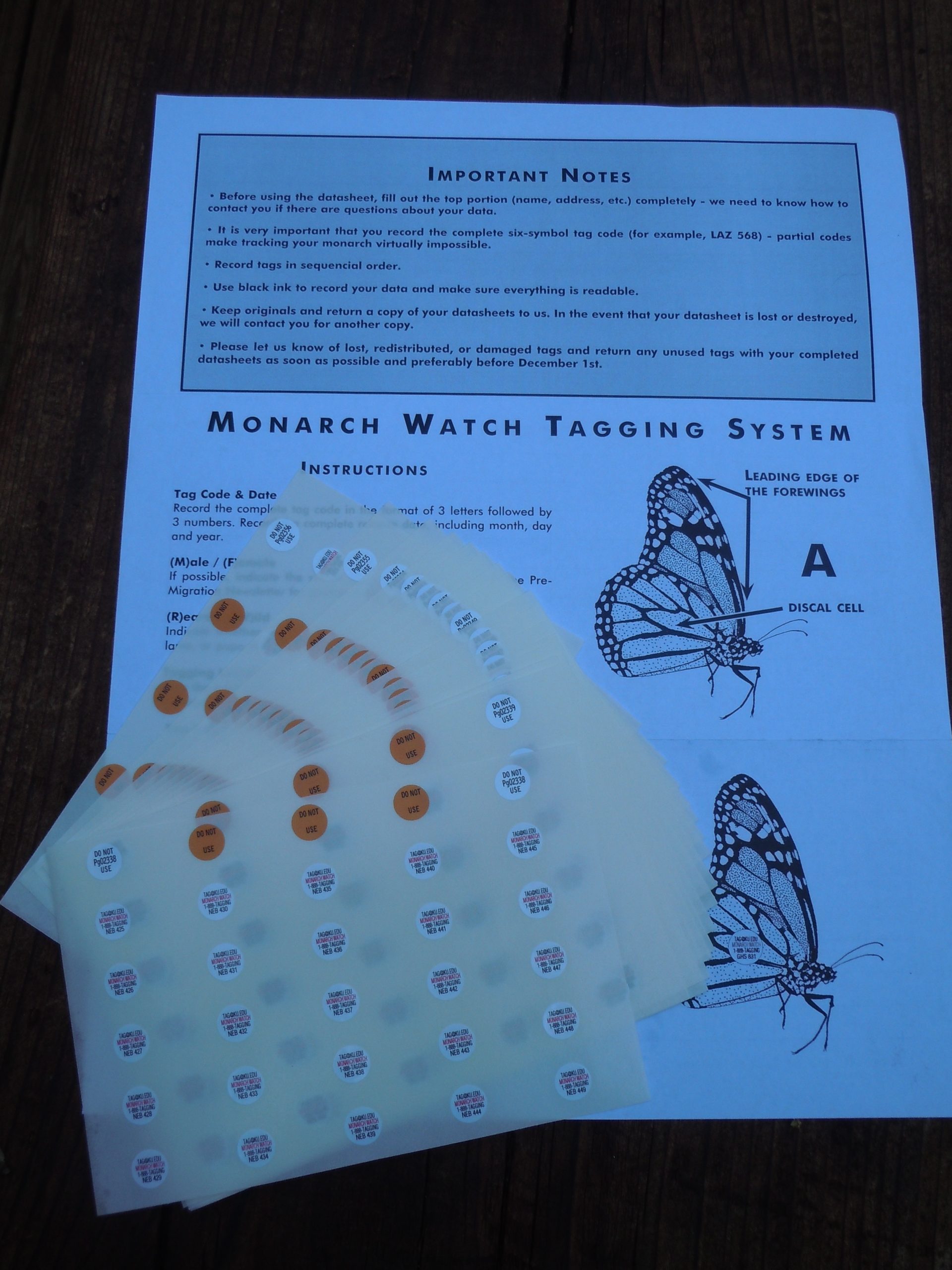
It’s pretty straightforward, really.  You’ll need a butterfly net, a clipboard or mini notebook and a writing utensil to record your findings.   You’ll also need tags issued by Monarch Watch ($15 for 25 tags).    I recommend a hat and camera, too.

Before you go, apply sunscreen or insect spray if you use them, then wash your hands thoroughly.   Monarchs and other butterflies are more resilient than we think, however, Deet, Paba  and other chemical contact with their scales, wings and bodies should be avoided.  There’s no need to sterilize your hands or wear gloves.  Just wash your hands.

Monarch Watch tags and data sheets

You’ll need Monarch Watch tags and data sheets to tag Monarch butterflies. And a butterfly net.

When should you go tagging?  I like late mornings after my second cup of coffee.   By then, the butterflies have had a chance to warm up their bodies and are out flying and nectaring.  Remember, butterflies won’t fly if the temperature is less than 60 degrees, so late mornings and afternoons on sunny days are ideal.   Right before sunset is good, too, especially when they’re migrating.  In the Hill Country in October, masses of Monarch butterflies will often drop from the sky around dusk and look for roosting spots—usually in protected tree limbs and often near water sources.

Ready for some tagging?  Here’s how to do it.

  1. Locate butterfly

Millions of migrating Monarch butterflies will pass through the “Texas funnel” on their way to their ancestral roosts in Michoacan, Mexico, over the coming weeks and months.    According to Monarch Watch, peak migration for San Antonio and Austin will be October 2 – 22.

Frostweed is a fall favorite nectar source for Monarch butterflies.

Frostweed is a fall favorite nectar source for Monarch butterflies.

Typically, we see a first pulse of vanguard Monarchs around Labor Day in the Hill Country and in our San Antonio and Austin gardens.  In September we’ll consistently see individual Monarchs trickling through town.  By October, groups will show up and form evening roosts in trees and large bushes like Poverty Weed along our rivers and other protected locations.

The best places to see them are along our streams and rivers where late season blooms offer a nectar rich rest stop.  Monarchs fuel up on their journey south, so anywhere with late season butterfly-friendly flowers—native and Tropical milkweeds, Gregg’s Purple mistflower, Cowpen daisies, Frostweed, Goldenrod, lantana, for example—should draw them, as well as other butterflies.

Your own garden, if it has butterfly-friendly flowers blooming, should draw Monarch butterflies.  Look, observe, wait.   And be patient.  For some prime Monarch butterfly spotting, stop by the Milkweed Patch along the Museum Reach of the San Antonio River this fall.

2.  Net butterfly

Netting a Monarch butterfly—or any butterfly for that matter—is more challenging than it looks. The flitting creatures exhibit extreme skittishness and their compound eyes afford them a 360-degree field of vision. The slightest movement can send them sailing.

When I first started tagging Monarchs, I diligently chased them in flight. After slipping in the river more than once and skinning my knee after tripping down the steps at my house while in hot pursuit, I resolved to only try and net Monarchs when they’re roosting or nectaring. I’ve witnessed several ace netters with excellent hand-eye coordination, quick reflexes, and a sniper’s aim nab butterflies in flight, but I’m not among them.

Monarch nectaring on swamp milkweed

It’s easier to net Monarch butterflies when they’re nectaring. Sneak up on them from behind.

Suggestions:  wear low-key clothing that blends into the environment, move slowly, keep quiet and sneak up on them from behind.  Once you swing your net, the butterflies will scatter.  It resembles fishing in that sense;  when you cast your line, the fish get spooked and flee, but they’ll be back. After a few minutes, the butterflies will resume their activities—nectaring, resting or roosting.  Or they may fly out of your reach.

Once you get a butterfly in your net, be sure to flip the net sock over the circle of the rim—otherwise the clever insects can slip out.   With the net sock folded over the net structure, they will remain in your net.

Annie Schenzel demonstrates proper net technique

Annie Schenzel demonstrates proper net technique. See how the net sock is draped over the rim? No butterflies can escape.

Some folks take the net down to the ground after they swoop the butterfly into the net to ensure the butterfly doesn’t escape.   This is especially helpful when you capture many at once.

3. Collect butterfly/butterflies from net

Once the butterfly or butterflies are in the net, gently reach in and clasp an individual in your cupped hand, wings folded together if possible.  (No insecticides or sunscreen on your hands, please.)  The butterflies will flail around in the net, so try to calm them by folding their wings closed and gently pressing the net fabric on them. Also, try holding the butterfly upside down;  it seems to calm them.

Keep the net closed so that other butterflies don’t fly out as you remove the one in your grasp, then pull out your catch and take a look.

Tracy Hamilton shows how to retrieve a Monarch from the net.

Tracy Hamilton shows how to retrieve a Monarch from the net.

4.  Examine butterfly, establish its sex.

This is when you examine the butterfly to determine its sex.   Open the wings gently and look for the two pheromone sacs on the lower half of the butterfly’s wings.  If you see two black dots, it’s a male.  If not, it’s a female.   Also note the state of the butterfly—is it

Male Monarch Butterfly

Male Monarch Butterfly: it’s a boy! See the two black dots on the veins of his lower wings? Those are pheromone sacks–supposedly they drive the lady butterflies CRAZY.

weathered and raggedy, or fresh and healthy?  If the butterfly is extremely worn out and highly unlikely to make it to Mexico, refrain from tagging it.  Let the poor creature fly off.  Note the info on your data sheet or notebook, as well as the tag number.

Raggedy Monarch butterfly

Raggedy Monarch butterfly. I don’t tag beat-up butterflies like this. Doubtful she’ll make it to Mexico. Plus, don’t want to waste tags.

5.  Remove tag from sheet and adhere to butterfly

Holding the butterfly between two fingers with wings closed with one hand, remove a Monarch Watch sticker from the tag sheet.  I like to use my thumbnail and get them on the tip of my nail so they’re easy to slip onto the discal cell of the butterfly’s wing. Some

Use your thumbnail to lift tag from sheet and transfer to butterfly.

Use your thumbnail to lift tag from sheet and transfer to butterfly.

people prefer a toothpick to lift the tag off the sheet. Try not to handle the adhesive too much, as it won’t stick to the butterfly’s wing as well if it has oil from your fingers on it.

Place the tag on the discal cell, as illustrated in the tagging sheet sent to you by Monarch Watch.  Press gently, but firmly.  Congratulations!  You’ve tagged a Monarch butterfly.

Press the tag onto the discal cell in the middle of the lower wing, as shown.

Press the tag onto the discal cell in the middle of the lower wing, as shown.

Make sure you’ve noted the tag number, butterfly’s sex, any other useful data, on your data sheet or notebook.

6.  Release

Open your grasp and let the butterfly go.  If you’re so inclined, send her off with a kiss and best wishes for safe travels to Mexico.

Off she goes!

Off she goes!

After the Monarch migration season, send all your data to Monarch Watch by December 1 so it can be entered into the online tag recovery database.   In the spring, you can check  to see if any of your Monarchs were recovered in Mexico.

Monarch butterfly recoveries

Of about 1800 Monarchs tagged, we’ve had 24 recoveries in Mexico.

Good luck with your tagging.  Please let us know how it goes.

Like what you’re reading?  Follow butterfly and native plant news at the Texas Butterfly Ranch. Sign up for email delivery in the righthand navigation bar of this page, like us on Facebook, or follow us on Twitter, @monikam.  You can also read our stuff on the Rivard Report.

Alamo, Texas, a Great Base for South Texas Sojourn of Bugs, Butterflies and Birds

For a fun outdoor getaway filled with butterflies and birds, look no further than Alamo, Texas. No, not The Alamo.  Alamo, Texas.

Empress Louisa butterflies at the Alamo B & B Inn

Empress Louisa butterflies at the Alamo B & B Inn

The small town in Hidalgo County may seem like an unworthy stop on the drive to South Padre Island with its strip malls and fast food joints dotting the highway.   But the former headquarters of the Alamo Sugar and Land Company sits in the center of the Rio Grande Valley and makes a perfect base for exploring the bird and butterfly hotspots of South Texas.

A Fourth of July trip took Bob and me to the National Butterfly Center, the Global Birding Center and the Santa Ana National Wildlife Refuge in a 48-hour off-season nature sojourn that made us want to rebook in the “high season” of October or March.

We stayed at the Alamo Inn B & B, a historic naturalists’ retreat just five miles from the fabulous Santa Ana Wildlife Refuge.  Our new friend Ro Wauer, butterfly guidebook author extraordinaire, who we met at the Wings Over the Hills Festival in Fredericksburg this spring, recommended it highly.  And despite the historic part of the hotel being closed for the off-season, Proprietor Keith Hackland made us feel welcome with his profound hospitality, charming South African accent, and dog friendly accommodations in adjacent studio apartments (Cost:  $78 per night).  Our dog Cocoa made friends with Hackland’s sweet pooch Henry, and roamed a huge, fenced yard.

Hackland offered hefty 20-page handouts of bird species we were likely to see upon check-in, retrieved from his well-stocked outdoor store which was also closed for the off-season.  Alas, we’re not serious birders and I’m a novice (but extremely enthusiastic) lepidopterist, more interested in the whole life cycles of plants, creatures and ecosystems than checking species off a life-list.  Yet the pages and pages of species had me intrigued:  were there really 500 species of birds and at least 200 different butterflies cruising the area around our hotel?  Apparently so.

Termite hatch left bug detritus everywhere

Termite hatch left bug detritus everywhere

We arrived Sunday afternoon and planned a late morning visit to the National Butterfly Center.   (One of the best things about chasing butterflies is that they don’t get up early.) As we sat on our front porch Sunday evening and watched buff-bellied hummingbirds nectar on Turk’s Cap, a thunderstorm blew in, dropping a quarter-inch of rain on the Alamo Inn’s garden.

Ten minutes later, a torrent of flying creatures filled the air–a massive hatch like we had never witnessed.  I thought at first they were Mayflies, but Hackland nabbed one with one hand and provided a positive I.D.: termites. “This happens pretty regularly after it’s been dry,” he said.

Empress Louisa butterflies at the National Butterfly Center

Empress Louisa butterflies at the National Butterfly Center

The next day, Empress Louisa, Asterocampa louisa, butterflies filled the air at the National Butterfly Center.  They fluttered along the pathways, nectared on lantana, and rested on miniature log roosts assembled by the Center.    This video provides a great overview.

The 100-acre park, opened in 2004, is a project of the North American Butterfly Association, which planted hundreds of host plants to draw butterflies from all corners of the Valley and northern Mexico.  More than 200 species have been identified along the Center’s trails.

Lake Flato's World Birding Center Headquarters in Mission, Texas

World Birding Center Headquarters in Mission, Texas, photo courtesy Lake|Flato Architects

Ambling the park-like grounds last week, we saw Queens, Sulphers, Whites, Swallowtails, Zebra Longwings, unusual hairstreaks and brush foots.  We had the place to ourselves, and enjoyed the solitude in spite of a muggy heat.  Tip:  be sure to bring your own snacks and drinks as the Butterfly Center offers no refreshments.  According to office manager Flora Vela, the Center had contracted with a restaurant to open a cafe on the premises earlier in  its history, but the deal fell through.

At the Santa Ana Wildlife Refuge in the Rio Grande Valley

At the Santa Ana Wildlife Refuge in the Rio Grande Valley

Next stop: the World Birding Center ecotourism headquarters, built by San Antonio’s  AIA Firm of the Year, Lake|Flato Architects.  The award-winning building anchors nine birding destinations that dot the Valley and draw thousands of ecotourists each winter.  Unfortunately our trip here was cut short by another downpour.  A lovely Black Witch Moth kept us company under the eaves of the magnificent galvanized metal quonset-hut style patio. As a drumbeat of raindrops pounded on the tin roof, we were able to observe the rainwater collection system in action.  It felt like the tropics.

Canopy Walk, feels like the jungle at Santa Ana Wildlife Refuge

Bob Rivard on the Canopy Walk at Santa Ana National Wildlife Refuge

At the Santa Ana National Wildlife Refuge, some of the wetlands were dry, but those back-to-back thunderstorms created a steamy, fertile backdrop for a hike.  We hoped to spot the Valley’s signature Green Jay, and helpful attendants at the front desk offered to spread birdseed in the feeding area to increase our chances.

No luck, but Kiskadees, Golden-fronted Woodpeckers, and other flying creatures kept our walk interesting and the screaming cicada chorus and tropical bird sounds provided an apt soundtrack as we traversed the Canopy Walk and climbed the Tree Tower.

An off-season visit has the advantage of  no crowds, but we’re already planning our high season return.

Like what you’re reading?  Follow butterfly and native plant news at the Texas Butterfly Ranch. Sign up for email delivery in the righthand navigation bar of this page, like us on Facebook, or follow us on Twitter, @monikam.  You can also read our stuff on the Rivard Report.

American Snout Butterflies Inundate South Texas–enroute to San Antonio, Austin?

Butterfly listservs were all aflutter this week with news of butterflies inundating South Texas.  The American Snout butterflyLibytheana carinenta, arrived en masse in Brownsville and McAllen this week, firing up Facebook, Twitter and email lists with tales of snout butterfly overload.  ”American snout butterflies swarm into the Valley,” reported the Brownsville Herald this morning.

American Snout Butterfly, photo via wikipedia

American Snout Butterfly, photo via wikipedia

“Clouds of those butterflies,” Carina A. Wyant Brunson posted on Facebook from McAllen, Texas.  ”It’s hard to walk without bumping into one.”

Dalia R. Salinas of Brownsville relayed that she was sitting outside with her granddaughter “when all of a sudden a swarm of butterflies flew right in front of us. It was amazing, and to see my granddaughter’s face light with amazement was so delightful.”

We had an American snout outbreak in San Antonio in the summer of 2006. The migrating masses clogged car grills, gummed up windshields, and massed on local asters, dogwood, goldenrod and anything else bearing nectar.  There’s a good chance they’re coming our way again soon.

The mottled grey insects disguise themselves as dead leaves when their wings are closed.  In an open-winged pose, they flaunt orange, black and white accents.   They lay their eggs on hackberry trees, a drought-tolerant native considered a trash shrub by some.   But the hackberry is actually a fantastic wildlife plant.  Its leaves provide food for

Hackberry tree

Hackberry, beloved by the American Snout butterfly, photo via Texas A&M

Snout caterpillars and its berries offer important winter sustenance for birds.  The large numbers of migrating Snout butterflies can completely defoliate a hackberry tree, but  ”It’s nothing to worry about,” said Michael Nentwich, Forester for the City of San Antonio.   “The trees will recover.  These are seasonal things that happen.”

This year’s weather pattern has lent itself to a butterfly boom, as we’ve written before.   And with temperatures rising earlier in the year, it makes sense the Snouts are arriving in June, rather than August, as they did last time.

In the annals of American Snout butterfly migrations, 1921 ranks as a most remarkable year.

I brake for butterflies via zazzle.com

After a world record downpour in Central Texas on September 9-10, 1921, when 36.4 inches of rain fell in an 18-hour period, a Snout butterfly breakout resulted a few weeks later.   “An estimated 25 million per minute southeasterly-bound snout butterflies passed over a 250 mile front from San Marcos to the Rio Grande River,” according to Austin entomologist Mike Quinn’s website Texas Entomology, a trusted and entertaining  source for Texas insect news and info.  Scientists noted at the time that the butterflies’ flight “lasted 18 days and may have involved more that 6 billion butterflies.”

Wow.  So no complaining if a few of the migrating insects get hung up in your car grill.  And remember to brake for the butterflies.

Banner Butterfly Year Caused by “Ecological Release” in Texas, says Monarch Watch Founder Dr. Chip Taylor

Texas has been called the “most important state” to the Monarch butterfly migration by Monarch Watch founder Chip Taylor.   Now our Lone Star State is getting attention for spawning an “ecological release” that has resulted in a butterfly “season like no other,”  Taylor told the Hornell Evening Tribune in New York.

Banner year for butterflies, thank you, Texas!

Banner year for butterflies. Thank you, Texas!

“This year continues to amaze,” Dr. Taylor wrote to the DPLEX email list, well-read by hundreds of academics, enthusiasts and others who follow the Monarch butterfly migration.   Taylor detailed ample and early sightings of Monarchs, Sulphurs, Red Admirals, Buckeyes and other species to the Midwest.   Watch the video above for examples.

Taylor and others attribute the 2012 banner butterfly year to a perfect storm of circumstances in Texas, including:

  •  An historic drought which killed butterfly and caterpillar predators, notably fire ants, followed by
  • Generous, well-timed rains, a mild winter that caused host and nectar plants to flourish, and caterpillars and butterflies to thrive.

Eventually, host plant and nectar populations will drop back to normal, as will this year’s butterfly explosion.

In the meantime, enjoy the show.

Like what you’re reading?  Follow butterfly and native plant news at the Texas Butterfly Ranch. Sign up for email delivery in the righthand navigation bar of this page, like us on Facebook, or follow us on Twitter, @monikam. 

Want to Meet the Beetles? Better Hurry, Removal of Milkweed Beetles from San Antonio River’s Milkweed Patch Imminent

An invasion of red-and-black milkweed beetles have made a temporary eyesore of the San Antonio River’s celebrated Milkweed Patch on the Museum Reach.  The striking insects, whose colorful torsos suggest the patterns of a tiki mask, have moved into the 1200-square foot Tropical milkweed garden on the banks of the San Antonio River just south of the Pearl Brewery  in a classic play of nature’s cycles.

Milkweed Beetles have taken over the Milkweed Patch

Milkweed Beetles have taken over the Milkweed Patch

The beetles, which look like ladybugs on steroids, don’t bite, sting or carry diseases. They do, however, defoliate milkweed plants, and have left the highly trafficked stretch of the River with some unattractive bald spots.

Migrating Monarch butterflies moved through town earlier this spring, laying the first generation of eggs in their annual migration at the Milkweed Patch.  The resulting acrobatic caterpillars occupied the Patch, feasting on milkweed leaves, the Monarch butterfly host plant.  Late straggling Monarchs continue to mingle with our local colony but the pervasive milkweed beetle, Labidomera clivicollis, dominates.

Milkweed Patch going bald thanks to milkweed beetles

Milkweed Patch going bald thanks to milkweed beetles

Volunteers for the Monarch Larvae Monitoring Project (MLMP), a citizen scientist program based at the University of Minnesota and which aims to better understand the Monarch life cycle and migration, have noticed fewer Monarch caterpillars and chrysalises during their weekly observations as beetles consume the milkweed leaves.

Discussions ensued about possibly pruning the milkweeds, which typically die back in winters when a hard freeze occurs.   That didn’t happen this year.  But San Antonio River Authority staff determined a better approach would be to hand-remove the beetles, THEN prune the plants.

Milkweed beetles have defoliated the Milkweed Patch. But aren't they cute?

Milkweed beetles have defoliated the Milkweed Patch. But aren't they cute?

“We believe this to be a holistic management approach with minimal negative impact to the environment that is consistent with our commitment to the local community for the project, ” said Steven Schauer, Manager of External Communications at the San Antonio River Authority (SARA), which oversees maintenance of the area.   The Museum Reach stretch of the San Antonio River was designed as a manicured, urban park setting, unlike the Mission Reach section, which is managed as a native riparian restoration.

SARA deserves praise for working with MLMP  volunteers and resisting the use of pesticides to address the problem.   A round of pesticides would quickly rid the area of

Gulf Fritillary

Gulf Fritillary, photo courtesy NABA.org

beetles (and other plant pests) and would also jeopardize the Monarchs’ and other butterflies’ continued colonization of the River.  Just north of the Milkweed Patch is a huge Passionflower planting, where Gulf Fritillary butterflies have made their home and are breeding.

If you’d like to “meet the beetles,”  better do so in the next few days.  The critters will be less visible once the hand removal is accomplished.

Like what you’re reading?  Follow butterfly and native plant news at the Texas Butterfly Ranch. Sign up for email delivery in the righthand navigation bar of this page, like us on Facebook, or follow us on Twitter, @monikam. 

Wings Over the Hills Nature Festival in Fredericksburg to Celebrate Butterflies, Bats and Birds this Weekend

Fredericksburg’s Wings Over the Hills Nature Festival takes place this weekend and brings a welcome respite from San Antonio’s 10-days of Fiesta.  Just a one-hour, wildflower-loaded drive from San Antonio or Austin, the event celebrates the unique winged wildlife of the Texas Hill Country.

The festival provides 72 hours of nature-oriented education and entertainment.   Guided nature walks, butterfly, birding and bat presentations, a raptor display, and a Star Party on Saturday night at a remote ranch that brags a 360-degree skyscape unsullied by light pollution, fill the three-day schedule.

I can’t wait.   Even though I’ll be presenting two talks on Monarch butterflies, I plan to grab a seat at award-winning nature photographer Rolf Nussbaumer‘s nature

Monarch buttefly on hummingbird feeder

I'll be talking about Monarch butterflies at the Wings Over the Hills Festival this weekend.

photography class, Ro Wauer‘s overview of Hill Country butterflies, Diane Oegard’s talk on bats, and James Laswell‘s presentation on dragonflies.  Early Saturday and Sunday mornings, birding, butterflying and dragonfly “chases” take place, guided tours held at Ladybird Johnson Park and other outdoor venues.

On Friday at 6 PM,  Master Falconer John Karger of Last Chance Forever, Birds of Prey will do his raptor show at the Fredericksburg High School Auditorium.   Karger helped me celebrate my birthday a couple of years ago by releasing two Coopers Hawks at our

John Karger, Last Chance Forever

John Karger, Last Chance Forever

place on the Llano River.   The raptors had tangled with an electrical line and were injured, unable to fly until Karger’s organization nursed them back to health.  I’ll never forget them perching momentarily on my leather-gloved forearm before they took flight.  Now whenever I see Coopers Hawks soaring over our stretch of the river, I assume they are my birthday raptors.

Karger’s work is laudable and his show starring rehabilitated owls, falcons, hawks, vultures and eagles unforgettable.

The Star Party on Saturday night, 9 PM, should be spectacular.  Anyone who has ever visited the McDonald Observatory’s weekend Star Parties in West Texas can attest to the majesty of a completely dark sky twinkling with millions of stars you’ve only seen in photographs.   Shooting stars are practically routine in such circumstances, so if you attend, bring your wish list and make a wish.

Members of the Fredericksburg Astronomy Club will be on hand with telescopes,  orientation talks and explanations of the constellations and satellites.  It should be a great time to see Venus, which is staging its last transit for more than a century before crossing the face of the sun on June 6. According to the stargazing website Stardate,   Venus will be at its most brilliant this weekend, “shining 20 times brighter than the brightest true star in the night sky.”

Organizers have done an excellent job breaking up the programs, field trips and events so visitors can partake at their own pace, picking and choosing all or some of the offerings.  A weekend pass goes for $40 and provides entry into many events;  day passes $15.  Star Party, raptor show, motor coach tours and photo class are separate, and some don’t require a festival pass at all.   For details, see the Wings Over the Hills website.

Austin’s Insecta Fiesta to Host World’s Largest Katydid and Butterfly Flyhouse with 500 Butterflies

Rotten bananas and grape Gatorade for feeding the butterflies?  Check.  Largest Katydid in the world for the insect petting zoo?  Delivered safe and sound.  Cockroach tractor pull assembled and swept?  Done.  Oh, and frozen crickets for the cricket spitting contest?  Almost time to time to thaw them out.

Assembling an Earth Day weekend celebration for the First Annual Insecta Fiesta in Austin has required  thousands of volunteer hours by more than 140 staff and volunteers. Yet final preparations for the daylong celebration of the most diverse species on the planet are almost complete.  The event takes place this Saturday, April 21, 11 AM -4 PM at the Brackenridge Field Labs,  3001 Lake Austin Boulevard.  It’s FREE.

Katydid or Katydidn't?  Insecta Fiesta to feature largest katydid in the world

Katydid or Katydidn't? Insecta Fiesta to feature largest katydid in the world --photo by Challiyil Eswaramangalath Vipin from Chalakudy, India via Wikimedia Commons

The inaugural bug fest, organized by The Texas Natural Science Center in Austin, will celebrate insects and anticipates a large crowd this Saturday.  More than 150 teachers from all over the state have registered for teacher training to be used in Texas classrooms.   Free parking and shuttle buses have been arranged at the LCRA  lot.  The educational event will feature a live butterfly house, a cricket spitting contest, cockroach races, entomophagy, or the exercise of eating insects for their inexpensive protein, and the largest, loudest Katydid on the planet.  ”It’s the size of a small sparrow,” said KUT’s John Aielli when the creature paid a visit to his radio show on Thursday.

Why celebrate insects?

“They’re so under appreciated,” says Dr. John Abbott, Curator of Entomology for the Texas Natural Science Center and a chief organizer of the event.  ”Insects tie all our ecosystems together.  They’re found everywhere, except in the open ocean, in every habitat and microhabitat.   They dominate the planet and they literally tether the ecosystems,”  he says.

And yet given their pervasive presence in our food, water, air and earth, insects have not received their fair share of conservation attention.   Some would argue that if Pandas disappeared, it wouldn’t matter much;  but if certain insects were extinct–bees, for example–the world would be irrevocably changed for the worse.  ”It’s more important than ever to understand the impact of climate change and habitat destruction on insects,” says Dr. Abbott.

The Texas Butterfly Ranch is a sponsor of the celebration.  With the help of Flutterby Gardens of Manatee and funding from Austin’s Peggy and Matt Winkler, we’ll help supply butterflies for a butterfly house that will include 500 live lepidoptera.

Cricket spitting, a questionable competition in which one inserts a cricket in mouth and then spits it out, will also be a highlight.   The cricket spit the furthest wins the competition.  The “sport” has been popularized by Purdue University’s annual indoor Bug Bowl with a record of 32 feet.  Since the Insecta Fiesta contest will be the first OUTDOOR cricket spitting contest, whoever wins the competition can claim to set a new Guinness Book of World Record.

Other insect activities:

  • Insect Petting  Zoo 
  • Insect Cooking/Eating Tent  
  • Live Insect-Themed Music  
  • Cricketspitting Contest  
  • Cockroach Races 
  • Butterfly Garden/Flyhouse
  • Insect Safari
  • Austin Bike Zoo
  • Insect Workshops for Teachers to earn CPEs
  • Pond Dipping
  • Forensic Entomology
  • Arts/Crafts

The free K–12 teacher training workshop offers six hours CPE credit and curriculum materials correlated to the Science TEKS. Teachers will learn how to use insects to teach about animal adaptations, ecosystems, evolution, and more.   Register for the workshop here. Contact Christina Cid with questions about the teacher training.

Insecta Fiesta this Saturday 11-4 at Brackenridge Field Labs

Insecta Fiesta this Saturday 11-4 at Brackenridge Field Labs in Austin

WHAT:         Insecta Fiesta

WHEN:         Saturday, April 21, 11 AM – 5 PM.  FREE.

WHERE:       Lake Austin Center – Brackenridge Field Lab 3001 Lake Austin Blvd.
Austin, Texas 78703
PARKING:  Free at the LCRA lot, with shuttles to entrance

Hope to see you there!

Like what you’re reading?  Follow butterfly and native plant news at the Texas Butterfly Ranch. Sign up for email delivery in the righthand navigation bar of this page, like us on Facebook, or follow us on Twitter, @monikam. 

Save the Date: Insecta Fiesta Austin to Feature Live Butterfly House, Cricket Spitting Contest, Cockroach Races

The Texas Natural Science Center in Austin will host a celebration of insects April 21 in the form of the First Annual Insecta Fiesta.   The FREE educational event will feature a live butterfly house, a cricket spitting contest, cockroach races, entomophagy, or the exercise of eating insects for their inexpensive protein, teacher training, and much more.

Insects are cool.  Really!

Insects are cool. Really!

Those of us who took Botany for Gardeners at the University of Texas fondly remember the  Brackenridge Field Lab, an 88-acre spread which hugs the shores of Lake Austin and serves as the site of the bug fest.   The outdoor laboratory, considered a premier urban field research station for helping academics and others to study climate change, invasive species, biodiversity, animal behavior, evolution and more, is generally closed to the public.

But on Saturday, April 21, the facility opens its gates in an attempt to make insects more accessible and understood.

Why celebrate insects?

“They’re so under appreciated,” says Dr. John Abbott, Curator of Entomology for the Texas Natural Science Center and a chief organizer of the event.  ”Insects tie all our ecosystems together.  They’re found everywhere, except in the open ocean, in every habitat and microhabitat.   They dominate the planet and they literally tether the ecosystems,”  he says.

Malachite Butterfly looks like a green Monarch --photo courtesy NABA

Malachite Butterfly looks like a green Monarch --photo courtesy NABA

Insects have always captivated people because of their beauty and intrigue, says Dr. Abbott, adding  that we find images of them everywhere:  on plates, drapes, earrings, stamps, tattoos, t-shirts.

And yet given their pervasive presence in our food, water, air and earth, insects have not received their fair share of conservation attention.   Some would argue that if Pandas disappeared, it wouldn’t matter much;  but if certain insects were extinct–bees, for example–the world would be irrevocably changed for the worse.  ”It’s more important than ever to understand the impact of climate change and habitat destruction on insects,” says Dr. Abbott.

The Texas Butterfly Ranch is a sponsor of the celebration.  With the help of Flutterby Gardens of Manatee and funding from Austin’s Peggy and Matt Winkler, we’ll help supply butterflies for a butterfly house that will include 500 live lepidoptera.

Monarchs, Gulf Fritillaries, Painted Ladies, Red Admirals, Swallowtails–even some sexy Malachites, which we don’t see all that often even though they’re native to South Texas–are scheduled to be flying in a converted greenhouse that organizers and volunteers have spent weeks preparing.  
Cricket spitting contest -- photo by www.purdue.edu

Cricket spitting contest -- photo by www.purdue.edu

Cricket spitting, a questionable competition in which one inserts a cricket in mouth and then spits it out, will also be a highlight.   The cricket spit the furthest wins the competition.  The “sport” has been popularized by Purdue University’s annual indoor Bug Bowl with a record of 32 feet.  Since the Insecta Fiesta contest will be the first OUTDOOR cricket spitting contest, whoever wins the competition can claim to set a new Guinness Book of World Record.

Other insect activities:

  • Insect Petting  Zoo 
  • Insect Cooking/Eating Tent  
  • Live Insect-Themed Music  
  • Cricketspitting Contest  
  • Cockroach Races 
  • Butterfly Garden/Flyhouse
  • Insect Safari
  • Austin Bike Zoo
  • Insect Workshops for Teachers to earn CPEs
  • Pond Dipping
  • Forensic Entomology
  • Arts/Crafts

A free K–12 teacher training workshop will also be offered during Insecta Fiesta. Teachers will receive six hours CPE credit and curriculum materials correlated to the Science TEKS. Teachers will learn how to use insects to teach about animal adaptations, ecosystems, evolution, and more.   Register for the workshop here. Contact Christina Cid with questions about the teacher training.

WHAT:         Insecta Fiesta
WHEN:         Saturday, April 21, 11 AM – 5 PM.  FREE.
WHERE:       Lake Austin Center – Brackenridge Field Lab 3001 Lake Austin Blvd.
Austin, Texas 78703
PARKING:  Free at the LCRA lot, with shuttles to entrance

Hope to see you there!

“Friendly” Red Admirals and Other Nymphs Slurp Sap in San Antonio, Bode Well for 2012 Butterfly Numbers

My friend Veronica Prida called to let me know that the beautiful Red Admiral butterflies we’ve often admired in her Alamo Heights front yard were clustering on the trunk of her yet-to-bud Burr Oak tree.    The lovely black-and-white creatures, distinguished by a red epaulet, gathered on the tree bark, slurping up tree sap as if it were some high octane smoothie.

Red Admiral Slurping Sap on Burr Oak tree

Red Admiral slurping sap on Burr Oak tree--photo by Veronica Prida

How did they get to it?   A Yellow-Bellied Sapsucker, a small woodpecker that passes through town each spring, made it easy by drilling the holes, allowing the sap to ooze out.  Nature’s teamwork is a marvel.

Mary Kennedy of Boerne shared a similar story.  Kennedy frequently finds herself at Cibolo Nature Center as a volunteer for the Monarch Larvae Monitoring Project.  She relayed via email that plum and oak trees there were covered in Red Admirals, Mourning Cloaks and Painted Lady butterflies nectaring on sap.  The Sapsucker (yes, it’s a real name of a real bird) made the butterflies’ meal possible.

Yellow-bellied Sapsucker, photo courtesy dcnr.state.al.us

Yellow-bellied Sapsucker, photo courtesy dcnr.state.al.us

Those of us who pay attention to butterflies have noticed Red Admirals before, but not like this.  Not in these numbers.   Our consensus:   this year will be BIG for butterflies.   Unlike the spring and summer of 2011 when lack of rainfall and pervasive wildfires discouraged all butterflies and the plants that sustain them, conditions this year couldn’t be better for a huge butterfly showing.

Austin and San Antonio have experienced double and triple their normal February rainfall this year (see chart below from the National Weather Service).   Wildflowers are just starting their stupendous showing.  And if the numbers of Red Admirals are any indication, it will be a butterfly year of record.


Via the Nation Weather Service                                    FEBRUARY 2012 WAS THE FOURTH WETTEST FEBRUARY IN SAN ANTONIO SINCE1871...AND THE 9TH WETTEST AT AUSTIN BERGSTROM SINCE 1943.
AT DEL RIO FEBRUARY 2012 TIED WITH FEBRUARY 1932 FOR THE 26TH
WETTEST FEBRUARY SINCE 1906.  AT AUSTIN MABRY FEBRUARY 2012
WAS THE 40TH WETTEST FEBRUARY SINCE 1856.

THE TABLE BELOW LISTS RAINFALL FOR FEBRUARY 2012 AND COMPARES
THIS TO THE LATEST 30 YEAR FEBRUARY NORMAL AND FEBRUARY RECORD
RAINFALL.

LOCATION          FEBRUARY 2012    1981-2010     FEBRUARY RECORD
                    RAINFALL        NORMAL          RAINFALL

AUSTIN BERGSTROM...3.86 INCHES        2.37      7.34 FEBRUARY 1958
AUSTIN MABRY.......3.04 INCHES        2.02      9.41 FEBRUARY 1903
DEL RIO............1.20 INCHES        0.88      7.82 FEBRUARY 1949
SAN ANTONIO........5.63 INCHES        1.79      7.88 FEBRUARY 1903

Red Admirals, Vanessa atalanta, and other “nymph” butterflies are among the most common on the planet.  Closely related to Painted Ladies, which are often used in science classes to teach metamorphosis, Red Admirals prefer oozing sap, rotten fruit and even dung to flower nectar.

Red Admirals also have a reputation as one of the “friendliest” butterfly species.   Stories of the small butterflies landing on shoulders, hats and fingers, “riding” with humans are not uncommon.

Commercial butterfly breeder Connie Hodson, of Flutterby Gardens of Manatee in Florida, says none of the many species in her massive butterfly garden are as friendly as Red Admirals.

“Last year I saw the first Red Admiral of the season, was talking with a friend and pointed to the butterfly.  It landed on my finger,” says Hodson, who has been breeding butterflies for research, education and celebrations for more than a decade.  ”When I reached for it with my other hand, it flew off.  Thinking that what had just happened was a fluke, I put my finger out again and the butterfly came back and landed.  This time, I just walked it back to the flight house and it rode on my finger all the way. ”  Hodson adds that you can watch Red Admirals “cleaning their feet,” as the sap makes them sticky.

“That Sapsucker thing goes way back, evolutionarily speaking,” says Austin entomologist Mike Quinn.  Quinn explains that these types of butterflies reside in wooded, shady areas with fewer flowers resulting in less nectar for butterfly food.  ’These butterflies have adapted to forested understories and to eating sap.”   Preumeably, Burr Oak sap has a high sugar content, much like maple syrup.

We might have to try that on our pancakes sometime.

Like what you’re reading?  Don’t miss a single post from the Texas Butterfly Ranch. Sign up for email delivery in the right navigation bar on this page, like us on Facebook, or follow us on Twitter, @butterflybeat.