
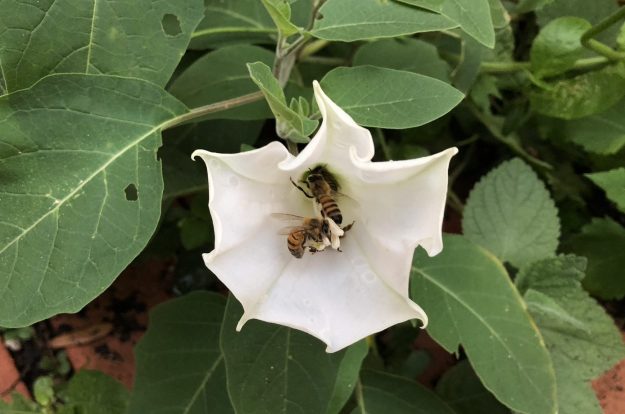
Syndicated gardening columnist Calvin Finch decided to bash my favorite plant, Jimson Weed, Datura Wrightti, in a recent article. Finch cast this amazing perennial as a useless, rambunctious, poisonous interloper in Texas gardens that merits no consideration beyond being dug up or slashed to the ground and sprayed with “Stump and Vine Killer at the fresh cut.”
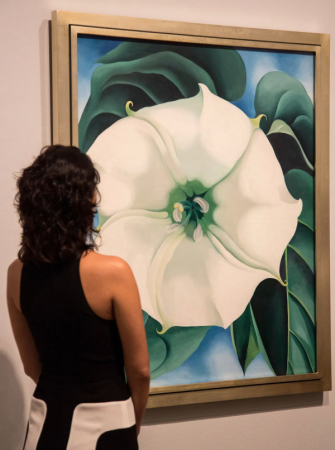
Georgia O’Keefe’s famous Jimson weed portrait on display. –Photo via Encyclopedia Britannica
While recent rains (six inches for San Antonio in May!) have caused rampant growth and extra work in our gardens, lumping native Texan Jimson weed into the same category as Bermuda grass in an article headlined “Rain helps gardens grow, but weeds demand quick action,” demonstrates an outdated gardening ethos.
Yes, every part of Jimson weed is toxic–as Finch emphasizes repeatedly. But lantana is toxic. Milkweed is toxic. Certain passionflowers are toxic. And you know what else is toxic? Stump and Vine Killer.
Here’s an idea: don’t eat plants you don’t know–and get to know your plants! Teach your children the same.
If you’re worried about your pets, rest assured that dogs typically reject Jimson weed because of its strong smell. If they were to eat it, they would likely refuse its bitter, fuzzy leaves and back off. My dogs have never eaten Jimson weed, but they regularly consume lantana leaves. Then, they throw up–it’s their way of purging their stomachs. As my chemical ecologist friend Anurag Agrawal says, “the details are in the dosage.”
Jimson weed has many attributes. As explained in my recent book, Plants with Purpose: Twenty-five Ecosystem Multi-taskers, if I were hosting a dinner party with plants as my guests, I would choose to sit next to Jimson weed. This plant is endlessly fascinating.
Also known as Jamestown Weed, Angel’s Trumpet (for its shape) or Moonflower (for its night-time blooming habit), Jimson weed can can take the heat, and blooms even at 100 degrees. It’s native to much of the United States, common in the Southwest. The great American artist Georgia O’Keefe memorialized Jimson weed in an oil painting in 1936.
Requiring little water or care, Jimson weed resists disease and pests and attracts bees and moths. It can climb to three feet and spread an equal distance, creating a handy shade canopy that protects less sturdy plants. Its dramatic white blooms emerge late in the day, flower in full at night, and give off an enchanting smell. I like to plant it along a pathway so when I return home at night I can enjoy its lovely fragrance.
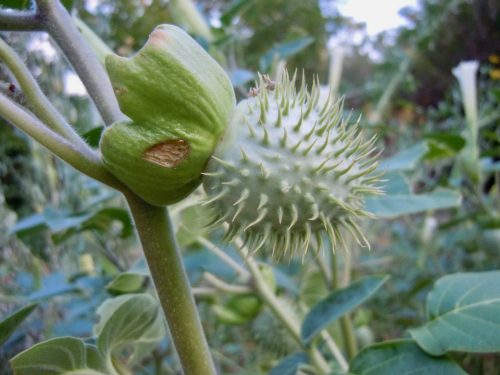
 Jimson weed seed pod--would your dog eat this?
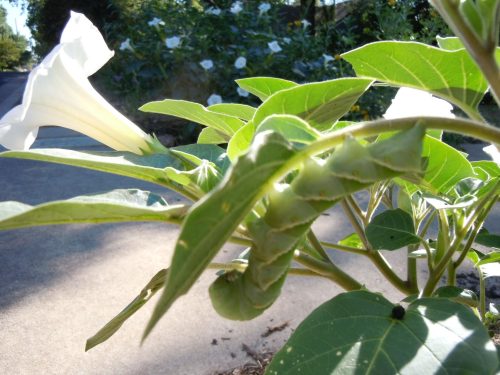
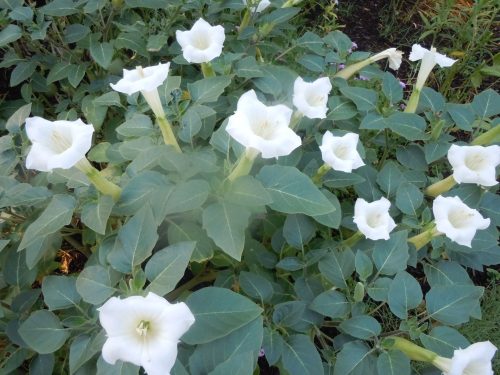
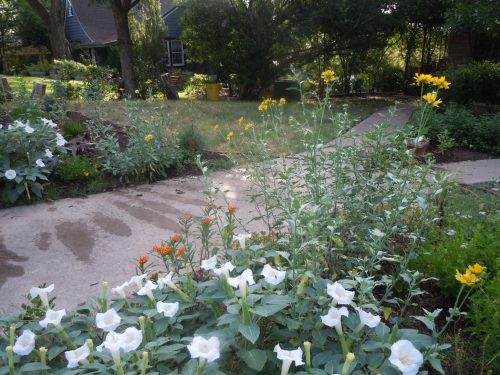
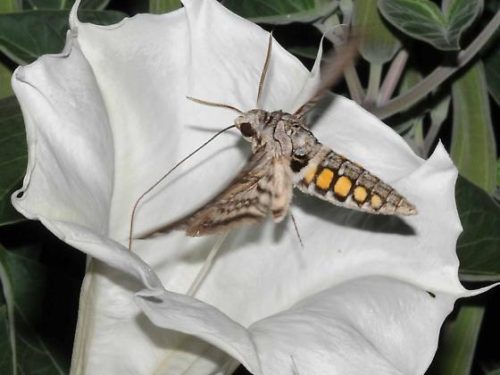
Despite itspoisonous reputation, the Carolina sphinx moth caterpillar feasts voraciously on Jimson weed’s foliage to no ill effect. The large moth with pink stripes also enjoys Jimson weed’s trumpet-like flower nectar as an adult.
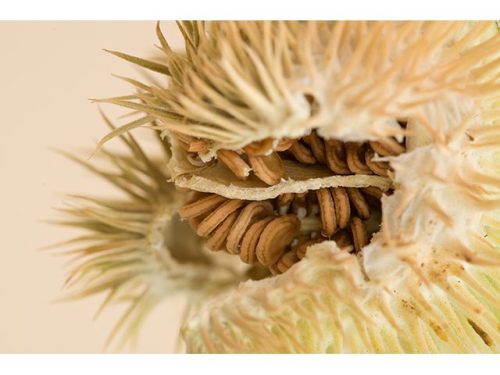
Jimson weed’s spiny seed pods inspire one of its common names: Thorn apple. As summer wears on, the walnut-sized pods turn from green to brown, burst open, and spread seed wantonly in the garden, making this durable plant refreshingly resilient. This member of the nightshade family forms a large tuber that seems to guarantee its survival and also hold the soil in place. It dies back in a freeze, emerges hardy in the spring.
Its fuzzy, lush leaves are laden with glandular trichomes, specialized hairs that exude chemicals and essential oils that account for its distinctive smell. Some folks compare it to “the smell of a wet dog.” I think it smells chocolaty and distinctive. The chemicals and scents it produces have been associated with deterring insect predation, which may explain why Jimson weed is so easy to cultivate.
Like its plant cousin belladonna, Jimson weed contains tropane alkaloids that were used in ancient times on poison-tipped arrows. Maybe that’s why deer and dogs avoid it? Native Americans used the leaves as a painkiller and hallucinogen. Adventurous teens have experimented with Jimson weed to get a cheap high–but they should beware. Hospital stays, even death, can result.
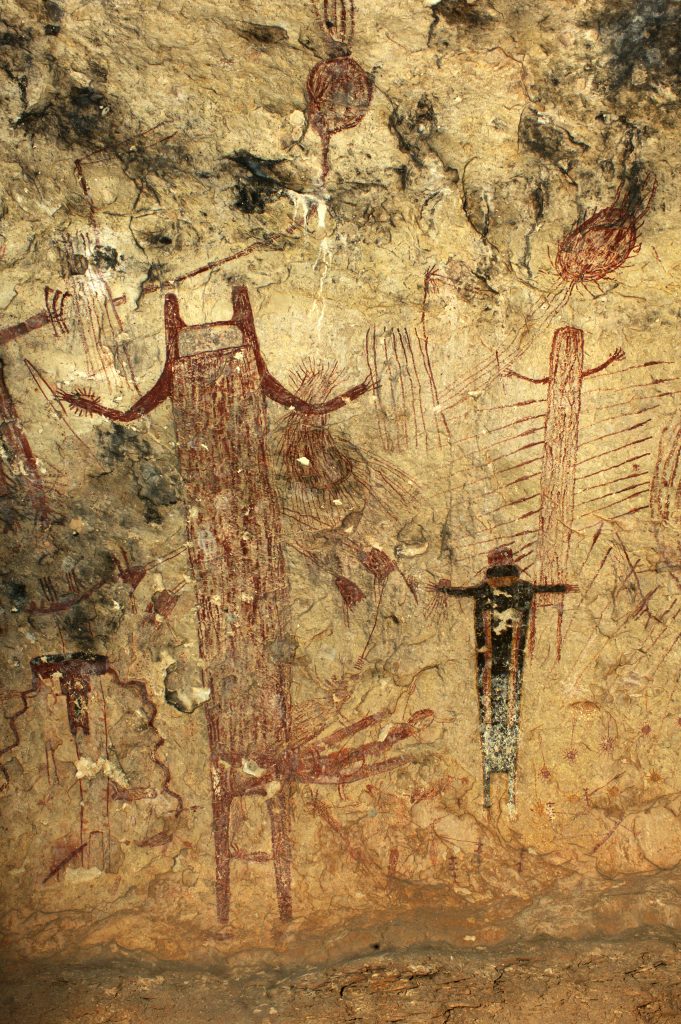
Cave paintings in South Texas show Jimson weed “power bundles” being hoisted to the gods. –Photo courtesy the Shumla project
Jimson weed’s namesake represents an early example of ethnobotanical warfare in American colonial history. In Jamestown, Virginia in 1607, settlers encountered a “seductive, beautiful weed.” Unfortunately, they consumed it, and many died, likely after horrifying bouts of delusions and convulsions.
About 70 years later, when British soldiers arrived to suppress rebellion at the fledgling colony, the settlers recalled the toxic plant and slipped Jimson weed leaves into the soldiers’ food.
The soldiers survived, but suffered hallucinations for eleven days. That extra time gave the Virginia colonists a temporary upper hand. The accomplice plant became known as Jamestown weed, and later, Jimson weed.
Centu ries before that, Jimson weed occupied the spiritual and medicinal arsenal of native peoples in Mexico, where it’s known as flor de toloache. Indigenous midwives used it to relieve labor pains of childbirth. Even today, it has a reputation for working as both a love potion and a death sentence.
Near the confluence of the Pecos, Rio Grande and Devils Rivers in South Texas, archaeologists at the Shumla Archaeological Center in Comstock have suggested that ancient paintings featuring a thorny circular motif represent Jimson weed seed pods, or a “power bundle.”
The scientists speculate that early peoples tapped the hallucinogenic properties of Jimson weed to connect with the Gods.
So please, Mr. Finch, don’t dismiss this plant. Especially at a time when ecosystem services are needed, water is scarce, and we need to look beyond beauty and tidy order and consider more plants with purpose for our landscapes.
TOP PHOTO: Bees on Jimson weed. –Photo by Monika Maeckle
Related posts:
- Multitasking passionflower inspires passion among Gulf Fritillary butterflies
- Queen butterfly: is that a hair pencil in your pocket or are you glad to see me?
- Flowering red yucca waves at drivers navigating traffic on Dallas’ Central Expressway
- Plants with Purpose: Wild onions bolt their bulblet in early spring heat
- Plants with Purpose: Multitasking plants that do more than look beautiful
- Agarita crop goes from “gangbuster” to busted
- Damn you, Malta star thistle! Ornery invasive takes up residence in Texas Hill Country
- Bastard Cabbage, a rambunctious and tasty invasive, is ousting our native Texas wildflowers
- Clammyweed named 2024 Pollinator Plant of the Year
- Mostly native urban pollinator garden outperforms lawn every time
This is a fascinating and informative article. Thank you for the information and the great photos.
Thanks for reading and writing, Shelia!
Wonderful Monika!
I also LOVE Jimson weed❤️
What’s not to like, Peggy? Just don’t eat it! 😉
Thanks, Monika, for rebutting Calvin Finch’s “outdated gardening ethos.” It’s a shame he holds so much weight in the gardening world, as his understanding of native plants is lacking.
Agreed.
Great article, Monika – calling out Calvin Finch who has long been a toady for the pro-chemical crowd. Minor correction: counter intuitively, there is no apostrophe in the “Devils River”. Keep up your great work and informative writings!
Thanks for the correction, Jeff. Fixed!
We love Jimson weed!
It’s my fave.
Being poisonous doesn’t mean it isn’t valuable in nature. It’s part of the ecosystem. Thanks for loving native plants with purpose, Monika.
Indeed! This plant has MUCH to offer. Just don’t eat it.
Way to respond to Calvin’s article, Monika! I was outraged at his conventional comments as well. I hope you emailed him your response. Thanks for speaking out.
Thank you Monika…Great info!
We grow the Angel’s trumpet every year in our Certified Butterfly Habitat, not only for the beautiful fragrant blossoms, but mainly for the Spinx moth & their cats!
Keep it up!
Another great posting Monika. As always I learned a lot more than I knew before and so important to counter Calvin’s misstated claims. And don’t worry, no Jimson Weed seeds in my granola!
Pass, the milk, please, Joan. 😎
Thank you for a most interesting article!
Great column, Monika! Thanks for setting the record straight. And I love O’Keeffe’s extraordinary Jimson Weed painting as well.
Thanks also for reminding Calvin about the Georgia O’Keefe paintings. I particularly love the two historical facts about Jimson. Is it safe to put in our home gardens.
Just don’t eat it.