
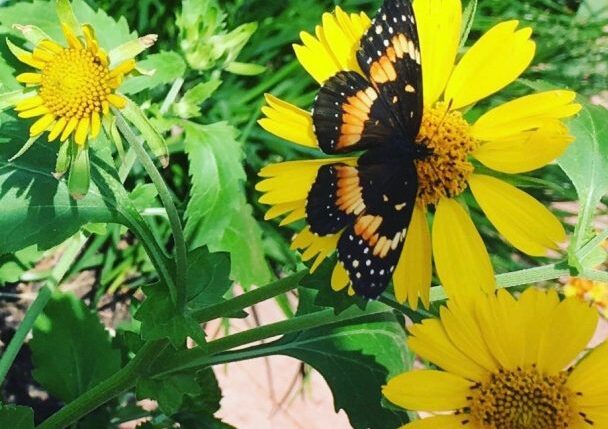
It’s National Pollinator Week, a good time to celebrate and recognize the creatures large and small that facilitate life on earth by making the food we eat possible.
Started in 2006 by the Pollinator Partnership, the seven-day focus on pollinator importance (June 22-June 28) has grown to include dozens of countries around the world.
Here in Texas, few scenarios could provide a better context for the annual celebration than the recent rains that have showered San Antonio and the Texas Hill Country.
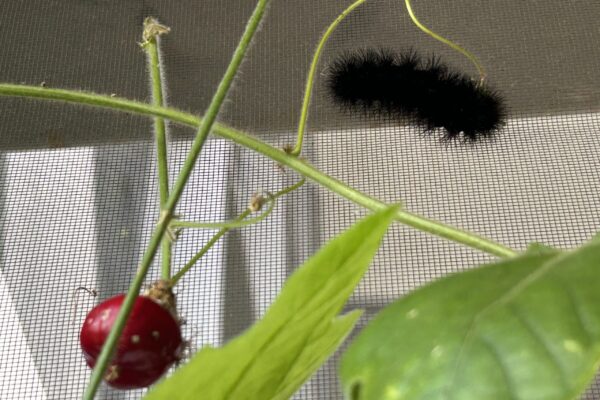
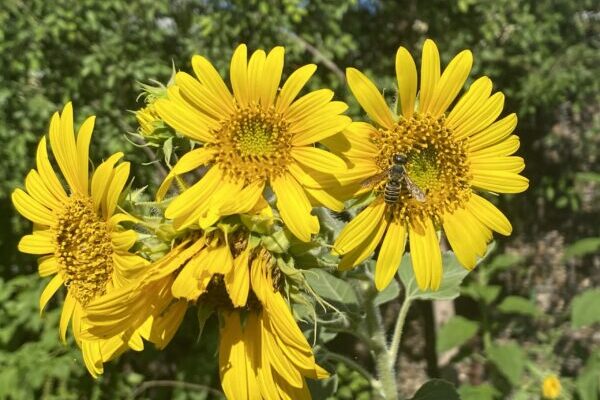
More than seven inches of rain have doused the Alamo City in the last month–21.74 inches so far in 2026, about six inches above average, according to virtual rain gauge Raindrop. The ongoing rains, attributed to an El Niño weather pattern, have provided temporary relief from the seven-year drought Texas has endured.
About 18-and-a-half inches of rain have doused our ranch along the Llano River so far this year. That’s seven inches above the historical year-to-date average.
Plants and pollinators are responding with rampant growth.
Sunflowers, members of the Asteraceae, or Aster family, seem to be especially happy, shooting from the soil like rockets. Several in my San Antonio front yard and are topping 10 feet in height.
“Why do the sunflowers keep tumping over?” texted my friend and Pharm Table chef Elizabeth Johnson, who sent a video showing dozens of common sunflowers practically prone on the ground in response to strong breezes. The condition is not surprising nor unusual. The plants don’t have giant root systems, their larger leaves act like sails catching the wind, and their height makes them vulnerable to blustery winds.
As noted in my recent book, Plants with Purpose: Twenty-five Ecosystem Multitaskers, sunflowers are quite generous with their resources. They provide nectar and pollen for insects, seeds for birds, shelter for wildlife, and leaf fodder for certain caterpillars.
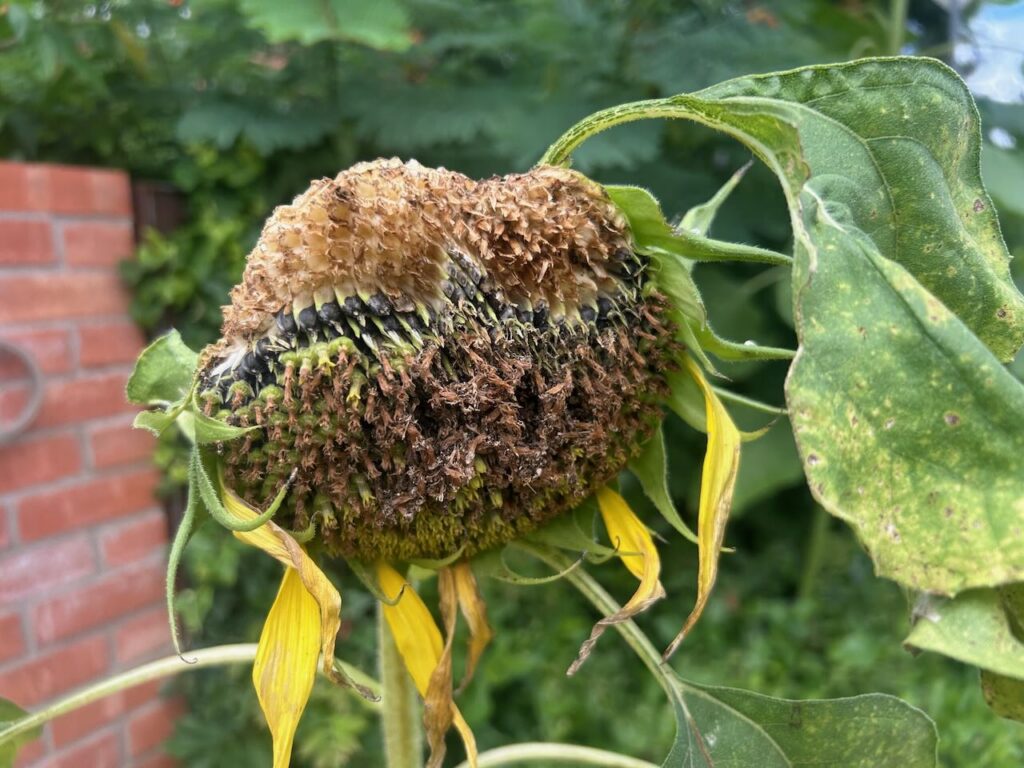
A mature sunflower head: at the top, notice where birds have plucked the high protein seeds. In the middle, the seeds are starting to show. At bottom, you can still see the dried mini “petals” on the sunflowers. –Photo by Monika Maeckle
Fun fact about sunflowers: the “flower” is NOT the obvious flower head. Rather, the flowers are the mass of tiny protrusions that reside in the middle of the plant. They are the precursors to the seeds.
Sunflower heads, in fact, are home to hundreds of tiny florets that later form the seeds. That’s why insect pollinators love this plant so much–they can literally land in the middle of the flower head and slurp nectar from dozens of flowers without even changing position. Literally, a nectar buffet.
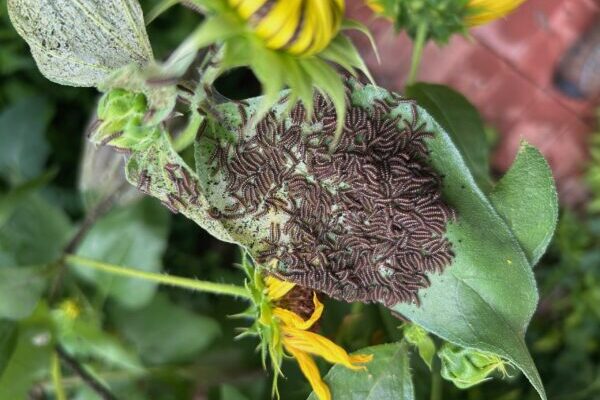
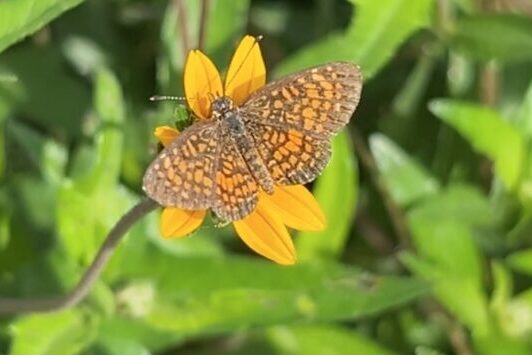
Seemingly ubiquitous on the leaves of the common sunflowers in my yard this year are the eggs and caterpillars of the Bordered Patch butterfly, Chlosyne lacinia,
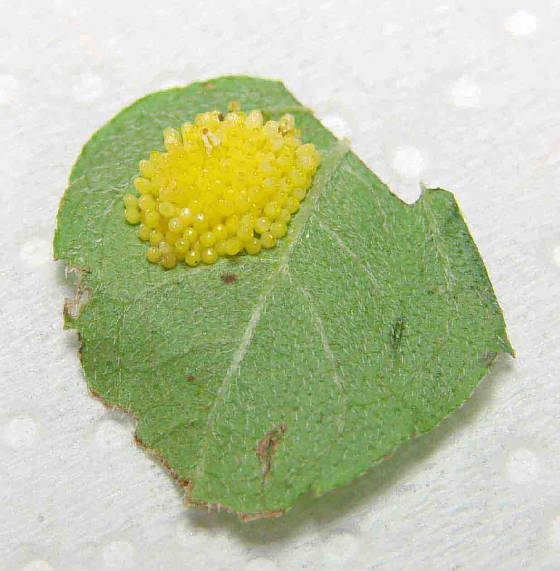
Mound of Bordered Patch eggs. Photo via The Rio Grande Valley’s Nature Site
Unlike other butterflies that lay their eggs one at a time, the Bordered Patch deposits up to 500 eggs in a single mass. The butterflies also utilize nettles and verbenas as a host plant to fuel their voracious offspring in the caterpillar stage.
After a few days, the mound of yellow eggs turns dark, then they hatch into yellowish caterpillars. As they devour the leaves of their host plant, they darken and show harmless charcoal black bristles on a dark orange body. The gregarious feeders create intriguing mounds of life on the plants that feed them and leave skeletonized foliage riddled with silk webbing in their wake. Check out this quick-but-complete description of the Bordered Patch life cycle on The Rio Grande Valley’s Nature Site.
Bordered Patch are not the only butterflies flitting around our verdant Central and South Texas landscapes.
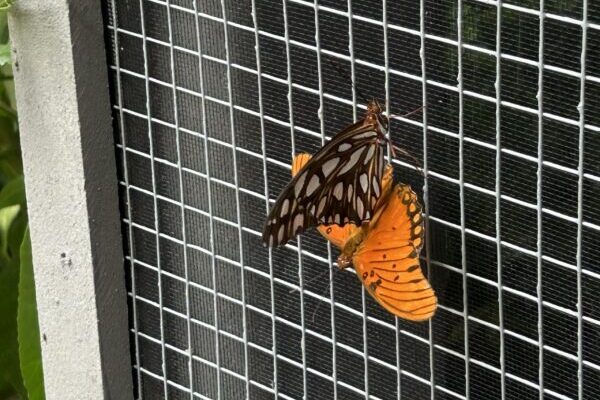
An intense burst of Gulf fritillaries, which use the rambunctious Passionflower, Passiflora, as a host and nectar source, are also widespread. My yard is popping with climbing vines of what’s known as Stinking passionflower, Passiflora foetida, another plant with purpose. Taking a cue from the cardinals that pluck these golf ball sized majenta-colored fruits from my screen porch, I enjoy harvesting the colorful fruit for its slightly sweet tang and gelatinous-covered seeds. See the slideshow above for pictures of passionflower fruit and Gulf fritillaries.
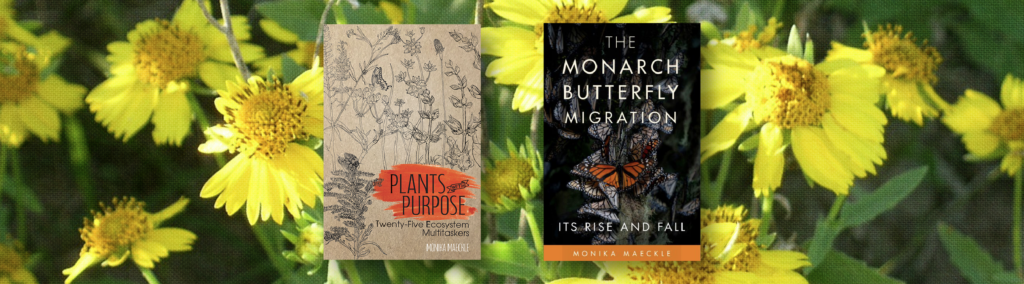
Check out my books!
We should enjoy this rain respite while we can, as meteorologists warn the drought is not behind us. Another brutal Texas summer will arrive soon, hotter and dryer than usual, thanks again to the extremes dealt by El Nino.
In the meantime, enjoy the Bordered Patch butterflies and kiss your Asters.
TOP PHOTO: Bordered Patch butterfly on Cowpen daisy. –Photo by Monika Maeckle
Related posts:
- Hey Calvin Finch–you’re wrong about Jimson Weed
- Multitasking passionflower inspires passion among Gulf Fritillary butterflies
- Queen butterfly: is that a hair pencil in your pocket or are you glad to see me?
- Flowering red yucca waves at drivers navigating traffic on Dallas’ Central Expressway
- Plants with Purpose: Wild onions bolt their bulblet in early spring heat
- Plants with Purpose: Multitasking plants that do more than look beautiful
- Agarita crop goes from “gangbuster” to busted
Happy to observe on my zexmenia plants today that they are being consumed, skelentonized and USED by the bordered patch caterpillars.
Quite impressive appetites, those Bordered Patches!
Thank you for the comment!
The best $25 that I have ever spent was for your metal Habitat Pollinator sign. Neighbors and code compliance have never complained about all the no-grass native plants front yard. My yard is some what landscaped. Others in the neighborhood have been cited for weedy, over grown yards. I think the posted sign saved me. Also, the are butterflies.
I vote that Alamo vine is invasive in a regular city yard landscape.
Keep up the good work and thanks for reading and writing! —MM