
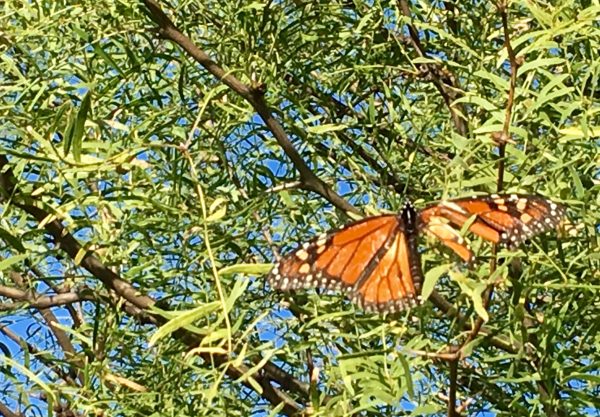
Mexican officials announced a 64% rise in the overwintering monarch butterfly population in Mexico this week.
The increase at nine colonies totaled an area of 2.93 hectares this season, compared to 1.79 last year. That’s about 7.24 acres this year, versus 4.42.
The good news represents the largest population in seven years. Monarch butterfly fans across the continent were ecstatic.
“I just got my Journey North email making that announcement. WOOT!” said longtime monarch butterfly advocate Diane Levesque on the DPLEX, an email list established by conservation organization Monarch Watch at the University of Kansas at Lawrence and which reaches hundreds of monarch butterfly followers and
“Congratulations to everyone! It’s because of your work and dedication!” said Mike Rizo on Correo Real’s WhatsAPP group thread. Correo Real is a monarch conservation and tracking organization based in Saltillo, Mexico.
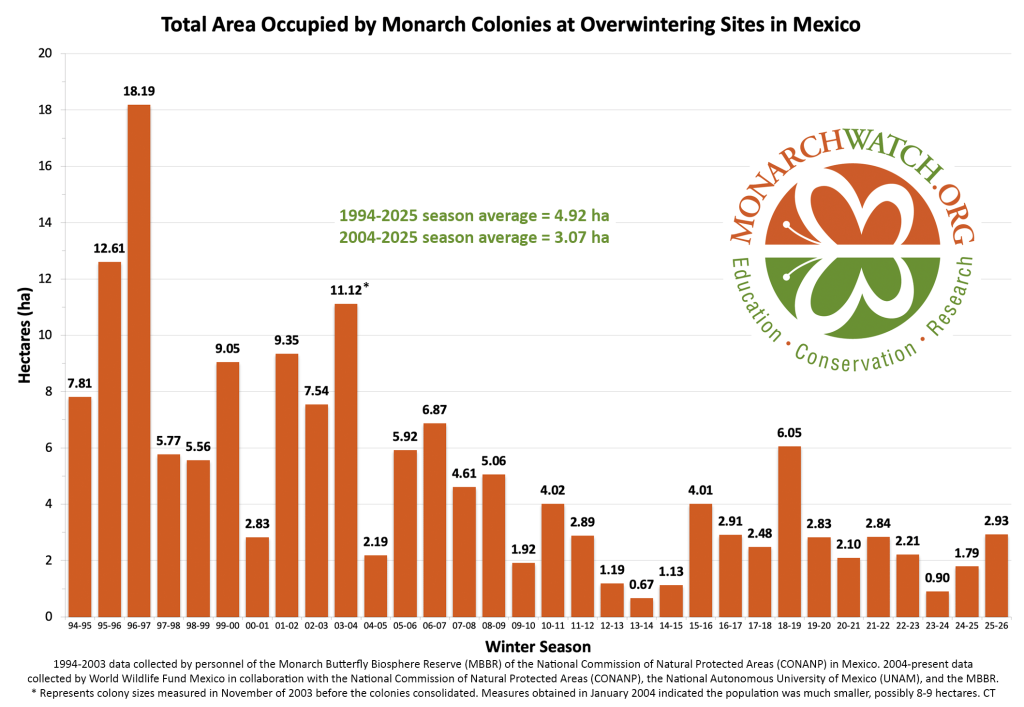
While the news is encouraging, the 2.93 hectares/7.24 acres of roosting colonies reported falls well short of the U.S. goal set in 2015 to maintain 15 acres of overwintering sites via the National Strategy to Promote the Health of Honey Bees and Other Pollinators. Since, the strategy has morphed from a presidential memorandum issued by President Barrack Obama into a Pollinator Protection Initiative managed by the Environmental Protection Agency.
The announcement was made by WWF-Telmex Telcel Foundation Alliance, in collaboration with the National Commission of Natural Protected Areas (CONANP), the National Autonomous University of Mexico (UNAM), and the Monarch Butterfly Biosphere Reserve (MBBR).
Each winter, researchers survey monarchs while they cluster at their overwintering sites in central Mexico before the migratory insects start their annual migration north toward Texas. Typically, the insects lay their first round of eggs to launch the next generation in what is called the Texas Funnel, the migratory flyway through which all migratingmonarchs must pass in spring and fall.That new generation of butterflies
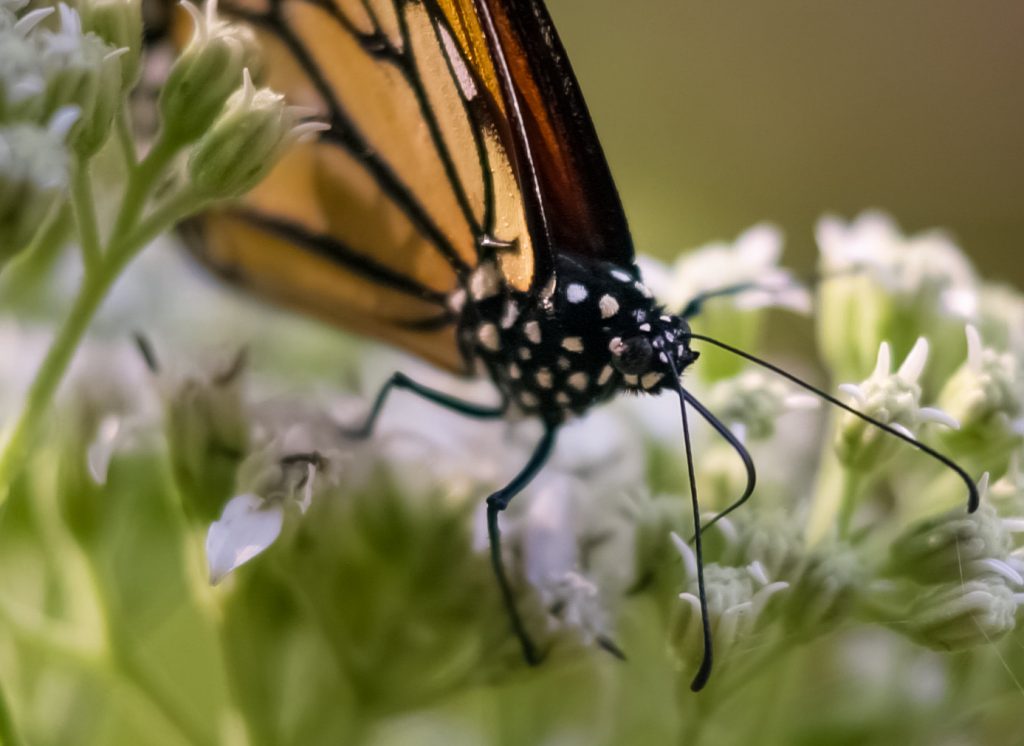
Monarchs need milkweed and nectar plants to continue their life cycle. –Texas Butterfly Ranch file photo
continue the multi-generational journey north over the summer. In the fall, subsequent generations move south to gather in the Mexican mountains where they they wait out the winter and start the cycle anew in spring.
Because of the impossible challenge of counting individual butterflies, researchers estimate population size by measuring the total area of trees occupied by the migrating insects.
As explained on the Monarch Joint Venture blog, “One hectare equals approximately 2.47 acres, or just over two American football fields. Although the number of monarchs per hectare varies by year and site, estimates suggest roughly 20–30 million monarchs per hectare, with a median estimate of 21.1 million.”

Monarch butterflies migrate north from Mexico in spring and summer over multiple generations. In the fall, the offspring of those butterflies head south to Mexico to wait out the winter. –Graphic by Nicolas Rivard
Using the 21.1 million metric, this year’s eastern population of migrating monarchs tallies about 61.8 million. The peak count since records have been kept occurred in the 1996-1997 season with 18.1 hectares, which using current metrics would have totaled more than 380 million.
The much smaller western population, which moves up and down the west coast of the U.S., was much less robust. According to the Western Monarch count conducted by more than 400 volunteers, the population peaked at just 9,119 butterflies, the Xerces Society announced in late January.
Given the volatile, schizophrenic weather in Texas and elsewhere this past year–early freezes, mid summer floods, persistent drought and record heat–many expected the counts to be down. At the Texas Butterfly Ranch, we only tagged a couple dozen monarchs last October, while we usually tag hundreds.
--Monarchs at El Rosario preserve in Mexico in January. Video courtesy Karen Oberhauser
Conservation biologist Karen Oberhauser, founder of the Monarch Joint Venture, said she was not surprised by this year’s eastern population growth. “We saw a nice uptick in egg and larva densities in the Upper Midwest in July and August, and these eggs and larvae turn into the butterflies that migrate to Mexico.”
Oberhauser explained that despite the ongoing drought in the Texas Funnel, by the time the fall migration kicked into gear, the central flyway was relatively drought-free until the southernmost part of the state.
“Conditions were good in the Mexican flyway. Plus, fairly good precipitation in the early summer meant that riparian areas probably had enough nectar to get them through southern Texas,” Oberhauser said.

Check out my books!
Nor was Chip Taylor, the founding director of Monarch Watch, surprised. “The breeding and migratory conditions were better than for the last two years,” he said.
Kristen Baum, Monarch Watch’s current director, described the past season as “interesting.”
Baum relayed that she was optimistic at the start of the fall migration, based on reports of good monarch activity at the end of the breeding season. But as the season progressed, “conditions in the central flyway were concerning.”
Delays in the migration also suggested a likely lack of nectar availability and when Day of the Dead passed in Mexico with little monarch activity, Baum grew concerned. Usually, the majority of the migrating insects arrive by that holiday, which occurs November 1-2.
“I was pleasantly surprised by the 64% increase,” she said. “All of those ups and downs in expectations highlight the challenges for monarchs as they cover such a large geographic range.”
The volatile weather in the Texas Funnel continues. Within the past week, temperatures have vacillated between below freezing to the 90s in the Texas Hill Country, a favored pathway for monarchs migrating north and south.
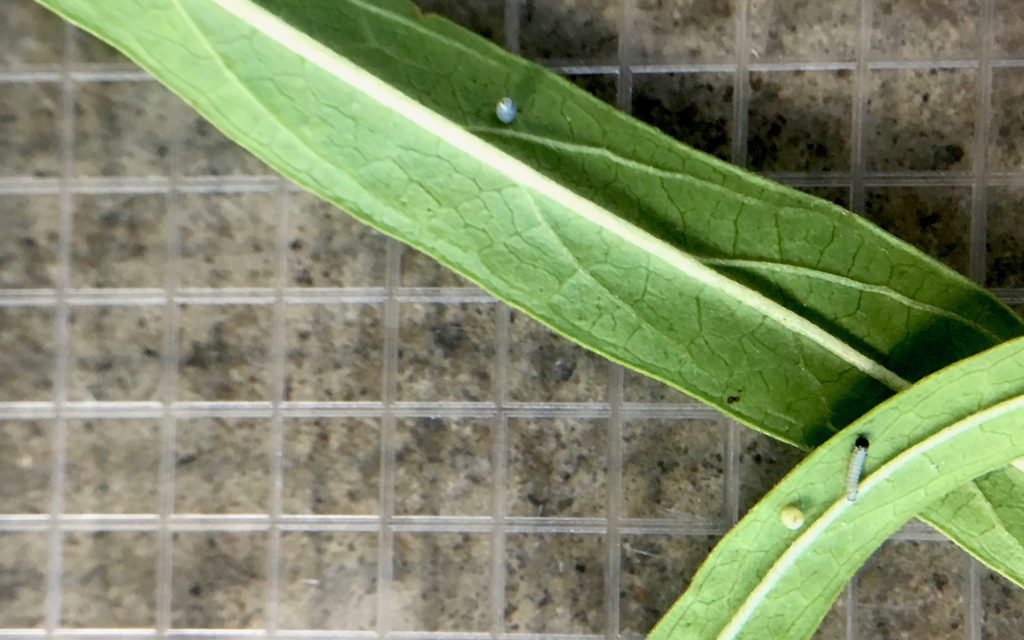
Eggs and first instar monarch caterpillars on milkweed. –Photo by Monika Maeckle
Chuck Patterson, a monarch butterfly advocate in Driftwood, Texas, between Austin and San Antonio, reported that in his area, temperatures dropped below freezing for about six hours overnight with a low of 25 degrees this week.
“From what we’ve seen so far, our milkweed did not fare well at all. Most of it is shriveled and shocked and does not look like it will recover,” he said. Milkweed is the only plant on which monarchs will lay eggs to continue their lifecycle.
With the ongoing drought in the Lone Star State and predictions of a likely El Niño weather pattern, 2026 seems likely to pan out as another volatile year.
TOP PHOTO: Monarchs are heading north this spring as their numbers are up in Mexico. –File photo by Monika Maeckle
Related articles
- Monarch butterflies depart Mexico
- New study: Hot temps cause monarch butterflies to ‘drop out’ of their annual migration
- Butterfly Bonanza on the Llano River this weekend–everything buy monarchs
- Monarch butterflies heading our way as annual fall migration takes flight
- Monarch butterfly numbers vault 99% over last year’s historic low, California population teetering
- Commercial butterfly breeders brace for devastating hit as monarch ESA listing looms
- Monarch butterflies listed as “threatened” under the Endangered Species Act
- A tense online debate: raising monarch butterflies at home
- New study: monarch migration at risk, monarch butterflies are not
- USFWS rules monarch butterflies worthy of protection, but they don’t have resources to protect it
Like what you’re reading? Don’t miss a single article from the Texas Butterfly Ranch. Sign up for our email newsletter, like us on Facebook, follow us on Twitter, @monikam or on Instagram.
Leave A Comment