
This year’s fall monarch butterfly migration is underway, with observers from northern states along the migratory flyway reporting healthy numbers with a mix of egg-laying and south bound flight patterns.
“Compared to last summer here in the Cedar Falls, Iowa area, I am seeing a decent number of monarchs,” Matt B. wrote August 19 on the D-PLEX list, an email list of more than 1,000 subscribers from 11 countries who follow monarch butterfly news. The list is managed by the University of Kansas at Lawrence’s Monarch Watch program.
Matt added that in his area, monarch numbers have been fairly steady since early July. “With abundant rainfall this summer, prairie plantings and milkweed have been lush all summer with plenty of flowers for them to nectar on.”
Christopher Brown weighed in the same day from Zimmerman, Minnesota, noting lots of egg laying and temperature fluctuations.
“These eggs that are everywhere now, under ideal conditions, should be ready to fly in 30 days which would put them at the end of September, which I believe gives plenty of time,” he wrote. He added that abundant rains left the area with ample pollinator plants ready to feed the parade of monarchs that will pass through the region over the next month.
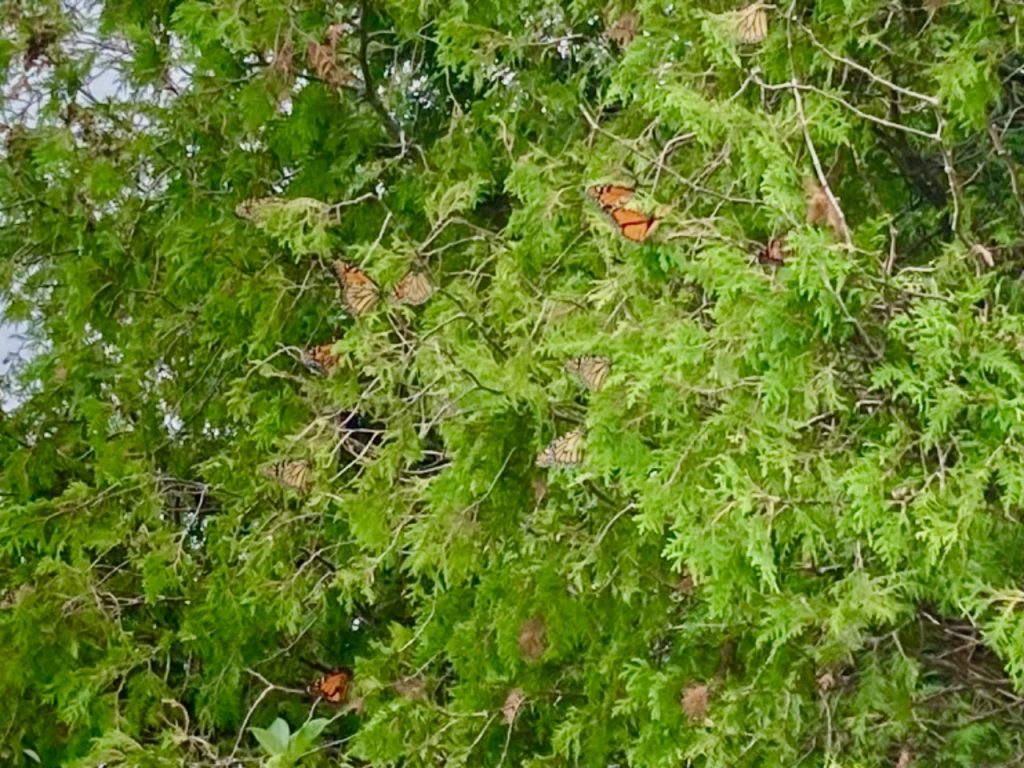
A monarch butterfly roost reported to Journey North by Opal in Escanaba, Michigan on August 20. –Photo via Journey North
Monarch butterfly expert Karen Oberhauser shared in a report distributed by monarch migration tracking organization Journey North that throughout their main breeding range, monarch numbers continued to be “relatively high” compared to the last several years.
Oberhauser, who founded the Monarch Larvae Monitoring Project, which taps volunteers to track and record egg laying and caterpillar activity by monarch butterflies, shared maps comparing 2025 and 2024 egg and larva densities in Wisconsin. She noted large increases in per-plant density of monarch eggs this year–a good sign.
“Of course, these migratory adults still need to make it all the way to Mexico, but drought conditions in Texas have lessened (albeit in dramatic and sometimes destructive ways), and monarchs should be able to find the nectar needed to sustain both the migratory flight and their overwintering period,” she added.
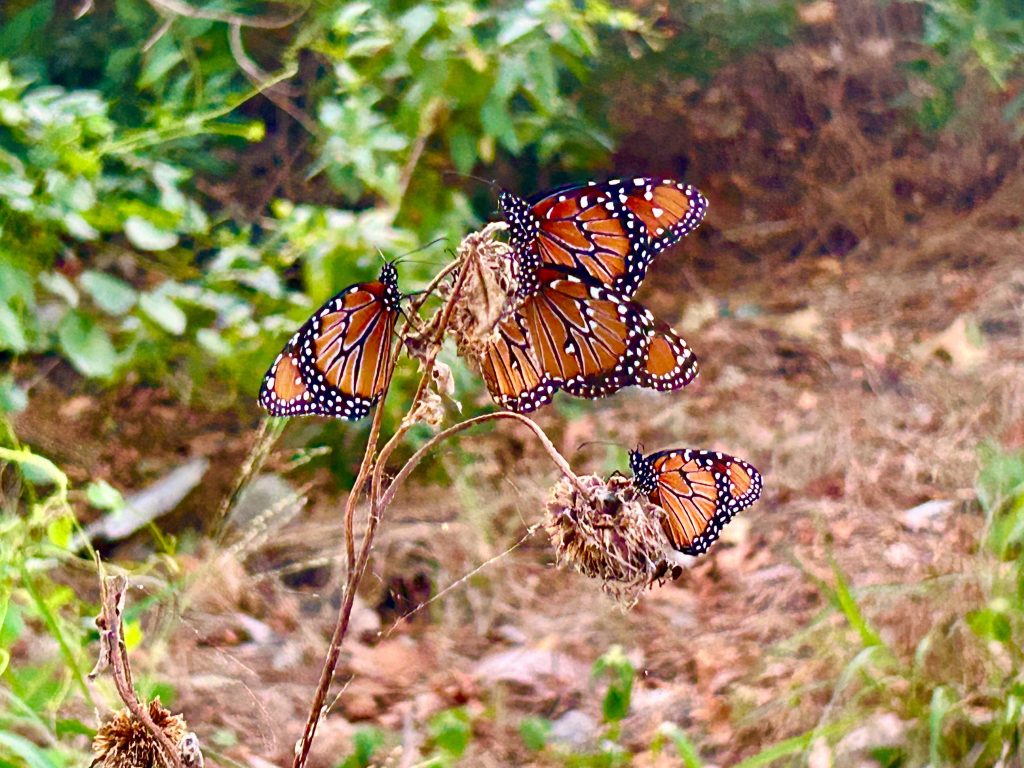
A cluster of Queen butterflies gather on a dehydrated stem of Maximillian sunflower along the San Antonio Riverin August. –Photo by Monika Maeckle
Indeed, here in Texas, oft cited as “the most important state” in the migration given its geographic position at the start and finish of the U.S. migratory flyway in spring and fall, has experienced dramatic, volatile weather this year.
An unusually hot May felt like August with several days topping 100 degrees. Then a cooler June was followed by torrential rains that devastated the Texas Hill Country, a favorite monarch butterfly passthrough given its myriad rivers and streams. The historic flooding that occurred on July 4th killed 138 people.
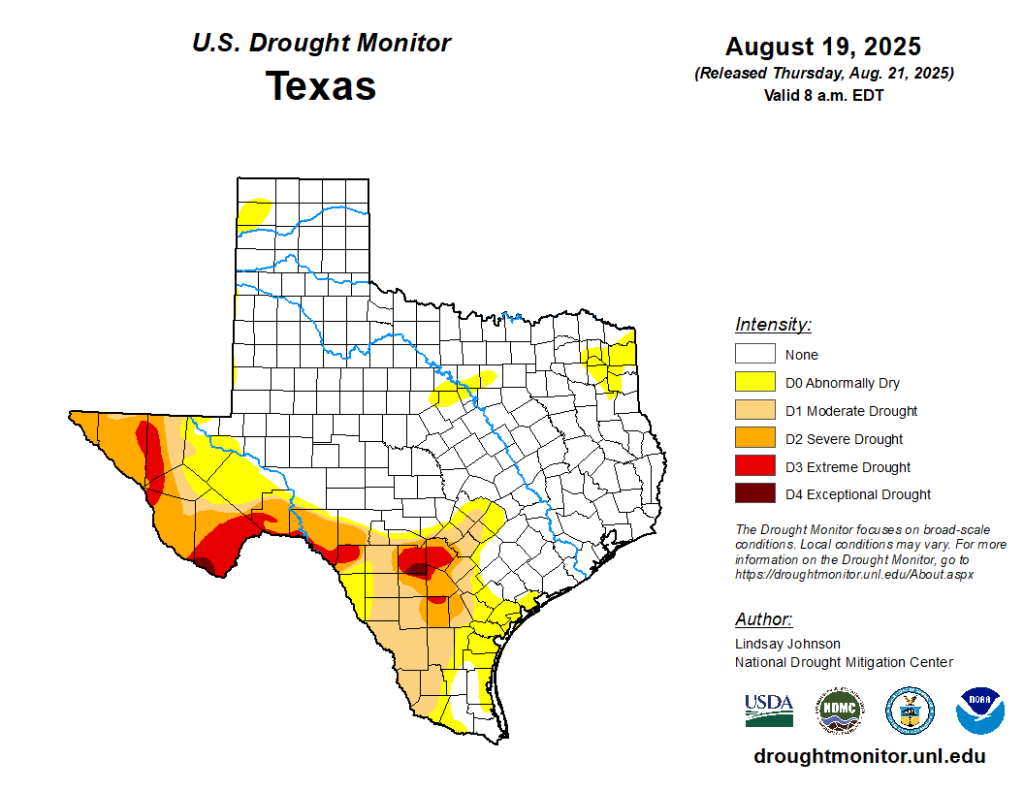
August has delivered a more typical weather pattern, and the recent historic rains finally moved most of the Texas Hill Country out of exceptional drought for the first time in years. That said, there’s no doubt that it’s been a rough year, weatherwise, in the Lone Star State.
In Central Texas, we’ve seen few monarchs this year. Queen butterflies, their look-like, milkweed-feeding cousins, are abundant. A recent walk along the San Antonio River found a roost of the seasonal visitors clumped on dehydrated Maximillian sunflower stems.
Chip Taylor, the founder of Monarch Watch, the citizen science tagging organization that tracks the butterflies with tags applied to their forewings, suggested on the D-PLEX list that despite all the challenges faced by the 2025 monarch crop, this year could possibly be a slight improvement over last, which measured 1.79 hectares, or about 4.42 acres. Last year was a huge increase over the 2023 – 2024 season, which resulted in the second lowest monarch counts since records have been kept, at .90 hectares, or about 2.22 acres.

Want to learn more? Check out my books!
When asked the number of hectares monarchs might occupy in Mexico this fall, Taylor suggested the following.
“Bottom line – about 1 hectare based on low production of first gen monarchs in TX and OK, or 1.5-1.9 hectares if I’ve underestimated the size of the first generation and there is no drought in Texas in October,” wrote Taylor. “Anything above 2 would be a real surprise and would send me back to go.”
NOTE: Conservationists measure the health of the monarch butterfly population by the number of hectares occupied by monarchs overwintering in Mexico.
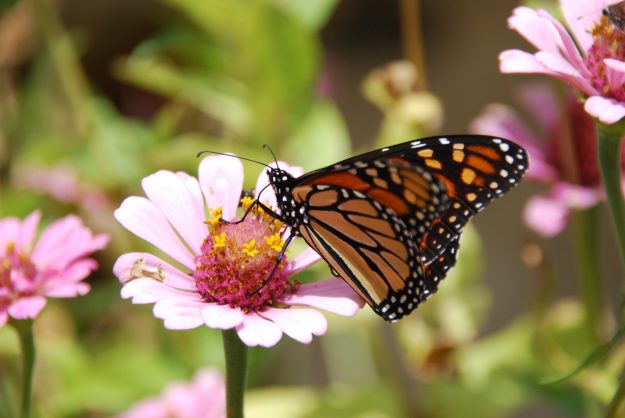
TOP PHOTO: Monarch nectaring on a member of the Aster family. –Photo by Jenny Singleton
Related articles
- Mother Nature asserts herself with historic flooding in Texas Hill Country
- Monarch butterfly numbers vault 99% over last year’s historic low, California population teetering
- Commercial butterfly breeders brace for devastating hit as monarch ESA listing looms
- Monarch butterflies listed as “threatened” under the Endangered Species Act
- A tense online debate: raising monarch butterflies at home
- New study: monarch migration at risk, monarch butterflies are not
- USFWS rules monarch butterflies worthy of protection, but they don’t have resources to protect it
- As ESA listing looms, new study challenges dogmatic narrative that monarchs are in decline,
- “Weird” weather has scientists concerned about this year’s monarch butterfly migration.
To me, the eastern fall migration looks much larger this year compared to last year given the many more fall roost reports on Journey North and the more numerous photos posted on social media of multiple fall migrants nectaring in residential gardens in the Great Lakes States. Also, the density of mid and late August 2025 monarch sightings in the upper Midwest and Great Lake States on iNaturalist dot org is about double compared to the same time frame in 2024.
I have had a few here in the upper northeast part of Texas. Some chrysalis and some eggs and in the milk wheat patch. Not near as many as years past. It is still kind of early, so maybe I will have more.