
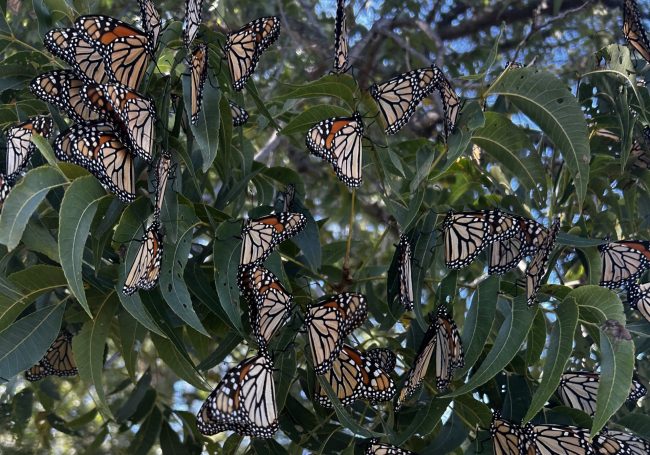
A hot autumn and hostile winds have delayed monarch butterflies’ arrival in the Texas Hill Country this season.
Many areas of the renown Texas Funnel, the migratory flyway through which monarchs and other migrating creatures typically pass on their way south each fall, saw few of the iconic insects during what is usually their peak migration time.
Until now.
“Here in Wichita Falls I am seeing more monarchs than I have seen in the last 20 years,” Mary Rhoads said via email on October 25. Sharing photos and videos of monarch butterfly roosts, Rhoads described “clouds of them,” clustered in her redbud and cedar elm trees.
The following day, about 250 miles directly south in Buchanan Dam, Texas, Christine Northrup shared a similar report.
“Out here in the Hill Country I have at least 200 monarchs swarming on my lantana, Turks Caps, Gregg’s mistflower and fall asters,” Northrup wrote on the monarch-centric email list known as the DPLEX. She added that a friend five miles south of her had an equally impressive cluster. “Very large and healthy. The front might have brought them in. Very encouraging,” she added referring to a cool front that dropped the temperatures by several degrees.
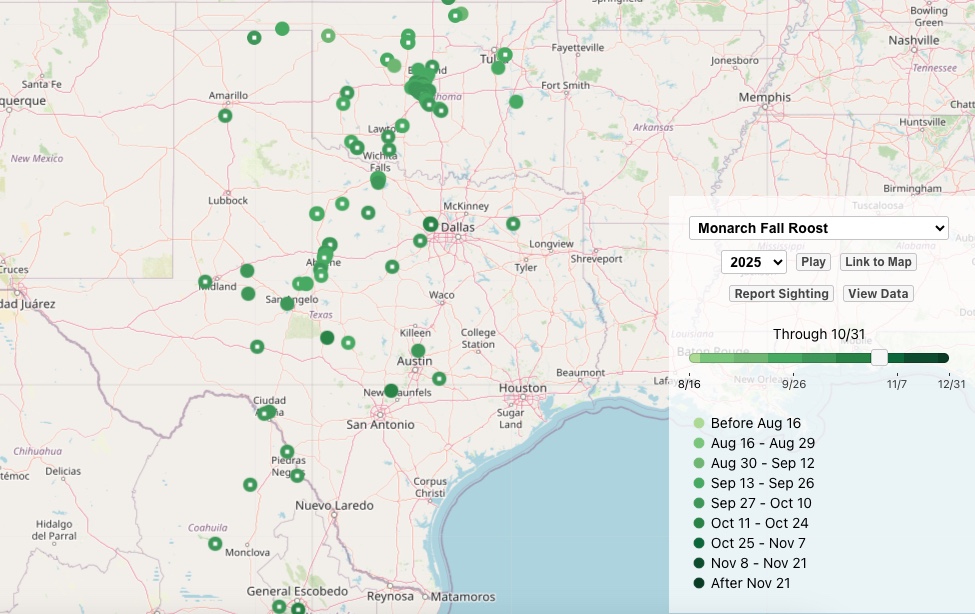
Journey North map of monarch butterfly roosts.
Usually, cool autumn temperatures push the monarchs south as they attempt to escape the cold. But this year, a persistent heat dome parked itself over the Texas Hill Country for much of September and October. Relief came last weekend as an epic storm system moved through the region, bringing rain and some relief from the heat.
“I was shocked to go out to my garden on Wednesday to see the flurry of monarchs in my garden. There were so many that I couldn’t count them!” Missy B. of McKinney, Texas, wrote on the DPLEX list October 27. “I don’t remember having this kind of activity this late in October but it was exciting to see. Even my neighbors were stopping by to observe their beauty!”
The same story unfolded the same day in Mason, in the heart of the Texas Hill Country. Harold Parker shared shared a photo on the Mason County Community Facebook page.
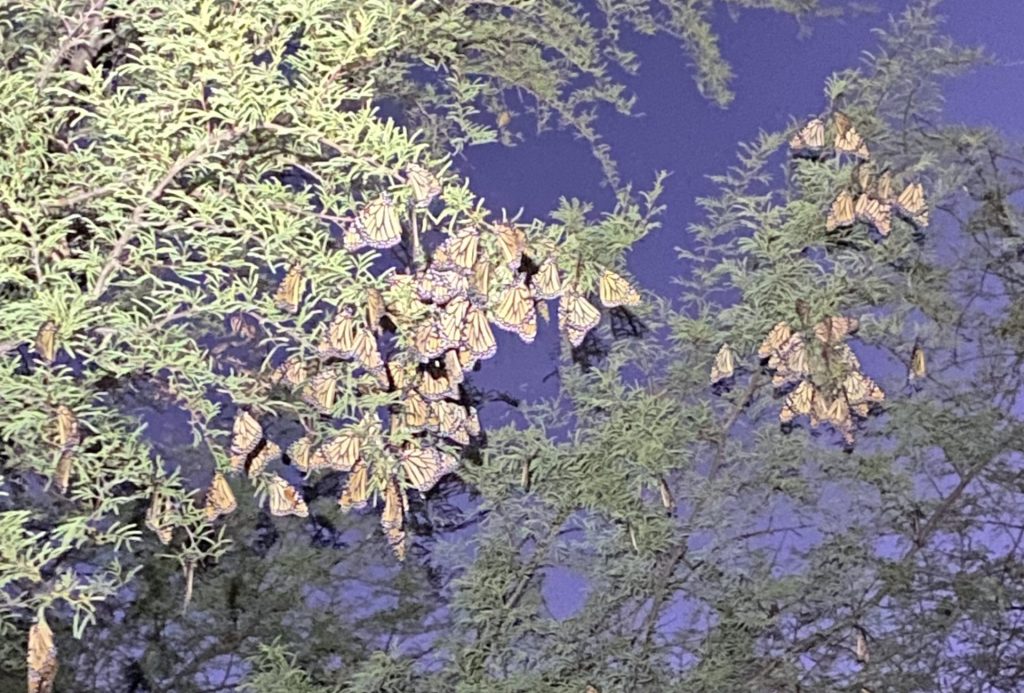
Monarchs settle on a Huisache tree in Del Rio, Texas on October 25 about 7 pm. –Photo by Hunter Stanco
“If there is a lepidopterist in Mason, please tell me if these are monarchs or viceroy butterflies,” Parker wrote. “I think they’re monarchs. There were hundreds of of them in the shade behind the ball fields.”
Biologist, author and fellow Mason resident David Hillis assured him that the creatures were indeed monarchs.
Last weekend, Victoria Echeverri of San Antonio and I spent three days tagging monarchs along a pecan grove on the Llano River where the creatures have traditionally roosted for decades. We saw hundreds of monarchs and witnessed several clusters, but not the density that we normally experience.
The monarchs switched between clinging to pecan limbs along the river bank and battling south and westerly winds that gusted to 24 miles per hour for most of the weekend. Friday night kicked off with the thunderstorm mentioned above, which dumped two-and-a-half inches of much-needed rain on our property. Temperatures continued to hover in the high 80s.
Video by Victoria Echeverri
By late Sunday, we had only tagged 34 monarchs. In the past, we usually tag hundreds.
So is the monarch butterfly migration finally unfolding–just 10-14 days late?
Biologists that study monarchs generally express concern when the temperatures are as high as they’ve been this October–an average of five degrees above the typical October readings, according to Weather Underground.
High temperatures and a longer lasting migration cause the butterflies’ to experience a higher energy expenditure associated with their movement. As they burn through their lipids, which are the fats that help them survive a cold winter for months in Mexico, they run out of time and are less inclined to keep going. A recent study suggested that hot temperatures cause monarch butterflies to “drop out” of the migration altogether.
Kristen Baum, director of Monarch Watch, agreed that this has been a late, and long migration that does not bode well for the migrating insects.

Check out my books!
“It’s been a long, drawn out migration,” said Baum via phone. “Lots of roosts that lasted a week or more….lots of winds out of the south.”
She said that earlier in the season, migration prospects looked promising. Nectar sources were abundant in Kansas where Monarch Watch is based, but the migration moved extremely slowly with some roosts appearing up to a month later than normal.
“Optimism has waned with the migration dragging on and on,” she said, adding that it’s not just the length of the marathon the monarchs are flying, but the lack of nectar associated with drought and heat.
“Nectar resources were pretty good around here….but it doesn’t look that good going further south,” she said. “What started out as a promising year turned out to be not so much so.”
TOP PHOTO: A monarch roost spotted earlier this week near Grit, Texas. Photo by Terry Pittsford
Related articles
- New study: Hot temps cause monarch butterflies to ‘drop out’ of their annual migration
- Butterfly Bonanza on the Llano River this weekend–everything buy monarchs
- Monarch butterflies hearing our way as annual fall migration takes flight
- Mother Nature asserts herself with historic flooding in Texas Hill Country
- Monarch butterfly numbers vault 99% over last year’s historic low, California population teetering
- Commercial butterfly breeders brace for devastating hit as monarch ESA listing looms
- Monarch butterflies listed as “threatened” under the Endangered Species Act
- A tense online debate: raising monarch butterflies at home
- New study: monarch migration at risk, monarch butterflies are not
- USFWS rules monarch butterflies worthy of protection, but they don’t have resources to protect it
- As ESA listing looms, new study challenges dogmatic narrative that monarchs are in decline,
- “Weird” weather has scientists concerned about this year’s monarch butterfly migration.
I so enjoy reading your posts about the Monarchs! Life finds a way!