
St. Davids, Wales —A recent road trip to Wales from England brought my husband Robert Rivard and me to what is quaintly known as the “smallest city in the United Kingdom,” St. Davids, located on the far western edge of Pembrokeshire. The area is best known for hosting Britain’s only coastal national park, an 872-mile long “coastal path” along the dramatic Bristol Bay coastline.
But it’s also the home to the first restaurant in the United Kingdom devoted to serving insects.
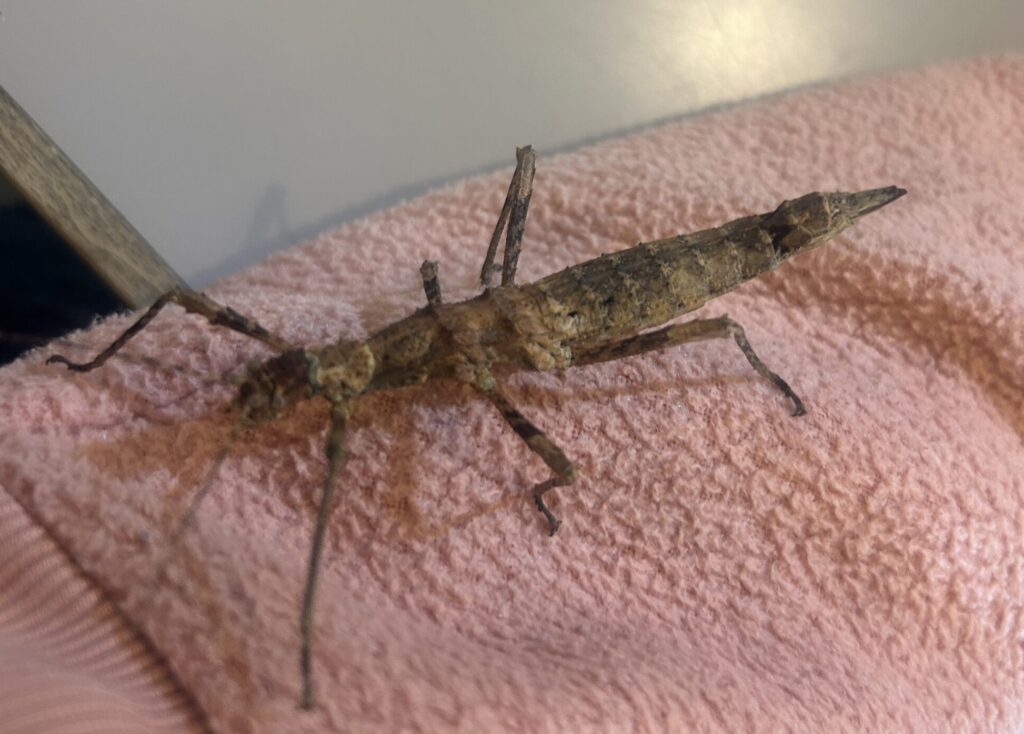
This Stick bug really liked my fleece sweatshirt at the “Meet the Bugs” encounter. –Photo by Monika Maeckle
The Grub Kitchen is just one feature of the The Bug Farm, a working farm-turned-visitor-and-research facility devoted to habitat recovery. Formerly managed by the cattle-raising Beynon family, whose presence here is documented in the Black Book of Wales dating to the 14th century, The Bug Farm opened a decade ago and is led by founder and award-winning entomologist Dr. Sarah Beynon and her husband and bug chef Andy Holcroft. Together, the duo has assembled a magnetic destination that invites insect and science lovers, foodies, and fun-loving families alike.
As a pollinator advocate, I was naturally drawn to such a spectacle. The farm offers a Tropical Bug Zoo, an Insect Museum, Farming Museum, a “meet the bugs” hands-on exhibit, and a kilometer-long pollinator hike around the restored former pastures. My husband, Bob, a history buff, was more tuned in to the exhibit on the history of farming in Pembrokeshire than having a four-inch-long stick bug crawling up his sleeve at the Meet the Bug event.
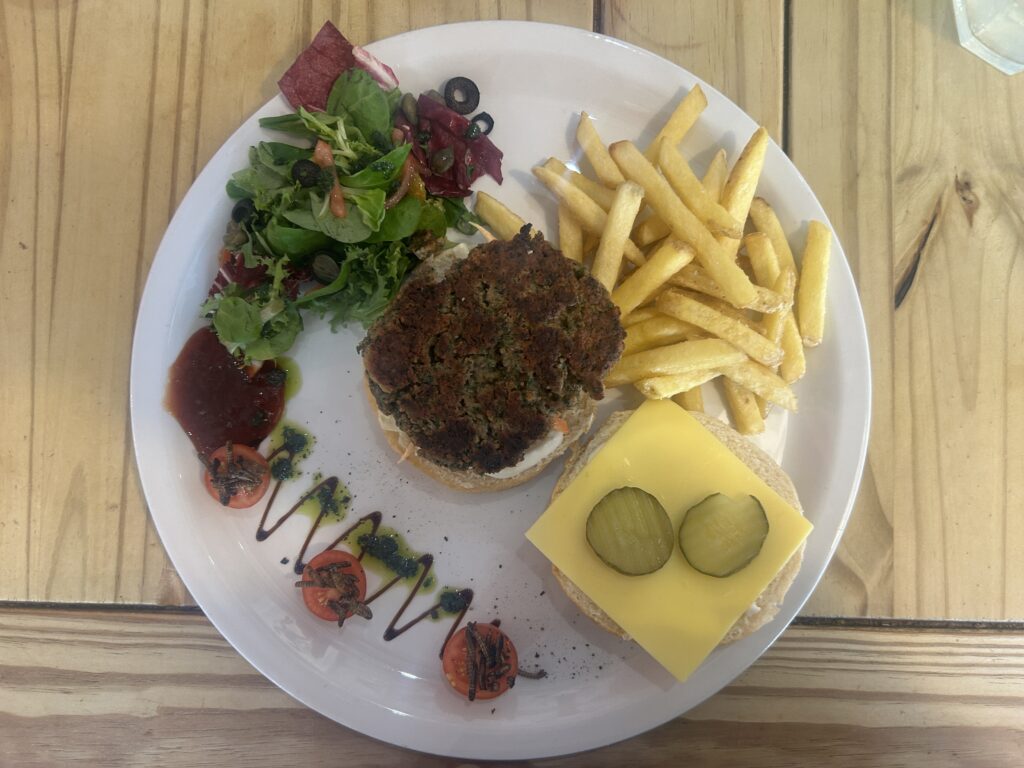
Lunch is ready! Bug Burger with fries, a salad and mealworm-dressed tomatoes. –Photo by Monika Maeckle
The Grub Kitchen was especially intriguing. It seems the U.S. interest in entomophagy–the eating of insects as food–can’t overcome the “ick factor” many people experience when they even consider eating insects. We had a moment in San Antonio back in 2017 when our Monarch Butterfly and Pollinator Festival staged several insect-eating events, but somehow the protein-rich food source never quite caught on.
Many people cannot get past the repulsion of eating invertebrates–even though we eat snails, crustaceans, raw oysters, and mammals’ livers (the body’s organ that processes poisons). And yet… insect protein is highly sustainable, incredibly nutritious, and tasty.
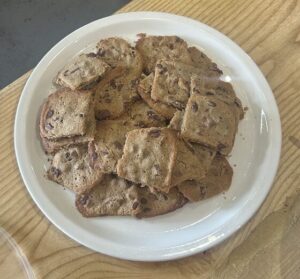
Cricket cookies at the Grub Kitchen in Wales. –Photo by Monika Maeckle
The stats are undeniable. According to the BBC, producing 10 kg/22 lbs. of beef takes 9kg/19 lbs. of feed, but to produce the same amount of insect protein requires only 1kg/2.2 lbs of feed. To get 150 grams/5.2 ounces of beef, it takes 3,250 liters/858 gallons of water. To create the same amount of insect protein requires only a pint/19 ounces.
In addition, insect protein is a nutrition bomb.
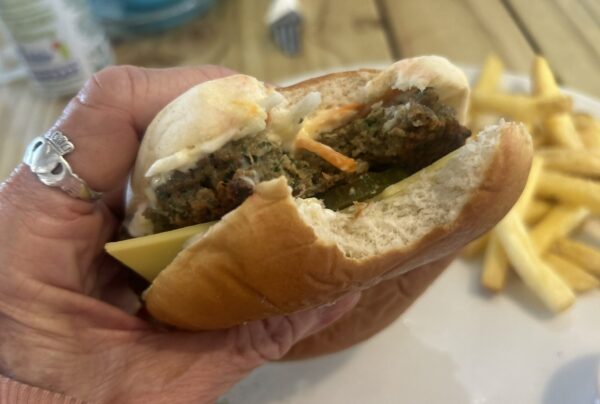
The featured Bug Burger at the Grub Kitchen is 60-70% protein, compared to a beef burger’s 50%. It tasted healthy, juicy, and satisfying–a bit like falafel, the garbanzo bean-based pita filling. A side garnish of cherry tomatoes dressed with a basil dressing and topped with deep-fried, crunchy meal worms served as a delicious garnish.
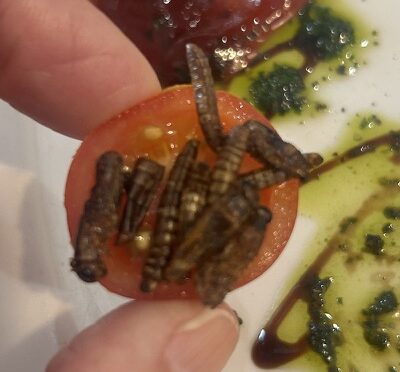
The burger was made of what Grub Kitchen labels VEXo, a nutrient-dense “flour” made from finely ground insect powder and plant-based protein developed by Chef Holcroft and entomologist Beynon. According to a press release issued by the Welsh Government and Innovate UK under the Small Business Research Initiative which helped fund its development, “The innovative VEXo can be used in a similar way to minced meat, whilst reducing saturated fat by over 80%.”
Following the burger, we enjoyed a tasty Cricket Cookie, made of cricket meal and the usual cookie ingredients, including chocolate chips. As a bonafide cookie snob and architect of my own well-regarded chocolate chip cookie recipe, I was impressed. Two containers of the delicious treats now occupy the limited space in my suitcase to serve as family gifts.
Equally impressive, the Bug Farm has been instrumental in many scientific studies and explorations of habitat and species recovery, especially regarding the vulnerable Marsh Fritillary, Euphydryas aurinia, a beloved member of the same Nymphalidae family to which our common Gulf Fritillary belongs in the U.S.
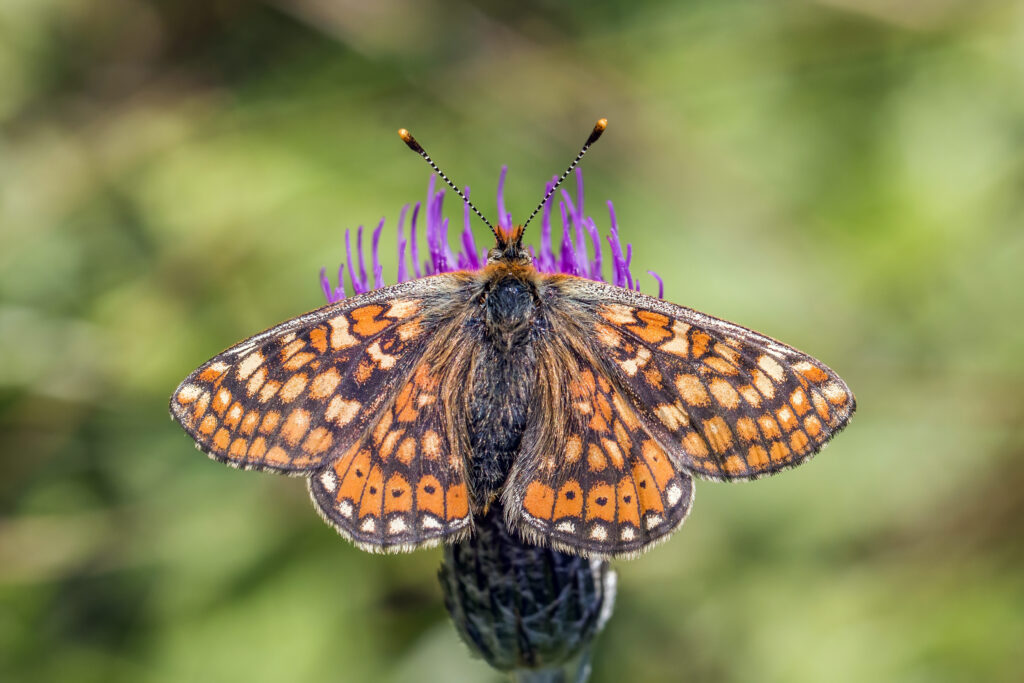
The Marsh Fritillary, once abundant on St. David’s peninsula, is now absent from there. -=-Photo by Charles J. Sharp via Wikipedia
Unlike our Gulf fritillary however, the Marsh Fritillary, once abundant in the St. David’s peninsula, was declared extinct here in 2013. Beynon and her team are working hard to restore the habitat that sustains it–installing diverse grasses and forbs, including the reestablishment of its host plant, the Succisa pratensis, Devil’s-bit scabious, also known as Blue cap, Blue ball, and Blue buttons. The purple bloomer once thrived in the area, and thanks to the efforts of the Bug Farm, it may soon flourish once again.
Check out my books!
In addition to serving as a destination for visitors and a nature/research reserve, the Bug Farm also hosts undergraduate, masters and PhD students working on research projects.
Hats off to the Bug Farm. Now…pass the cricket cookies, please!
TOP PHOTO: Yummy Bug Burger at the Grub Kitchen in Wales’ Bug Farm. –Photo by Monika Maeckle
Related articles
- Heat, drought await monarch butterflies heading south in one of the hottest years on record
- Caterpillar Canapes, anyone? Eating bugs could be answer for a hungry planet
- Austin Bug Eating Soiree: munch on insects to sustain the planet
- Monarch butterflies depart Mexico
- New study: Hot temps cause monarch butterflies to ‘drop out’ of their annual migration
Like what you’re reading? Don’t miss a single article from the Texas Butterfly Ranch. Sign up for our email newsletter, like us on Facebook, follow us on Twitter, @monikam or on Instagram.
I’m sorry but I can’t even read about eating bug burgers or other such foods. 🤢 I skipped to the Marsh friterlary
That’s unfortunate. Thanks for reading and writing. —MM
Great article, Monika!!
It is very fascinating about the insect protein. Of corse in ancient times, people understood the value of insect protein, something abundant and relatively easy to hunt/catch. Modern marketing and our modern culture of entertainment-focused topics have rejected the scientific curiosity we all start out with. Not to mention that the vast majority of people do not raise their own chickens and pigs as our grandparents did, losing that knowledge of where our food actually comes from. If people had to watch the cattle being slaughtered they may be more inclined to eat insects!
I do find it fascinating that it does not taste much different than plant-based protein. It makes sense that if the insect eats plants, it will taste like a plant!
Keep up the good work!!
Thanks! — MM
I think it’s awful for people eating the beautiful insects I dedicate my life to saving them along with the beautiful monarchs. There’s plenty of food to not need to do this, as it is so many are killed by the farmers.
Actually, there’s not plenty of food, nor water to produce the beef and crops we eat. But thanks for reading and writing. — MM
Wow, this happened today. The author of the Eat A Bug Cookbook, David George Gordon, passed away today. May he rest in peace. https://www.nytimes.com/2026/09/21/dining/david-george-gordon-dead.html?unlocked_article_code=1.EVE.YTzv.TRKKbya4BVgX&smid=nytcore-ios-share