

An estimated 5,000 attendees and 455 exhibitors gathered in San Antonio’s Henry B. Gonzalez Convention Center this week for the 2026 Texas Nursery and Landscaping Expo.
Staged in the middle of what is likely to be the hottest summer in history, following dramatic flooding, years of drought, and air quality across the nation compromised by raging wildfires, the TNLA Expo invited attendees to “learn, connect, discover new solutions and strengthen relationships that move their businesses forward.”
And what does moving forward look like?
According to those who attended, the future holds more resilient landscapes that survive high temperatures and a lack of water. And that means more native plants.
George Cates, a restoration specialist at Native American Seed in Junction, Texas, was invited by the TNLA to assemble a presentation on how Expo attendees could substitute native plants for some of the nursery industry’s most popular nonnative ornamentals.
Cates was initially a bit vexed by the assignment.
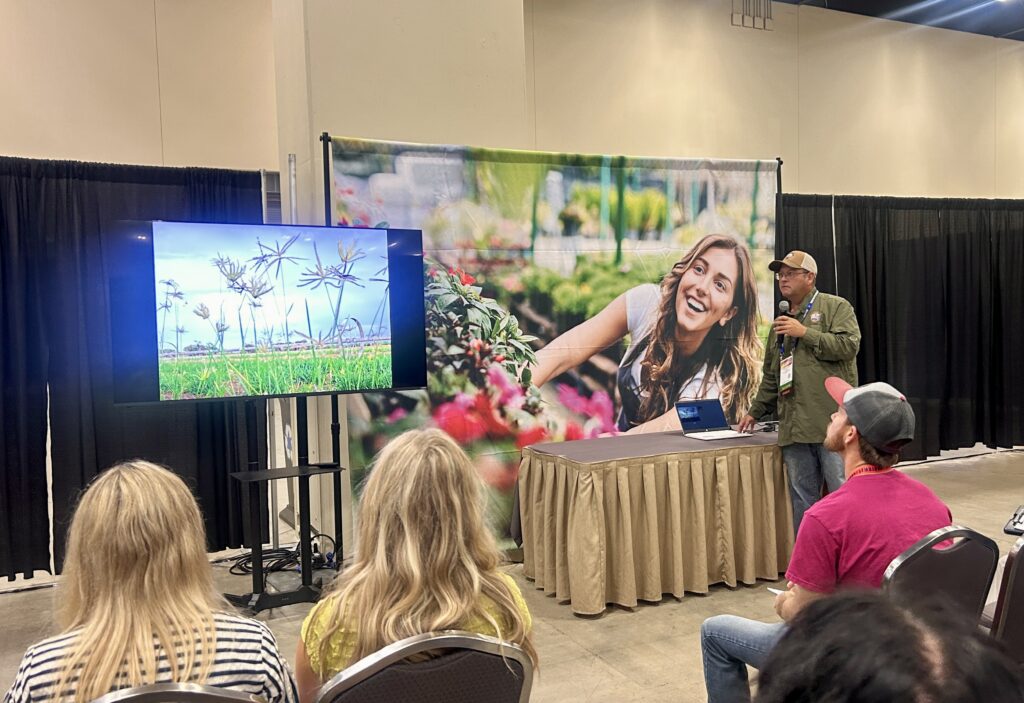
George Cates of American NAtive Seed, presents at the 2026 TNLA Expo. –Photo by Monika Maeckle
“I just kinda think we’re asking the wrong questions,” he said during his 40-minute session, titled “Native Alternatives,” which occurred at the end of the three-day exposition’s second day.
Contemplating what particular native plants could successfully stand in for exotic boxwoods, Asian Crape Myrtles and various vincas and vines, Cates had some ideas. But he couldn’t get past the fact that we would all be better served by focusing on a plant’s functionality rather than its looks.
“What role is that nonnative plant playing and what native plant can you use as a substitute for it?” he asked the small crowd that had gathered for his session.
Cates expressed his appreciation to the TNLA for inviting him to present on the topic of native plants. “This is the first time that’s happened,” he said, adding that a focus on natives is “More than just a trend. This is a fundamental shift in people’s relationship with outdoor spaces.”
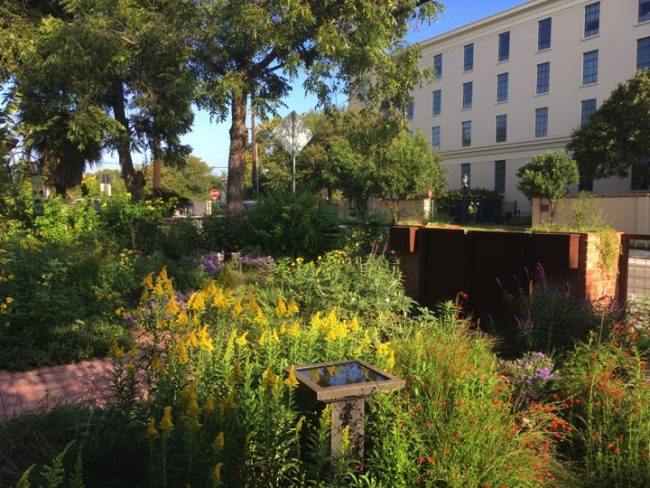
A shift toward more native plants in our landscapes? Yes, Please! –Photo by Monika Maeckle
That shift seems to be largely driven by water shortages across the country. Words like “waterwise” and “drought tolerant” are the descriptors of choice when it comes to future landscaping trends. Yet of the more than 100 educational sessions, only three focused on the utilization of native plants.
The overzealousness of some native plant advocates has turned off many–including, apparently, the TNLA.
TNLA member Donald Gerber, co-owner with his wife Melanie Gerber of Pollinatives, a native plant nursery located in Converse just outside San Antonio, said that he had several conversations with TNLA reps about including more native plant programming.
Gerber said he was told by the TNLA that native plant enthusiasts are “on thin ice” because of strident blaming and shaming that has made less enlightened gardeners and landscapers feel ashamed. TNLA communicated that it prefers to use words like “waterwise” and “drought tolerant” for more appropriate landscaping.
Plant shaming is a fact of life. I’ve often witnessed hardcore native plant advocates declare “but it’s not native” and dismiss plant choices, suggesting the extrication of non native trees or established shrubs. Sometimes that makes sense. Sometimes not. While I’m no purist about native plants, I do try to utilize plants that serve the ecosystem, as detailed in my recent book, Plants with Purpose: 25 Ecosystem Multitaskers.
The move toward natives is accelerating as people face expensive water bills in the face of worldwide water bankruptcy. According to the Environmental Protection Agency, landscape irrigation is estimated to account for nearly one-third of all residential water use–about nine billion gallons of water per day.
The TNLA did not respond to requests for a comment.
The organization represents more than 1,300 member companies, including the largest businesses in the Texas Green Industry. Collectively these nurseries, growers, suppliers and services represent more than $22 billion dollars in annual sales in the State of Texas, according to the organization’s website. Convincing them to “go more native” in their plant choices could create a significant boost in the public’s adoption of more sustainable landscapes.
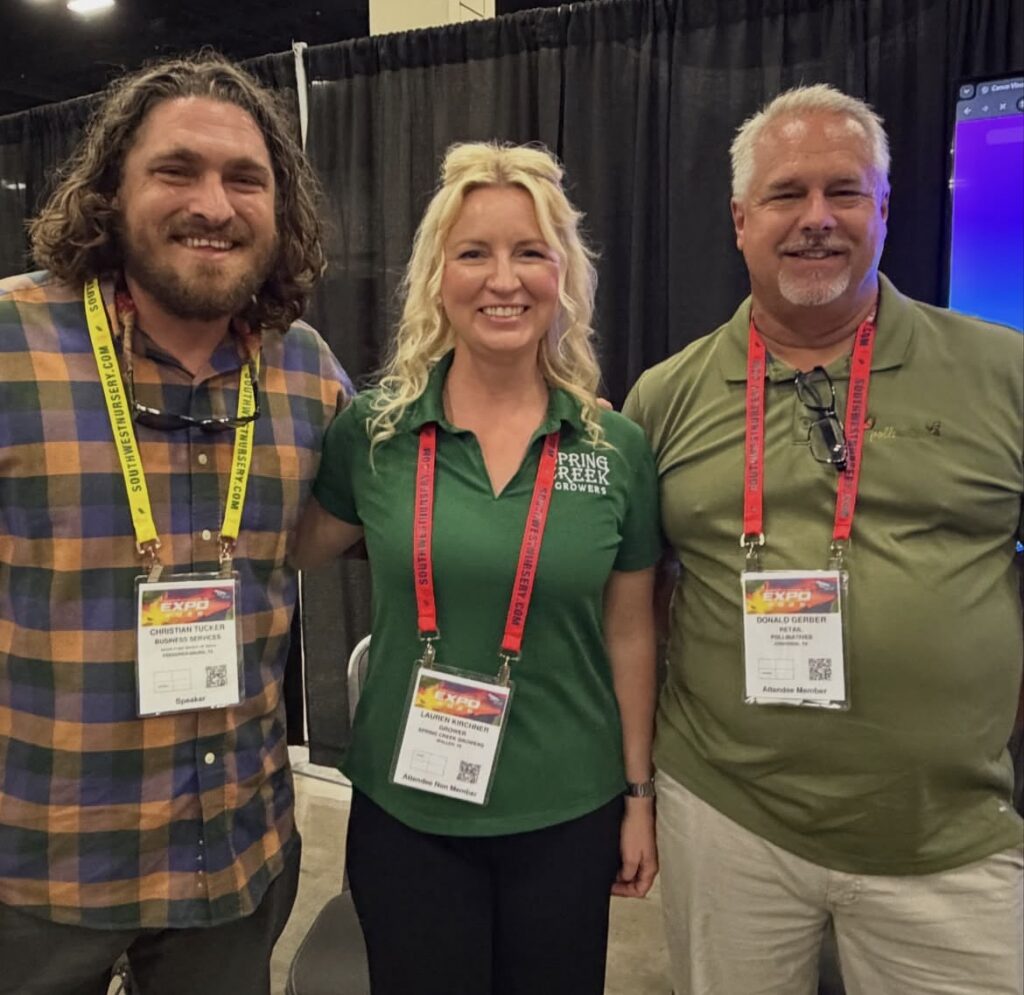
Christian Tucker, Lauren Kirchner and Donald Gerber spoke at a TNLA Expo panel on native plants –Photo via NPSOT
A tour of the massive exhibit floor at the Henry B. Gonzalez Convention Center occupied by the 455 companies that signed up as exhibitors revealed mostly lawn care services, traditional landscaping companies, chemical and fertilizer suppliers, irrigation specialists, and artificial turf companies. A handful of native plant nurseries, growers and landscapers also were present.
One of the more interesting native-forward panels, titled “The Future of Landscape Design: Native & Adaptive Plants,” featured Gerber, Lauren Kirchner of Spring Creek Growers in Waller, Texas, and ecological landscaper Christian Tucker of Garden Waco, who also serves as that city’s president of the Native Plant Society chapter. Mary Sirgo, executive director of the Native Plant Society of Texas, moderated.

When Sirgo asked what customers are looking for, Gerber noted that at his nursery, 80% of customers just want to purchase plants that will survive. “They’re sick of their plants dying, ” he said.
Kirchner said she felt that the mass market for plants is “curious” about natives, but most people buying a native plant often have no idea what a native plant is. “They’re curious, not fully knowledgeable,” she said.
Tucker, who moved into ecological landscaping seven years ago after working in conventional landscaping, emphasizes native and well adapted plants that restore habitat. He pointed out that despite his shift, his business continues to be viable. “That’s proof that we’re moving in the native plant direction.”
Tucker encouraged those in the industry to not be strictly native but well adapted. “Call it ‘drought tolerant,’ ‘waterwise’–these are what currently drive the industry.”
To encourage a broader supply of native plants, which is an oft-cited complaint for those seeking to utilize them, Tucker said he visited an estimated 100 growers at this week’s Expo in search of new suppliers.
Of those, three growers offered native plants only. About 20 had a decent selection, he said.
“It was my way of letting growers know there are lots of native plant exclusive clients out there. I’d approach each booth and ask if they sold native plants. If they said ‘no’, I would walk away saying, ‘Ok, thanks anyway.’”
TOP PHOTO: A sampling of brochures collected at the 2026 TNLA Expo. –Photo by Monika Maeckle
Related posts:
- Alamo vine: a native plant with purpose or a pain in the yard?
- Kiss your Asters and cheers to the Bordered Patch Butterfly! It’s National Pollinator Week!
- Hey Calvin Finch–you’re wrong about Jimson Weed
- Multitasking passionflower inspires passion among Gulf Fritillary butterflies
- Queen butterfly: is that a hair pencil in your pocket or are you glad to see me?
- Flowering red yucca waves at drivers navigating traffic on Dallas’ Central Expressway
- Plants with Purpose: Wild onions bolt their bulblet in early spring heat
- Plants with Purpose: Multitasking plants that do more than look beautiful
- Agarita crop goes from “gangbuster” to busted
Monika, A great post to hear what the industry is promoting and selling. George’s comment about functionality vs aesthetics has been my mantra for years. And if only people understood that we have two dormant seasons in south Texas, we might save some more water.