“Squish remorse” — Genista Larvae on Mountain Laurels Create Caterpillar Quandary

A mega hatch of Genista larvae on transplanted Texas Mountain Laurels along the Llano River created an uncomfortable “caterpillar quandary” for me this weekend.

Sophora worm, genista moth larvae

Not cool. Hundreds–no, thousands–of these Genista moth larvae, devoured our Mountain Laurels. Photo by Monika Maeckle

It was an odd day, digging up wild parsley in search of chubby, Eastern Swallowtail caterpillars for fostering and fun at home, followed by hours of trying to figure out a humane and responsible way to kill hundreds–no, thousands–of unwelcome critters decimating several precious Mountain Laurels.

The culprit:  the Genista Broom moth caterpillar, Uresiphita reversalis.   Sometimes called the Sophora worm, these moth larvae relish the toxic leaves of our native Texas Mountain Laurels, Sophora secundiflora.

We have painstakingly imported several of the gorgeous native evergreens to our stretch of the Llano, digging difficult holes for transplanting them in the Hill Country caliche and watching the slow growers progress over the last 10 years.  Mature Mountain Laurels are expensive at nurseries.  They serve as a harbinger of spring with their Kool-aid scented purple blooms, which alert us that ground temps have warmed, vegetables can be planted, and summer will be here too soon.

Genista Broom Moth,  photo via http://wildflowers.jdcc.edu

Genista Broom Moth, photo via http://wildflowers.jdcc.edu

First I tried picking them off by hand.   Then I fetched a sheet from the ranch house and shook the bushes, watching as they fell by the dozens to the ground.   Finally I got a hose and blew them away with a high pressure jet of well water.    Those handpicked and retrieved from the sheet went into a jar that was placed in the freezer for a relatively painless death.

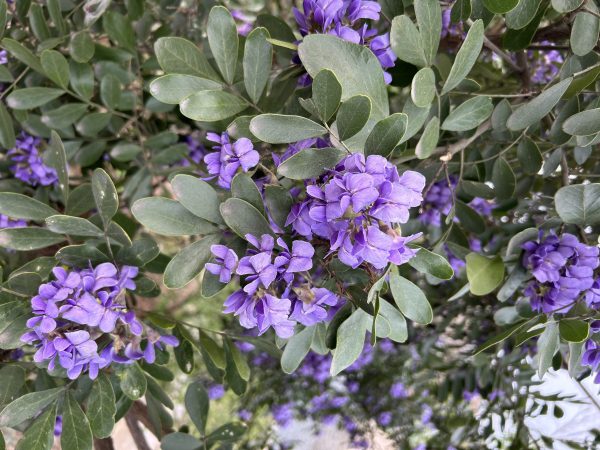
Texas Mountain Laurel, always a harbinger of spring in the Hill County   Photo via Ladybird Johnson Wildflower Ctr.

Texas Mountain Laurel, always a harbinger of spring in the Hill County.  Blooms form on second year growth.                 Photo via Ladybird Johnson Wildflower Ctr.

I felt bad. But my Mountain Laurels were decimated.  Genista larvae favor new growth and eat the buds and terminals of the Mountain Laurel first.  And that’s where the purple flowers form in the spring.  Interestingly, I had never noticed the abundant caterpillars in 20 years in Central and South Texas.

“They’re always around,” said Elizabeth “Wizzy” Brown, an integrated pest management specialist for Texas Agrilife Extension Service in Austin, dismissing my theory that something special was going on.   I read somewhere that Genistas are poisonous to birds, and speculated that perhaps that’s why they were left seemingly untouched by avian species.   Brown dismissed that.

She recommended BT- bacillus thuringeisis, the organic biological pesticide and all- around caterpillar killer.   When I let her know I garden for butterflies and moths–just not THIS moth–she suggested getting out the vacuum cleaner to suck them off the tree.  Wish I had thought of that.

Genista moth caterpillars desinted for the freezer

Sorry, fellas! You’re history.            Photo by Monika Maeckle

Entomologist Mark Muegge, a Texas Agrilife butterfly expert out of Ft. Stockton, felt the pain of my “squish remorse.”

“I understand….I’m kinda the same way,” he said.  ”Sometimes you have to use tough love.”

“They’re not a particularly attractive moth or caterpillar,” sniffed Mike Quinn, an Austin entomologist and founder of the useful Texasento.net website.   “There’s no aesthetic reason to not squish them. They’re a pest.”

Brown and Muegge both proposed that the Genista Broom moth’s purpose in the universe is to supply fodder for the food web.

Lizards eat them, the brilliant tachinid fly uses the Genista as a host, laying its eggs on the caterpillars, eating them from the inside out, and wasps also consume the Genista as food.  ”They fit into the food web,” said Brown.

“Everything has its purpose,” said Muegge.  ”What they’re good for is hard to say.”

According to Muegge, my reaction to the onslaught of caterpillars may have been extreme, an embarrassing admission for a butterfly evangelist.

“I have never seen a tree or shrub die from being defoliated,”  he said.  ”They’ll stress, but they’ll come back.”

And, fortunately or not, so will those caterpillars.

More posts like this:

Like what you’re reading?  Don’t miss a single post from the Texas Butterfly Ranch. Sign up for email delivery in the right navigation bar on this page, like us on Facebook, or follow us on Twitter, @butterfly beat.


Black Witch Moth: Large, Common, Bat-like, and Harmless

In European folklore, moths were regarded as witches.  Not a big stretch.  Witches are creatures of the night.  Moths are creatures of the night.  Witches can transform themselves….  Moths can transform themselves (metamorphosis)…. Witches fly.  Moths fly.  Witches have long noses.  Moths have long noses.

–John Himmelman, in the book, Discovering Moths

All hail the Black Witch Moth.  It might be a harbinger of death–or a sign that your future includes a lucky lottery ticket.

Black Witch Moth Female

Black Witch Moth Female, photo via www.whatsthatbug.com

The  intriguing Black Witch Moth, sometimes known as “the bat moth” resembles a bat in size and shape and with a a seven-inch wingspan is the largest moth in North America.  They are common in these parts.

”People often come across it by causing it to fly up and around them,” said entomologist Mike Quinn, who has been tracking the migration of Ascalapha odorata for his Texasento.net website.  ”There’s a real startle factor.”

Reports of large,  bat-like moths surprising people, frequently as they return home and are unlocking their front door, are not uncommon.   We spooked several Black Witch Moths on a recent visit to the Santa Ana Wildlife refuge in the Rio Grande Valley, where they roosted under wooden benches and in the eaves of the breezeway near the entrance to the visitor center.    When these big boys flush, they get your attention.

Black Witch Moth Caterpillar

Black Witch Moth Caterpillars like legumes and can reach three inches. Photo via www.texasento.net

Females have a white, sometimes iridescent stripe across their wings with wings open.  Males exhibit the plain, grey, brown mottled pattern commonly associated with moths, but with small dark eyespots on each forewing.   Black Witch Moth caterpillars eat legumes, and favor acacia and mesquite.   They are perfectly harmless, not an agricultural pest, and have no teeth or stingers.

The folklore surrounding Black Witch Moth, like the moth itself, is all over the map.  In Mexico they are known as “mariposa de la muerte,” the butterfly of death.   Some believe if a Black Witch Moth enters the home of someone who is ill, the person will die.

A variation on the folk wisdom suggests that the moth must travel to each corner of the house for death to occur.  The Mayans called the Black Witch x-mahani-nail, which means “the habit of entering buildings.” This moth apparently has a long history of inviting itself inside.

Interestingly, in the Carribean, the Black Witch Moth is known as the “Money Moth” and if it visits your home, you are likely to come into cash.   Here in South Texas, some believe if a Black Witch Moth roosts over your door, you will win the lottery.

Native to Central America and Mexico, the Black Witch starts migrating north in late spring.  ”The migration has been going on since June,” said Quinn.  Because of our timely rains and climate change, several Black Witch Moth “records” have been set, meaning the moths have appeared further north earlier in the year than ever.

Black Witch Moth Records 2012

More than 500 Black Witch Moth Records Have been set in 2012. For details, click on the map. Map courtesy www.texasento.net

“This year may end up as the best year yet for Black Witch Moth (BWM) records,” wrote Quinn to the University of Houston Texas Butterfly Listserv, which includes more than 250 novice and professional lepidopterists.   Quinn has recorded more than 500 records so far, including a significant record in Maine, in mid June.

The Black Witches’ seven-inch wingspan allows them to cover a lot of ground quickly.  Entomologists note that  Monarch butterflies start crossing the Rio Grande and take two months to reach Canada.  Black Witches start migrating in June and have been recorded

Hannibal Lechter used actual Black Witch Moth cocoons

Serial killer Hannibal Lechter inserted actual Black Witch Moth cocoons into the mouths of his victims in the movie, Silence of the Lambs.

reaching Maine by June 9 and Manitoba, Canada, by June 28.  That’s a rapid pace for a moth.  Scientists wonder why the Black Witch Moth migrates so far north with no southbound return?  Hmm.


In the movie Silence of the Lambs, serial killer Hannibal Lechter inserted cocoons of Black Witch Mothsinto the mouths of his victims as a weird gesture of transformation.   The moth on the movie poster is a Death’s Head Hawk Moth, but the actual cocoon was that of a Black Witch.

If you’d like to have one roost above your door to inspire a winning lottery ticket, you might try setting out a cocktail of fermented fruit or stale beer.   Black Witch Moths also like tree sap.  Good luck!

Like what you’re reading?  Follow butterfly and native plant news at the Texas Butterfly Ranch. Sign up for email delivery in the righthand navigation bar of this page, like us on Facebook, or follow us on Twitter, @monikam.  

Loathed by Gardeners, Tomato Hornworms Morph into Magnificent Sphinx Moths

Vegetable gardeners might be inclined to squish tomato and tobacco hornworms, which feast voraciously on tomato, pepper and potato plants and other members of the Solanaceae  family this time of year.  But hey, it’s Pollinator Week, so consider ceding a few fruits or entire plants to these dramatic caterpillars, which later morph into beautiful Sphinx Moths.

Sphinx Moth on Datura, photo by Betsy Betros, via BugGuide.net

Sphinx Moth on Datura, a.k.a. Jimsonweed, photo by Betsy Betros, via BugGuide.net

Loathed by gardeners in its caterpillar stage, the Manduca quinquemaculata, or tomato hornworm, has eight V-shaped marks on each side and a signature horn on the rear.  Manduca sexta, the tobacco hornworm, closely resembles its tomato preferring cousin, but shows seven diagonal white lines on its sides and a curved horn.

Both caterpillars turn into large moths with four- to six-inch wingspans in colors ranging from brown and gold to pink and grey.   They often are mistaken for small hummingbirds when they fly during the day and  hover helicopter style to nectar on flowers, which is why they are also called Hummingbird or Hawk Moths.

Sphinx Moth

C’mon, admit it: she’s adorable. Sphinx Moth, photo courtesy Colorado State University extension office

Moths, the nocturnal brethren of butterflies, are generally under appreciated and yet many are as striking as their celebrated butterfly siblings.  Like butterflies, moths  perform necessary pollination tasks and serve as primary fodder for bats, birds, even small mammals.

The hornworm caterpillars get their name from the signature horns that grace their hind ends.  The “Sphinx Moth” monicker results from the distinct pose the caterpillar assumes when disturbed.  Upon the mildest poke, the creature rears its head in a thoughtful stance, hoisting the upper third of its body in a sphinx-like posture.

The intriguing Sphinx Moth caterpillar on Jimsonweed

Perfectly disguised: the intriguing Sphinx Moth caterpillar blends in on this Datura, a.k.a. Jimsonweed plant.

According to one study, Sphinx Moths are a primary pollinator of Agave plants in the Arizona desert, which in some fashion makes tequila possible.   And yet moths have an unfair reputation as creepy and scary, perhaps because they fly at night, have fuzzy antennae and often exhibit an erratic flight pattern.  Some people even have a fear of moths, called mottephobia.  “Motte” means “moth” in German.

The 1991 thriller The Silence of the Lambs, starring Jodi Foster as tenacious cop Clarice Starling and Anthony Hopkins as cannibalistic serial killer, Hannibal Lecter, didn’t help moths’  reputation.  In the award-winning movie, “Hannibal the Cannibal” places the cocoon of a certain species of hawk moth, the Death’s Head Hawk Moth, in the mouths of  his victims as some sort of sick gesture of transformation. The moths fly around in a creepy, dark basement and evoke a weird terror.

The thriller, Silence of the Lambs, has contributed to moths' creepy reputation.

Quid pro quo, Clarice:The thriller, Silence of the Lambs, has contributed to moths’ creepy reputation.

According to the film trivia website IMDb, the tobacco hornworm moths used in the the film were treated like celebrities by the filmmakers: “They were flown first class to the set (in a special carrier), and had special living quarters (rooms with controlled humidity and heat).”

The movie poster at right featured Jodi Foster with a tobacco hornworm moth photoshopped with a skeleton skull–actually a realistic portrayal of the Death’s Head Hawk Moth, which is generally only found in Africa and southern Europe.

Interestingly, the iconic Death’s Head Hawk Moth tapped for the film is one of few moths that makes a squeaking sound when startled.  Described as a loud, high-pitched squeak, the noise results from air expelling from their proboscis–which might have come in handy during encounters with Hannibal the Cannibal.

Like what you’re reading?  Follow butterfly and native plant news at the Texas Butterfly Ranch. Sign up for email delivery in the righthand navigation bar of this page, like us on Facebook, or follow us on Twitter, @monikam.  You can also read our stuff on the Rivard Report.

Bats, Blooms, Butterflies and Moths–Everyone is Early this year

Our wet and mild winter has migratory creatures and seasonal blooms arriving in Central and South Texas early this year.  According to biologists and naturalists, we’re running seven – 10 days ahead of schedule.

Monarch butterflies, which typically start showing up in Texas en masse in late March, have been spotted regularly since early in the month.  Over at Bracken Bat Cave, maternal bats who overwinter in Mexico also arrived ahead of schedule.

Caterpillar on Bluebonnet

Caterpillars and bluebonnets--both early this year

“This year they were 10 days early,” says Fran Hutchins, Bracken Bat Cave coordinator and a Texas Master Naturalist.  Hutchins adds that the insect eating mammals began showing up in waves around February 21.  ”There hasn’t been a lot of research on specific dates of their comings and goings,” says Hutchins, explaining that he inadvertently noticed the increase in bat population while completing an overwintering survey at the Cave. Congress Ave. Bridge bats returned early this year.

Congress Ave. Bridge bats were early this year

Bats returned early this year

The pattern holds for wildflowers and birds. “It’s definitely early,” says Andrea Delong-Amaya, director of Horticulture at the Ladybird Johnson Wildflower Center. “But in terms of what’s normal, it’s hard to say.  It just hasn’t been as cold.”  Reports of the Golden Cheeked Warbler, our local endangered songbird, arriving a bit early have made the rounds at the San Antonio Audubon Society, according to Martin Reid, an avid birder and environmental consultant.

“It’s a mixed bag: some of our resident birds are showing signs of breeding activity slightly earlier than usual–probably related to rain,”  he explains.  ”But it doesn’t seem to have much effect on the wintering birds.”

Is it the warmth or the wet that drives the timing?   Depends on who you ask.

“On average I think the Weather Service is better than us insect experts at predicting the future,” says Dr. Mike Merchant, writing on Texas Agrilife Extension’s delightful Insects in the City blog. “But I still don’t put too much stock in long-term weather forecasts.”   Dr. Merchant chronicles the early arrival of Armyworms to North Texas in a recent post.   The gregarious grass eaters get their name from reproducing in droves and marching across prairies in soldier-like formations.

Armyworm Moth in Lawn

Armyworm Moths have arrived early to North Texas -- photo Texas Agrilife Extension

Matt Reidy points to the weather.  ”Pepper weeds, bluebonnets, prickly poppies–those are all early.  Not because of temperatures, but because of rain,”  says Reidy,  Texas Parks and Wildlife Biologist.  ”When you get the moisture, that’s what determines what you’re gonna get when.”

Many peg climate change for the advance of the season.   Interestingly, February 2012′s average high temperature was about the same as–actually .07 degree less than–the historic average of 66 degrees in San Antonio.   Yet, the average LOW temperature for the month was 4.5 degrees higher than average.

Minimum temperatures are especially impactful to seed germination and plant growth.  Seeds and plants require a certain soil temperature in which to germinate and thrive.  Savvy gardeners know to put a heating pad under setting seeds to expedite sprouting. Higher average minimum temperatures translate into faster growth, and an earlier season.

At the Children’s Garden at the San Antonio Botanical Garden, volunteers planted tomatoes the first week in March–”weeks early,” according to David Rodriguez, Horticulture specialist for the Texas Agrilife Extension.  Those tomatoes will likely be ready the first week in May.   “Everything’s off,” says Rodriguez, referring to Nature’s unpredictable timing.

Earlier this year, the USDA announced changes in plant hardiness zones, moving parts of San Antonio into the same planting zone as Houston and Corpus Christi. Some San Antonio zip codes moved from zone 8b, with annual lows of 15 – 20 degrees, to zone 9a, with annual lows of 20-25 degrees.

The redrawn maps (plug in your zip code and find out your zone here)  seem to be telling us something that birds, butterflies and bats have known for awhile: it’s just not as cold as it used to be.

Like what you’re reading?  Follow butterfly and native plant news at the Texas Butterfly Ranch. Sign up for email delivery in the righthand navigation bar of this page, like us on Facebook, or follow us on Twitter, @monikam.


Butterfly Garden: Jimsonweed Takes the Heat, Sports Elegant Flowers and Hosts the Endearing Sphinx Moth

With its elegant white trumpet flowers, spiny seed capsules, and fragrant evening blooms, Jimsonweed ranks as one of my favorite butterfly garden plants.

The native datura inoxia partners well with another favorite, Cowpen Daisy.  Plant them together and you’ll have sprays of yellow and white blooms throughout the scorching summer, well into October.  Both plants gracefully defy our brutal heat, need little water or care, resist disease and pests and attract butterflies and moths.

Jimsonweed climbs to three feet and spreads an equal distance.  It creates a handy shady mass that protects less sturdy plants.  Up until this past week, Jimsonweed’s shade shielded verbena from frying and saved my tropical milkweed, too.  The plant is versatile, attractive and easy-to-grow.

Jimsonweed bloom.  Do you see the caterpillar?

Jimsonweed bloom. Do you see the caterpillar?

What else does this member of the potato family have to offer? Its spiny seed pods provide an unusual garnish–or should I say gardenish?  The thorny balls would make delightful earrings, or at least play a starring role in an exotic ikebana flower display.  As summer wears on, the walnut-sized pods turn from green to brown, spreading seed wantonly in the garden, making this durable perennial almost impossible to defeat once established.  The lush, large leaves of Jimsonweed also exude a chocolatey smell when watered or handled.

Spiny seedpod of Jimsonweed

Spiny Jimsonweed seedpod dusted with caterpillar frass

Another bonus: the captivating Sphinx moth, whose large size and brazen daytime flying cause it to be confused with small hummingbirds, hosts on Jimsonweed.  Sphinx moth caterpillars have a reputation with tomato gardeners as the despised tomato or tobacco hornworm, which is beautiful upon close inspection.  Look for it in the photo of the Jimsonweed bloom, above.

Cowpen Daisy, Jimsonweed, milkweed and lantana
August butterfly garden: Cowpen Daisy, Jimsonweed, tropical milkweed, Texas lantana

Underappreciated Jimsonweed does have a down side.  As a member of the nightshade family, it contains tropane alkaloids, the same toxins as belladonna, used in ancient times on poison-tipped arrows.  All parts of  Jimsonweed are poisonous.  Native Americans used the leaves as a painkiller and as an hallucinogen.   

Recent reports have reckless teens using Jimsonweed as a cheap high, but they should beware.  Hospital stays, even death, can result.

Jimsonweed’s namesake may represent one of the first instances of ethnobotanical warfare in American colonial history. Amy Stewart explains in her delightful book, Wicked Plants, that in Jamestown, Virginia, in the late 1600s, ”British soldiers arrived to quell one of the first uprisings at the fledgling colony and the settlers remembered the toxic plant and slipped datura leaves into the soldiers’ food.”

They survived, but hallucinated severely for eleven days, giving Virginia colonists a temporary upper hand.   The assisting plant became known as Jamestown weed, and later, Jimsonweed.