
For the second year in a row, the monarch butterflies skipped my birthday party during peak migration in October. The storied flyers also seem to be taking their time, continuing to trickle southward, many breaking their diapause to lay eggs and discontinue the journey to their overwintering sites in Mexico.
Wendy Caldwell, executive director of the conservation organization Monarch Joint Venture described this year’s migration as “strong” in a recent webinar and noted that the 2026 migration took a more westerly path than usual. Strong winds blowing west in mid-October partially explained their choice of routes.
Our place on the LLano River, typically a monarch hotspot and favored roosting site, endured one of the hottest summers in history, then enjoyed almost nine inches of rain in October, according to Raindrop, a precipitation monitoring app. Another six inches have fallen so far in November, bringing the year-to-date rainfall total to almost 44 inches–double the average annual rainfall of 22-26 inches.
The downpours have removed several Hill Country counties from drought for the first time in years and set the stage for plenty of nectar. That said, the monarchs appear to have chosen a different route, traveling further west. During peak migration in October, West Texas towns like Marathon and Balmorhea were seeing plenty of monarchs as evidenced by the video below.
In San Antonio, longtime monarch butterfly tagger Drake White, founder of the Nectar Bar native plant nursery and chief docent of San Antonio’s Monarch Butterfly and Pollinator Festival, witnessed 30-40 monarchs on her Frostweed around October 23.
“Clearly, I was a roosting stop on their journey,” White added. “But I haven’t seen any since, which isn’t typical. I usually get to enjoy their presence for a few weeks as they come and go.” She attributed the shift from the norm to the drastic changes in Texas weather.
“We had such a hot September, right into the first part of October. Then back-to-back heavy rains and winds. I’m seeing less pollinators in general right now,” she said.
Longtime monarch butterfly aficionado Cathy Downs, who lives in Comfort, Texas, just west of San Antonio said she’s only seen a few monarchs this season. “Not a lot of monarchs. Saw only three. Had a LOT of larva earlier in the year but not much migration. ”
Personally, I’ve seen less than a dozen monarchs this fall and haven’t tagged a single one.
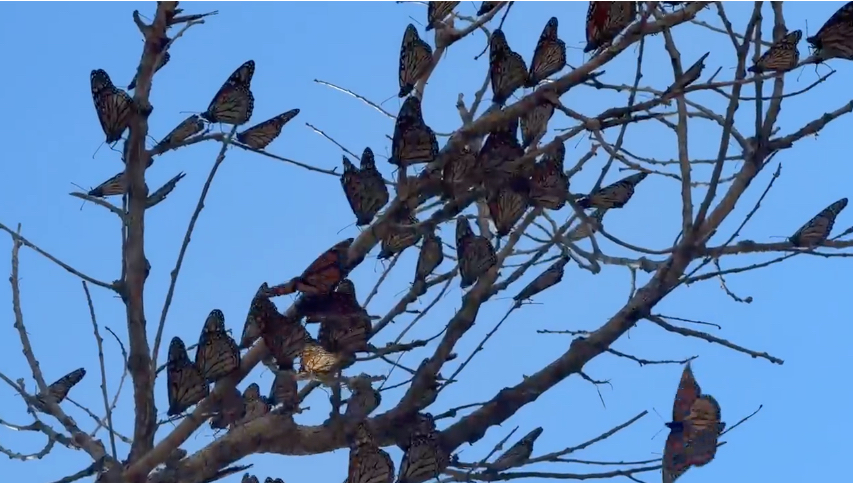
Monarchs roost on cottonwood trees at Balmorhea in West Texas, October 11, 2026. –Photo by Nicolas Rivard
In Junction, near the headwaters of the Llano River, Bill Neiman, founder of Native American Seed reported much the same: “I’ve seen very few this year … none in groups of any size. Just one here and there. Saw one ragged looking soul on a blooming Turk’s cap today so far,” Neiman said via text.
Friends on Facebook’s Mason County Community page shared various monarch anecdotes. “In Cherokee, our peak was around Oct 24, but I have continued to see ones and twos drifting through,” wrote Donna Norman Dutton. “Tons in San Angelo,” said Jake Maenius.
On the D-Plex list, the Univeristy of Kansas at Lawrence Monarch Watch email listserv followed by hundreds of monarch butterfly followers, the organization’s founder Chip Taylor shared on November 10 that “The unprecedented late season continues.”
“There are still flowers in bloom in the garden and at the front of the building. During most years, killing frosts eliminate the bloom and butterflies during the third week of October,” Taylor wrote, declaring 2026 “unprecedented.” Pipevine swallowtails, cloudless sulphurs, sleepy oranges, painted ladies, buckeyes, gulf fritillaries and other butterflies were also lingering. “This is the latest migration we’ve ever seen,” Taylor said later by phone.
This year is so unusual, Taylor launched a friendly competition on the D-Plex to see who spots the latest monarch of the year.
D-Plex recipients chimed in with myriad late season sitings.
Check out my books!
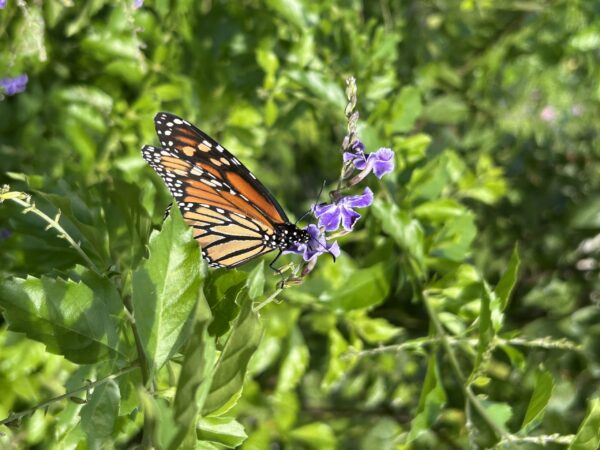
Don Davis reported two monarchs spotted in Ontario, Canada, on November 19, and then another November 20. I spotted the monarch in the picture at the top of this post on November 18 on the San Antonio River. Many people mentioned that monarchs were continuing to lay eggs on milkweed, which is not typical this late in the year, and which prevents them from migrating.
Undeterred by hefty winds, massive rainfall, schizophrenic weather and other disruptions, the butterflies made an “extraordinarily punctual arrival” at their overwintering sites on Saturday, Oct. 31.
Longtime Journey North correspondent Estela Romero reported in her monthly update that “despite no trace of a single monarch during the previous 72 hours” monarchs started pouring into the sanctuaries 75 miles west of Mexico City in the mountains of the Transvolcanic belt, just in time for Day of the Dead.
“The legendary migration of this extraordinary species once again fulfills its incredible mission, bringing a sense of awe, community commitment, identity, and friendship to the three hosting nations that embrace it,” she wrote.
TOP PHOTO: Monarch butterfly spotted on the San Antonio River on November 18, 2026. –Photo by Monika Maeckle
Related articles
- Heat, drought await monarch butterflies heading south in one of the hottest summer on record
- Migrating monarch butterfly population up 64% over last year
- Monarch butterflies depart Mexico
- New study: Hot temps cause monarch butterflies to ‘drop out’ of their annual migration
- Butterfly Bonanza on the Llano River this weekend–everything buy monarchs
- Monarch butterflies heading our way as annual fall migration takes flight
- Monarch butterfly numbers vault 99% over last year’s historic low, California population teetering
- A tense online debate: raising monarch butterflies at home
- New study: monarch migration at risk, monarch butterflies are not
- USFWS rules monarch butterflies worthy of protection, but they don’t have resources to protect it
Like what you’re reading?
Don’t miss a single article from the Texas Butterfly Ranch. Sign up for our email newsletter, like us on Facebook, follow us on Twitter, @monikam or on Instagram.
Leave A Comment